
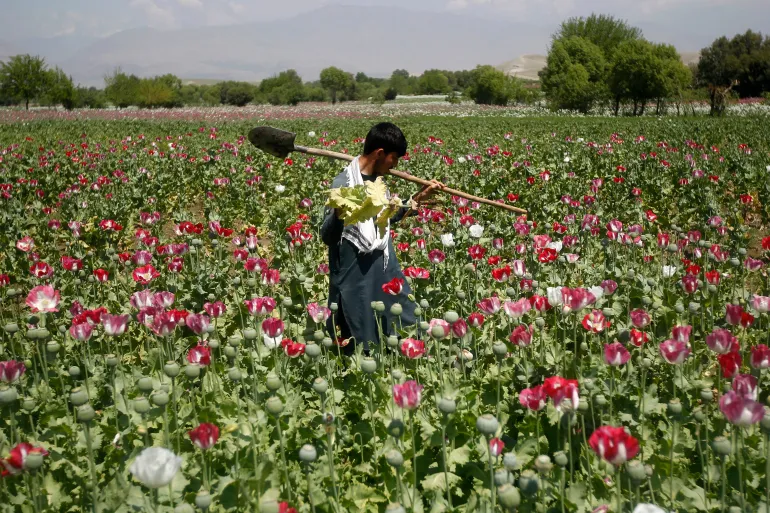

Afghanistan’s pre-ban opium stockpiles continue sustaining the global heroin trade, a new UN report says. However, the Taliban’s poppy cultivation ban has sharply reduced fresh opium production.
The United Nations Office on Drugs and Crime released its World Drug Report 2026. According to the report, Afghanistan’s opium production has fallen by about 95 percent.
Despite this decline, existing stockpiles continue supplying international heroin markets.
Stockpiles Delay Market Disruption
For more than two decades, Afghanistan supplied nearly 80 percent of the world’s illicit opium. Consequently, it became the backbone of the global heroin trade.
The report says no country has replaced Afghanistan’s dominant production role. Myanmar, Mexico, and Laos continue producing opium on a much smaller scale.
Meanwhile, heroin prices have nearly doubled across 12 major destination markets. At the same time, drug purity has declined because supplies are shrinking.
Traffickers Continue Shifting Strategies
The UN warned that traffickers increasingly rely on synthetic opioids, including fentanyl and nitazenes. These drugs cost less to produce and remain easier to smuggle.
Experts fear this trend could trigger a more severe global public health crisis. Additionally, overdose deaths may increase as synthetic opioids spread.
Although heroin trafficking continues, seizure volumes have declined in Afghanistan and neighboring countries. Nevertheless, existing trafficking routes remain active.
The report also highlighted severe economic consequences for Afghan farmers. Thousands lost their primary source of income after the cultivation ban.
Furthermore, traffickers appear to be exploring new cultivation areas outside Afghanistan. The UN expects Afghanistan’s stockpiles to influence global heroin markets through at least the end of 2026.

