
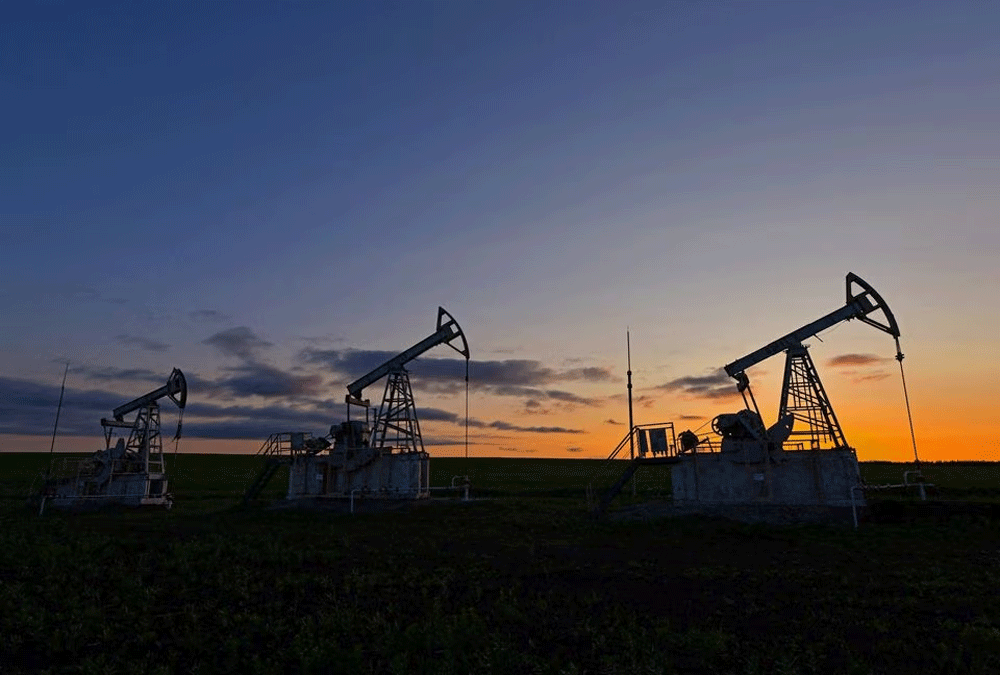

Crude oil prices jumped more than 2% on Monday as renewed US-Iran tensions unsettled energy markets.
Brent crude, the international benchmark, climbed above $90 a barrel during trading. The latest surge followed a fresh escalation in the six-month-old US-Iran war.
Oil prices had declined for most of the previous week. However, concerns returned after the United States reported strikes against Iranian rocket launchers near the Strait of Hormuz.
The attacks took place on a small island in the strategic waterway. They marked the first reported US strikes against Iran in a month.
Iran responded by launching missiles at US military targets in Jordan. Subsequently, US President Donald Trump said Washington would respond to the Iranian strikes.
The renewed exchange has raised fresh concerns about the conflict spreading across the Gulf region.
Strait of Hormuz adds to market concerns
The latest escalation comes after a period of relative calm in the six-month-old conflict.
However, the renewed fighting has quickly revived concerns about global energy supplies. The Strait of Hormuz remains central to those concerns.
Around a fifth of global crude and gas normally passes through the strategic waterway. Yet, the strait has remained largely closed amid the conflict.
Attempts to advance peace talks have also appeared to make little progress. Therefore, traders remain highly sensitive to any developments affecting energy shipments through the region.
“For oil traders, (the) move is another reminder of how quickly the geopolitical premium can return,” said Quintex Intel’s Stephen Innes.
“Physical flows through Hormuz have improved materially from their worst levels, which is precisely why crude had started giving back some of the fear premium, but the latest exchange shows how fragile that progress remains and how quickly the shipping story can be pushed back onto the trading desk,” he added.
The comments underline the fragile nature of recent improvements in physical oil flows.
Trump to meet US oil executives
The latest oil price increase also comes as the US faces pressure from higher domestic petrol prices.
Trump is scheduled to meet oil refining executives on Tuesday. The meeting aims to address soaring petrol prices in the United States.
Higher energy costs have also contributed to persistent inflation. As a result, monetary policy remains a major concern for financial markets.
The issue has become particularly important for Trump’s Republican Party ahead of upcoming midterm elections.
Meanwhile, the US Federal Reserve faces pressure over its response to inflation and economic conditions.
Fed policy adds to market uncertainty
Financial markets have also reacted to recent comments from Federal Reserve chief Kevin Warsh.
Warsh’s refusal to provide clear guidance has added to uncertainty surrounding the Fed’s next policy decision.
In a highly anticipated speech at the Jackson Hole symposium on Friday, Warsh gave his strongest signal yet about potential rate increases.
He indicated that rate hikes could be coming soon. Consequently, investors increased their expectations for an interest-rate increase at the Fed’s September meeting.
All three major US stock indexes fell on Friday following the shift in expectations.
The decline continued on Monday, with the Dow Jones Industrial Average closing 0.7% lower.
More important US economic data is expected later this week. Job market figures are due on Friday and could influence the Federal Reserve’s next decision.
Strong employment figures could allow policymakers to focus more closely on inflation.
“This could be another ‘good news is bad news’ report for the market,” said Jay Woods at Freedom Capital Markets.
“A hotter-than-expected payroll number, particularly if wages accelerate and unemployment remains near 4.1%, would reinforce the idea that the economy can handle tighter monetary policy.”
Global markets remain under pressure
The renewed oil surge has added to wider pressure across international financial markets.
Asian stock markets struggled during morning trading. However, some markets recovered as the session progressed.
Consequently, some Asian markets ended in positive territory, while others remained just below Friday’s closing levels.
European markets also produced mixed results. Paris moved higher, while Frankfurt declined.
London’s market remained closed for a public holiday.
Meanwhile, the US dollar retreated against major rival currencies after initially gaining following Warsh’s comments.
US long-term bond yields also remained elevated. The 10-year US Treasury yield reached its highest level since January 2025.
The latest market movements show how closely investors are watching both geopolitical tensions and monetary policy.
For oil traders, however, the renewed US-Iran confrontation has once again placed the Strait of Hormuz at the centre of global energy concerns.
With Brent crude moving above $90, markets are again confronting the possibility that a fresh escalation could bring the geopolitical risk premium back into oil prices.

