
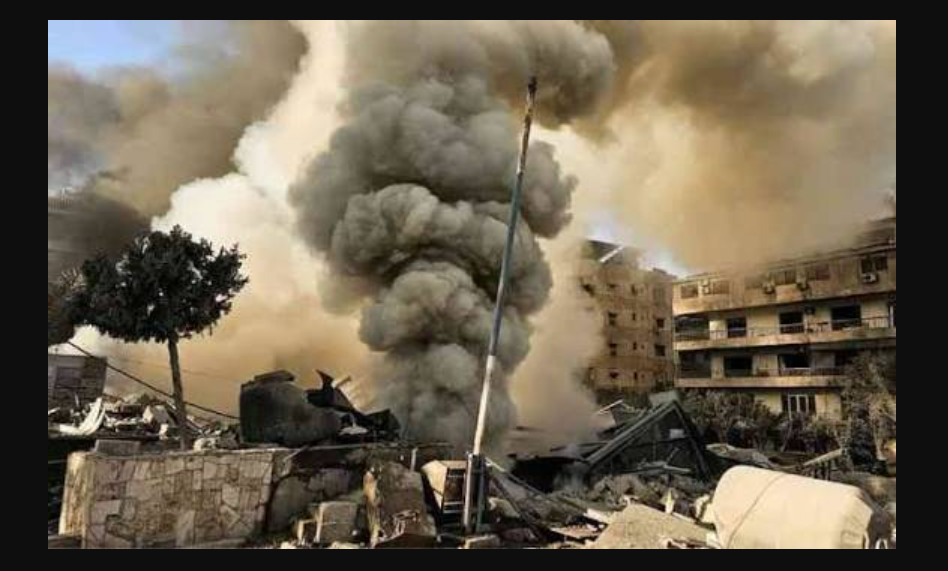

Tensions between Iran and the United States escalated again after both sides exchanged fresh military strikes, raising new concerns across the Middle East.
Iran’s Islamic Revolutionary Guard Corps (IRGC) announced that it had targeted United States military positions in the Gulf region. The announcement came after fresh American attacks on Iranian military infrastructure.
However, Iranian authorities did not specify the locations of the reported targets or provide operational details.
The latest developments have renewed uncertainty over regional security, maritime trade, and ongoing diplomatic efforts.
Iran Announces Retaliatory Military Response
According to statements carried by Iranian state media, the IRGC said the operation was launched in response to recent US military action.
The group described the strikes as retaliation for attacks on missile and drone storage facilities, along with coastal radar positions.
Shortly afterward, Iranian state television reported that Revolutionary Guard forces had targeted American sites in the Gulf region.
The statement also carried a warning.
“If the aggression is repeated, our response will be broader than this.”
The announcement came hours after Washington accused Tehran of attacking a cargo vessel and undermining an already fragile ceasefire environment.
United States Says Action Followed Attack on Commercial Shipping
American military officials said recent strikes targeted Iranian facilities connected to missile storage, drones, and radar infrastructure.
US authorities argued that the action responded to what they described as attacks on commercial shipping.
According to US officials, the operation represented:
“a powerful response to yesterday’s attack on a commercial ship that was transiting the Strait of Hormuz.”
American officials further described the reported incident as:
“unwarranted aggression against commercial shipping by Iranian forces”
and said such actions:
“clearly violated the ceasefire.”
Meanwhile, President Donald Trump criticized the reported attack and stated:
“Obviously, this is a foolish violation of our ceasefire agreement.”
Vice President JD Vance also issued a warning, writing:
“violence will be met with violence”
if further attacks occur.
Questions Grow Over Stability in the Strait of Hormuz
The exchange of strikes created fresh concerns about the future of maritime movement through the Strait of Hormuz.
The route remains one of the world’s most important energy corridors.
Iran has previously warned vessels against entering or leaving Gulf waters without authorization.
However, shipping activity has continued despite those warnings.
Reports indicated that multiple vessels recently moved through routes not formally approved by Tehran.
International efforts had also been underway to assist ships and crews affected by regional instability.
Before the latest escalation, evacuation operations had reportedly helped release vessels and seafarers stranded because of the conflict.
Even so, uncertainty continues to affect maritime planning and regional trade.
Israel, Lebanon and the US Move Toward New Framework
At the same time, diplomatic activity continued on another front.
Israel and Lebanon announced progress under a US-backed framework aimed at reducing tensions.
Speaking during the signing process, Secretary of State Marco Rubio said:
“begins to put in place a framework for lasting peace and security.”
He also added:
“It’s the beginning of the beginning. There’s a lot of work ahead.”
Israeli Prime Minister Benjamin Netanyahu welcomed the development and said:
“Iran has been trying to force us to withdraw from southern Lebanon through pressure but, in effect, Israel, Lebanon, and the United States are telling them: this is none of your business.”
He stated that Israeli troops would remain in designated security areas until Hezbollah is disarmed.
Meanwhile, Lebanese President Joseph Aoun described the agreement as:
“first step”
toward allowing civilians to return.
However, criticism also emerged from Hezbollah supporters and political representatives.
Nuclear Oversight Remains a Key Issue
Beyond military developments, Iran’s nuclear programme remains a major issue in ongoing negotiations.
The head of the UN nuclear watchdog emphasized that verification measures remain necessary.
Rafael Grossi said:
“The government of Iran has declared quite clearly that this is not their intention,” referring to nuclear weapons.
However, he added:
“But of course intentions are not enough. We have to have a very strong verification system in place… as soon as is practicable.”
Discussions continue over future inspections and oversight mechanisms. As diplomacy moves forward, military exchanges continue to challenge hopes for long-term stability.

