
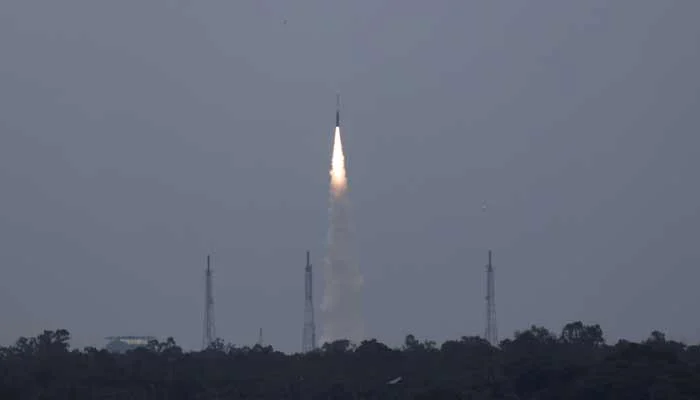

Vikram-1 Completes Historic Maiden Mission
India has successfully launched its first privately developed orbital rocket, marking a major breakthrough for the country’s rapidly expanding commercial space industry.
The Vikram-1 rocket lifted off from the Satish Dhawan Space Centre in Sriharikota on Saturday, July 18. It was developed by Hyderabad-based space technology company Skyroot Aerospace.
The launch was completed amid cheers from engineers, officials and invited guests watching from the space centre. Skyroot later confirmed that the rocket had completed its first test mission successfully.
The mission, named Aagaman, carried multiple commercial and experimental payloads towards an orbit approximately 450 kilometres above Earth. It also tested the rocket’s propulsion, guidance, avionics and stage-separation systems under real flight conditions.
Skyroot celebrated the achievement by declaring that India’s private space sector had arrived in orbit. The company had previously launched the smaller Vikram-S rocket on a suborbital test flight in November 2022.
However, Vikram-S did not attempt to place a satellite into orbit. The success of Vikram-1 therefore represents a much more complex technological achievement and establishes Skyroot as India’s first private company to complete an orbital launch.
Seven-Storey Rocket Designed for Small Satellites
Vikram-1 is approximately 22 metres tall, making it similar in height to a seven-storey building.
The four-stage rocket is designed to carry small satellites into low-Earth orbit. It can transport payloads weighing up to 350 kilograms on certain missions.
The vehicle uses solid-fuel propulsion for its three lower stages. Its upper section includes a liquid-powered adjustment system that can help deliver satellites more accurately into their intended orbits.
The upper-stage engine was manufactured using advanced three-dimensional printing technology. Skyroot says the rocket is designed to provide rapid and flexible launch services for satellite companies requiring dedicated access to space.
Small satellites are increasingly used for communications, navigation, climate monitoring, agriculture, defence and scientific research.
Many satellite companies currently share space aboard larger rockets. Dedicated small launch vehicles such as Vikram-1 could offer customers greater control over launch schedules and orbital destinations.
The maiden mission carried a mixture of technological, commercial and symbolic payloads.
These included a laboratory-grown diamond and robotic arms designed to demonstrate technology that could eventually assist with the removal of debris from orbit.
A miniature 18-karat gold rocket was also carried aboard the mission. It reportedly contained small sculptures honouring Indian scientists Vikram Sarabhai, C.V. Raman and former president and aerospace engineer A.P.J. Abdul Kalam.
The payload selection was intended to combine practical technology demonstrations with tributes to leading figures in India’s scientific history.
Success Strengthens India’s Commercial Space Ambitions
Prime Minister Narendra Modi described the launch as a defining moment in India’s space journey.
He said greater private-sector participation was opening new opportunities and accelerating technological innovation. He also expressed hope that the achievement would encourage young people to pursue ambitious scientific and engineering projects.
Pawan Goenka, chairman of the Indian National Space Promotion and Authorisation Centre, said the performance exceeded expectations for a private company’s first orbital mission.
IN-SPACe was established to regulate and support private participation in India’s space sector. The government opened more space activities to private companies through reforms introduced in 2020.
India’s space programme was previously dominated by the state-run Indian Space Research Organisation. ISRO remains central to major national missions, but private companies are now developing rockets, satellites, engines and data services.
The country’s space economy is valued at approximately $8.4 billion. India now has more than 400 space startups and hopes to secure a larger share of the growing international launch market.
The Vikram-1 mission comes nearly three years after India became the fourth country to complete a successful controlled landing on the Moon through the Chandrayaan-3 mission.
Former ISRO chairman K. Sivan said Skyroot’s achievement demonstrated the benefits of allowing private companies to participate more fully in the space industry.
He described rocket development as one of the most difficult areas of space technology. A successful orbital mission by an Indian startup could therefore strengthen the country’s international reputation and encourage further investment.
Skyroot is expected to use data collected during the mission to improve Vikram-1 before regular commercial launches begin.
The company is also developing larger launch vehicles with greater carrying capacity and more advanced orbital capabilities.
The successful flight gives India a privately built orbital rocket and creates new competition in a global market currently dominated by established government agencies and companies such as SpaceX.

