

By Humaira Motala
KARACHI: In a world where hardship often walks with silent feet, someone once wrote that if a difficult time had to take the shape of a life, it would look like a cat — quiet, resilient, moving with stealth through darkness. And if love and selflessness had to take a name, it would be Dr. Ruth Pfau. At the tribute ceremony held to honor her, the air itself seemed to echo the words of Kahlil Gibran: “You give but little when you give of your possessions. It is when you give of yourself that you truly give.” For more than 50 years, Dr. Pfau gave not just medicine, but her entire life to Pakistan’s forgotten and forsaken.
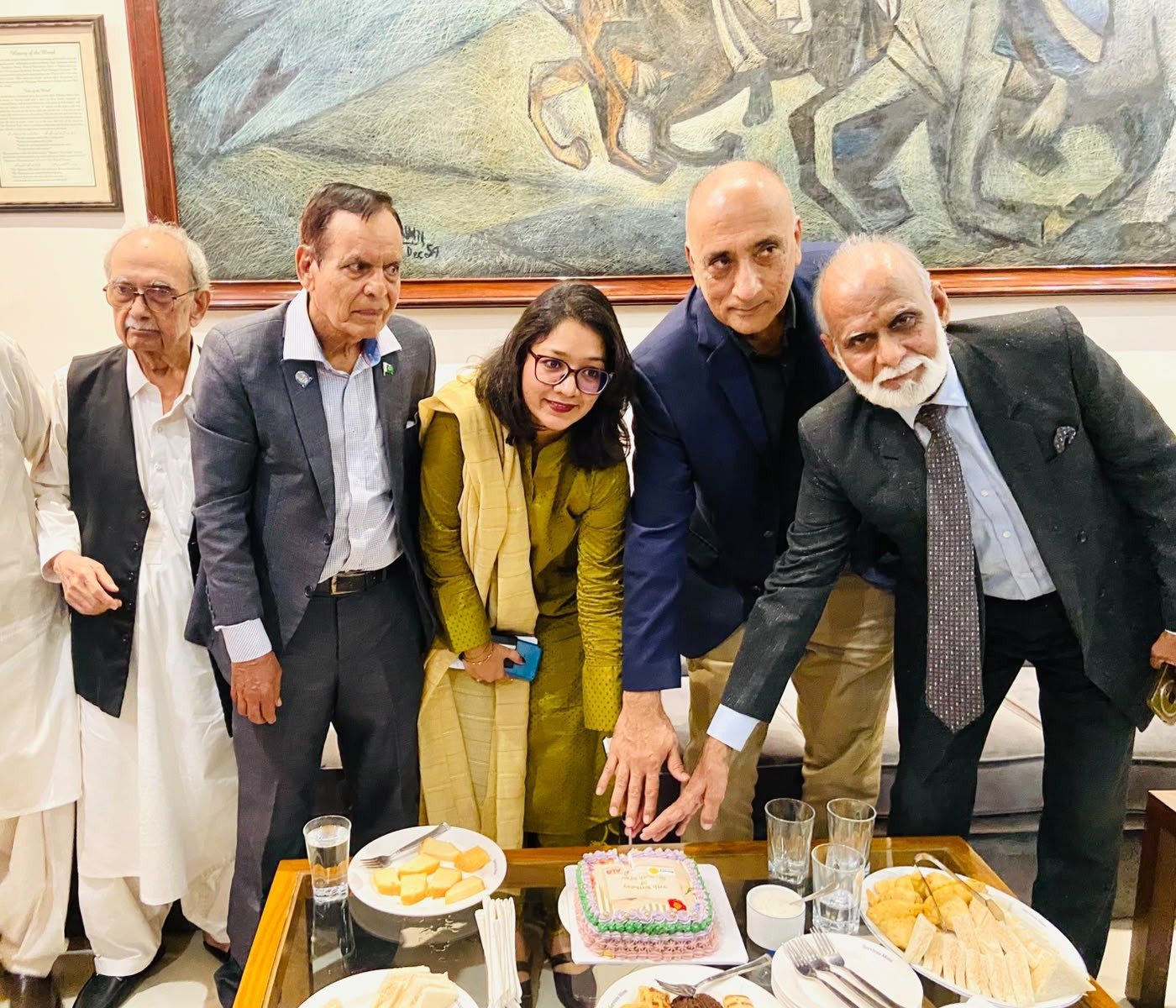
Last week, the Marie Adelaide Leprosy Centre and Rotary Club District 3271 came together to mark what would have been Dr. Ruth Pfau’s 97th birthday with a graceful tribute ceremony at Services Mess, Karachi. The hall was filled with voices that had been touched by her work — doctors, diplomats, dignitories, bureaucrats and civil society — all paying tribute to a life lived entirely for others. Even Google honored her that day, changing its Doodle to bear her name, a rare digital salute for a woman who chose the margins of society as her home. As Victor Hugo once said, “The greatest happiness of life is the conviction that we are loved; loved for ourselves, or rather, loved in spite of ourselves.”
Dr. Pfau earned that love not through words, but through decades of service. The celebration also highlighted 70 years of MALC’s service to humanity. The Woman Behind the Legacy Dr. Ruth Katherina Martha Pfau (9 September 1929 – 10 August 2017) was a revered German-Pakistani physician and Catholic nun who dedicated more than 55 years of her life to eradicating leprosy in Pakistan. Widely known as “Pakistan’s Mother Teresa,” her lifelong devotion transformed the country’s healthcare landscape. Through her relentless efforts, the World Health Organization (WHO) declared Pakistan one of the first countries in Asia to successfully control leprosy in 1996. She founded the Marie Adelaide Leprosy Centre (MALC) in Karachi and masterminded the National Leprosy Control Programme. She helped establish 157 leprosy clinics across Pakistan. Beyond leprosy, she branched out to treat vision loss and actively participated in relief efforts during the 2010 Pakistan floods.
Upon her passing in August 2017, she was granted a full state funeral — making her the first woman and non-Muslim in Pakistan to receive this prestigious honor. Today, major institutions like the Fazaia Ruth Pfau Medical College and Civil Hospital Karachi stand as a testament to her memory. A Benchmark of Service and Determination Guest of Honour, Ms. Shahnaz Wazir Ali, elected twice to the National Assembly of Pakistan, said that women like Dr. Ruth Pfau, Florence Nightingale, and Mother Teresa are the real models of service and kindness — benchmarks for women everywhere. “These women, by their character, showed what a determined woman with a cause can do,” she said. Ms. Wazir Ali recalled that Dr. Pfau was denied a visa to India and was only in Pakistan on a transit visa. That one incident, she noted, changed the entire landscape of leprosy care in Pakistan. “Can you imagine a Pakistani society without Dr. Pfau to contain leprosy, when we are still fighting to eradicate polio?” she asked. She added that Dr. Pfau proved what a sustainable response looks like when committed individuals, civil society, and government work together. Ms Wazir congratulating MALC on its platinum jubilee said “its not historical history of 70 years, it tells the history of institution building, how they are being built and maintained.” Recalling a personal bond, Ms. Wazir Ali shared how her mother shared a close relationship with Dr. Pfau.
On her invitation, they visited MALC and witnessed the terrible condition of patients — yet Dr. Pfau would hold their hands with unwavering affection. Building Institutions Against All Odds Sitare-e-Imtiaz Syed Tariq Mustafa, senior bureaucrat and Advisor to the Governor of Sindh, said that as a seasoned bureaucrat, he knew how difficult it was to build and maintain institutions in Pakistan. “Before Dr. Pfau, leprosy patients were scattered and forgotten,” he said. “Through MALC, she brought them together from all over Pakistan and gave them access to healthcare and dignity.” Appreciating MALC’s services, Mr. Mustafa urged that “we must all stand shoulder to shoulder” to continue her mission. He added that Karachi loved her from the core. Highlighting her recognition, he noted that the state honored her with a state funeral and named many organizations after her. As Charles Dickens wrote, “No one is useless in this world who lightens the burdens of another.” Dr. Pfau, he said, spent her life doing exactly that. A Life Built Minute by Minute Dr. Ali Murtaza, Director of Programs at MALC, shared his personal experience of working with Dr. Pfau. He recalled that in 1960, on McLeod Road — now I.I. Chundrigar Road — she saw a few leprosy patients and decided to stay in Pakistan along with a group of sisters. “Establishing MALC itself was a challenging achievement,” Dr. Murtaza said, “especially in a nation where building and sustaining institutions often remains a struggle.” He spoke of the deep bond she shared with patients, and of her discipline: “She did not waste a single minute during office hours. She was that dedicated and hardworking.” Dr. Pfau traveled across Pakistan to set up 157 leprosy centers, reaching patients even in the most remote villages. She went to Afghanistan even in troubled times to reach the leprosy victims.
Beyond healthcare, he noted, she worked for their rehabilitation so they could earn a livelihood with dignity. “I find no words to describe her humility, dedication, and vision to broaden the scope of MALC,” Dr. Murtaza said. The Calling That Rose Above Ego Sirajuddin Aziz, the Federal Banking Mohtasib, addressing the ceremony asked the audience a piercing question: “What was the motivation behind her selfless service? Why is it that we are not able to produce even one percent like her?” He described her as a real instance of beauty at its peak in her youth— but then came the calling, at the right time. Being a Catholic, he said, she followed the rigor and discipline of Catholic training. It was her ability to dominate her ego that allowed her to care for people whom even their own loved ones had abandoned. “Whether she believed in God or not — such people rise above all such queries because of the cause they work for,” he remarked. A nun, he explained, must achieve renunciation to realize the true beauty of the self. In Islam, we call it nafs ko marna. “Change happens when we decide to change,” Mr Aziz emphasized. For 70 years, this lady served our community with unmatched patience. He reminded us that it was the healing touch of Hazrat Essa (AS) that cured leprosy. Yet Dr. Pfau, he said, did not try to convert us — she taught us to be better Muslims. Her message stands in direct correlation with our Islamic teachings.
The Holy Quran says: “And do good; indeed, Allah loves the doers of good.” — [Al-Baqarah: 195] Dr. Pfau lived that verse. A Legacy That Will Outlive Us All A large number of dignitaries attended the ceremony. Dr. Mohammad Zaigham gracefully hosted the event. President of the Intra-City Chapter of Rotary Club, Mr. Naseem, delivered the welcome address. Ms. Sarwat recited a poem in tribute to Dr. Pfau, and Shayan Fatima, Lead of Marketing and Resource Mobilization at MALC, coordinated media participation. SSP CTD Zeeshan Siddiqui was also present to honor her memory. But beyond the speeches and tributes, what remained was the weight of a legacy. In MALC, Dr. Ruth Pfau did not just build an organization — she built a home for the forgotten, a system of compassion that continues to serve thousands across Pakistan even today. People like Dr. Ruth Pfau are born once in centuries. They are remembered not because they sought fame, but because they gave everything of themselves to others.
As she herself said: “Love will have the final word.” And in the lives she touched, in the institution she left behind, love truly did. The evening ended not with applause, but with silence — the kind of silence that follows when a great life has been remembered well. Karachi, the city she chose and served for seven decades, stood together to say thank you. _“Khudaya, kahan aisi hastiyan baar baar janam leti hain, Jo apna ghar chhor kar dusron ka aangan sajaati hain.”_ May her light, and the institution she built, continue to guide us for generations to come.
About the writer: The writer is a senior journalist and columnist covering crime, law, social issues, governance, energy, health, literature, and women and children’s rights across Pakistan’s leading English media houses. Feedback: mediawomen2014@gmail.com

