
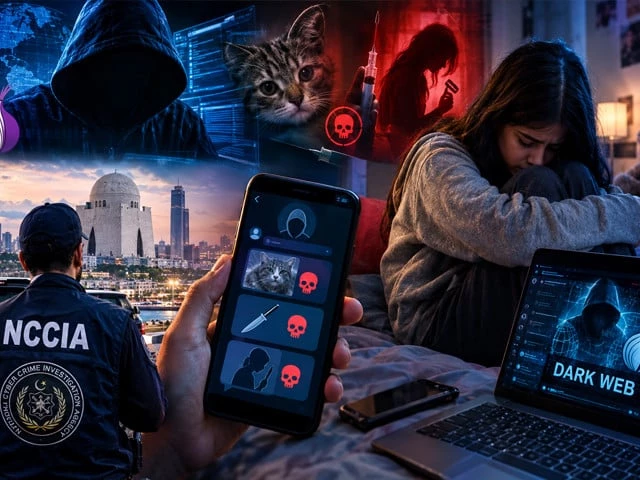

What if the person your child talks to every day online is secretly leading them towards danger? What if an ordinary message, a friendly conversation or a seemingly harmless online connection becomes the beginning of something far more disturbing?
For many Pakistani families, this is no longer just a frightening possibility. Recent investigations by the National Cyber Crime Investigation Agency (NCCIA) have exposed the risks children face through online manipulation, exploitation and hidden digital networks.
The Karachi Case That Shocked Pakistan
In October 2026, a disturbing investigation in Karachi brought these dangers into focus. The NCCIA intervened in the case of a 13-year-old girl who had allegedly been influenced by a group linked to the dark web.
According to an NCCIA official, international intelligence helped authorities trace suspicious online activity to Pakistan. Investigators discovered that the girl had initially encountered the group through social media before communicating with its members through a messaging application.
The group allegedly assigned her increasingly dangerous tasks. Authorities located her before she could follow an instruction to harm herself. They also examined her electronic devices and arranged psychological counselling.
Investigators are continuing to identify those behind the suspected network and determine whether other children were targeted. The case highlights how online manipulation can develop over several months without families recognising the danger.
How Online Trust Becomes a Weapon
Online exploitation does not always begin with threats. Sometimes, offenders build relationships through friendship, compliments, emotional support or promises of rewards.
Gradually, these interactions can become controlling. Children may face pressure to keep secrets, share private information or follow uncomfortable instructions. Fear, embarrassment and emotional attachment can make it difficult for them to seek help.
A UNICEF study published in September 2026 revealed the scale of this problem in Pakistan. Nearly 1 in 16 internet-using children aged 12–17 experienced technology-facilitated sexual exploitation or abuse within a single year. This represents approximately 1.5 million children.
The findings also challenge the belief that online abuse mainly comes from strangers. In 85 per cent of reported incidents, the perpetrator was someone the child already knew.
The Dark Web and Its Hidden Risks
The dark web is a part of the internet that requires specialised software to access. While anonymity tools have legitimate uses, criminals can exploit them to conceal illegal activities and communicate beyond ordinary online platforms.
Investigating these networks can be difficult. Offenders may use anonymous accounts, encrypted communications and services operating across international borders.
However, online exploitation does not necessarily begin on the dark web. Contact can start through familiar social media platforms before moving into private messaging spaces. This makes everyday digital interactions just as important to monitor as hidden online networks.
Warning Signs Parents Should Never Ignore
Sudden behavioural changes can sometimes indicate that a child is experiencing online difficulties. Unusual secrecy, anxiety after receiving messages, withdrawal or fear of losing access to an online account may deserve attention.
These signs do not automatically mean exploitation is taking place. However, parents should approach children with patience and encourage honest conversations without immediately blaming or punishing them.
Children must understand that they can refuse uncomfortable requests, block suspicious accounts and seek help whenever an online interaction makes them feel unsafe.
Pakistan Needs Stronger Digital Protection
Protecting children requires more than monitoring their phones. Schools must introduce practical digital safety education, while technology companies need effective reporting systems to address harmful accounts and content.
Law-enforcement agencies also need stronger investigative resources and international cooperation to identify offenders and protect victims.
UNICEF’s research highlights another serious concern: more than half of children who experienced technology-facilitated sexual exploitation or abuse did not tell anyone. Fear, stigma and the possibility of being blamed often prevent victims from seeking help.
Protecting Childhood Before It Is Too Late
Pakistan’s recent investigations reveal that online safety can no longer be treated as an optional concern. Children need guidance, protection and the confidence to speak up when something feels wrong.
Keeping children away from every digital platform is not the answer. Families, schools, authorities and technology companies must work together to create safer digital environments.
Behind every screen is a young life worth protecting. No child should have to face the hidden dangers of the digital world alone.
For the latest updates, visit and follow The Truth International website (www.thetruthinternational.com) and subscribe to the YouTube Channel.

