
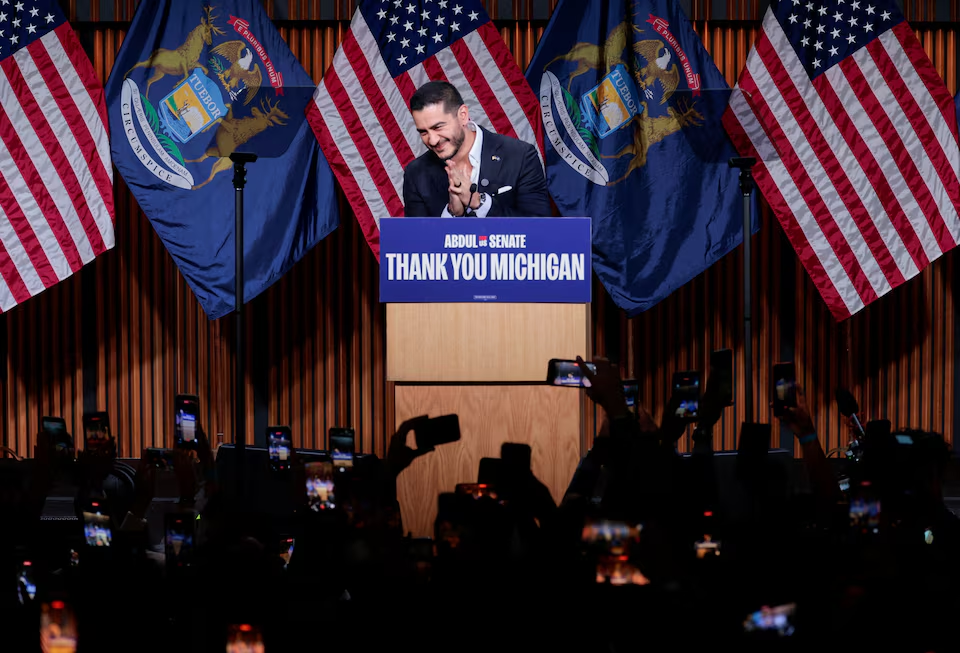

“America is big enough for all of us.”
When Abdul El-Sayed delivered these words on election night, he was responding to more than political criticism. He was sending a message about identity, belonging and the future of American politics. A Muslim politician with Egyptian roots had just made history by winning a seat in the US Senate. His victory was not only a personal achievement but also a defining moment for representation in Washington.
From a public health doctor in Detroit to America’s first Muslim senator, El-Sayed’s journey reflects years of public service, political battles and a campaign that challenged established power.
When Abdul El-Sayed stepped before supporters in Detroit after winning Michigan’s closely watched Senate race, his victory carried significance beyond party politics. The 42-year-old Democrat had defeated Republican Mike Rogers and secured a place in American political history as the first Muslim ever elected to the United States Senate.
His victory followed a fiercely contested campaign marked by debates over healthcare, economic inequality, corporate influence, immigration, religion and US policy towards Israel. It also represented a breakthrough for the Democratic Party’s progressive wing, which had faced questions about whether its candidates could win in competitive states.
El-Sayed’s journey from public health official to the Senate began long before the 2026 election. His professional background, political ambitions and commitment to healthcare reform shaped a campaign that attracted national attention.
Who Is Abdul El-Sayed? A Profile Beyond Politics
Born and raised in Michigan, Abdul El-Sayed is the son of Egyptian immigrants. His background and education helped shape his interest in public service, healthcare and social policy.
He attended the University of Michigan, graduating with the highest distinction in political science and biology. He also played lacrosse for the university’s team.
El-Sayed later earned a medical degree from Columbia University. He also received a doctorate in public health from the University of Oxford as a Rhodes Scholar.
Although he holds an MD, he did not complete a medical residency or obtain a licence to practise medicine. Instead, he chose to build his career in public health and government administration.
This distinction became a campaign issue after Republican opponent Mike Rogers questioned his medical credentials. El-Sayed’s educational qualifications are established, although he has not practised as a licensed physician.
His decision to focus on public health came from his belief that healthcare problems often begin outside hospitals. Poverty, unsafe environments, inadequate services and unequal access to treatment can all affect people’s health.
That perspective eventually became central to his political identity.
From Detroit’s Health Department to Statewide Leadership
El-Sayed entered public service through healthcare administration. In 2015, he became executive director of Detroit’s Health Department, taking responsibility for rebuilding an institution that had faced serious challenges following the city’s bankruptcy.
During his tenure, his work focused on improving public health services and addressing problems affecting vulnerable communities.
He later directed Wayne County’s Department of Health, Human and Veterans Services from 2022 to 2025. The department serves approximately 1.8 million residents, including people living in Detroit and surrounding communities.
His campaign highlighted several initiatives from his public service record. These included efforts to remove lead from Detroit schools, expand access to life-saving Narcan and improve children’s access to free glasses.
He also helped develop a medical debt relief programme that aimed to cancel up to $700 million in debt for approximately 300,000 residents.
These experiences gave him a platform to argue that government could improve people’s lives through stronger public services and better healthcare access.
The Political Journey That Led to His Historic Victory
El-Sayed’s political career was not an overnight success. In 2018, he ran for Michigan governor but lost the Democratic primary to Gretchen Whitmer.
The defeat did not end his political ambitions. Instead, he continued working in public health, writing and political commentary.
He later became a prominent progressive voice through his work on healthcare reform and his podcast, America Dissected. His public profile expanded as he discussed healthcare inequality, corporate influence and the wider problems facing American society.
In 2026, he entered the race for Michigan’s open US Senate seat after Democratic Senator Gary Peters decided not to seek reelection.
His campaign quickly became one of the most closely watched contests in the country. However, his first major challenge came from within his own party.
He faced Democratic Representative Haley Stevens in a competitive primary. Their contest exposed divisions between progressive supporters and more established Democratic figures.
El-Sayed ultimately defeated Stevens in August 2026, securing the Democratic nomination. The primary attracted substantial outside spending, including nearly $30 million from the American Israel Public Affairs Committee opposing his candidacy, according to the Associated Press.
His nomination set up a high-profile contest against Republican Mike Rogers, a former congressman and FBI agent.
Campaign Highlights: Healthcare, Affordability and Corporate Influence
Healthcare stood at the centre of El-Sayed’s campaign. His signature proposal was Medicare for All, a single-payer healthcare system intended to guarantee coverage for Americans.
He argued that access to healthcare should not depend on income, employment or insurance arrangements. His campaign presented the proposal as a way to reduce financial pressure on families while expanding access to treatment.
He also focused on the rising cost of everyday living. Housing, healthcare, food and energy costs featured prominently in his message to working families.
Another major campaign theme was reducing corporate influence in American politics. El-Sayed criticised the role of wealthy donors and outside political organisations in elections.
His campaign promoted grassroots fundraising and argued that elected representatives should answer to ordinary citizens rather than powerful corporate interests.
He also introduced a broader health policy agenda. It included stronger food safety protections, clean drinking water, support for local farmers and action against harmful chemicals in consumer products.
His proposals reflected his professional experience in public health and his argument that healthcare policy must address the conditions affecting people’s lives before they become medical emergencies.
Gaza, Israel and the Controversies Surrounding His Campaign
El-Sayed’s position on Israel and Gaza became one of the most contentious aspects of the election.
He opposed US military assistance to Israel and described Israel’s actions in Gaza as genocide. His criticism attracted support from voters who wanted a different approach to American foreign policy.
However, it also created tensions with some voters and members of the Democratic Party, particularly within parts of Michigan’s Jewish community.
The controversy intensified after El-Sayed made comments following an attack on a Michigan synagogue. He later apologised to people who felt hurt by his remarks.
His campaign appearances with political streamer Hasan Piker also attracted criticism because of Piker’s previous controversial comments.
Republican figures, including Donald Trump, repeatedly questioned El-Sayed’s loyalty and attempted to associate him with Islamic extremism. El-Sayed denied the allegations, and reporting by Reuters and the Associated Press found no supporting evidence for claims of terrorist connections.
Democrats criticised these attacks as attempts to exploit religious identity for political purposes.
Despite the controversy, El-Sayed continued to campaign on healthcare, economic issues and his criticism of corporate influence.
The Senate Race: Defeating Mike Rogers
The general election placed El-Sayed against Mike Rogers, who received strong support from Trump and national Republican figures.
Rogers attempted to portray his opponent as too progressive for Michigan. He also focused on El-Sayed’s positions on Israel and his public comments.
Meanwhile, El-Sayed presented Rogers as a Washington insider aligned with Trump’s political agenda.
The economic situation became another important factor. Voters faced concerns about rising prices, fuel costs, tariffs and the economic consequences of the war in Iran.
El-Sayed’s message about affordability and healthcare helped him connect with voters seeking relief from everyday financial pressures.
He also received support from prominent progressive figures, including Senator Bernie Sanders and Representative Alexandria Ocasio-Cortez. Former President Barack Obama and former Vice President Kamala Harris also campaigned for him.
On November 3, 2026, El-Sayed defeated Rogers in Michigan’s Senate election. The Associated Press called the race, confirming a historic victory for the Democratic candidate.
His win also prevented Republicans from capturing the seat previously held by retiring Senator Gary Peters.
The Speech That Turned Victory Into a Statement
El-Sayed’s victory speech became another major moment of the election.
Addressing supporters in Detroit, he thanked voters for supporting a candidate he described as unlikely to succeed. He also criticised the campaign attacks directed at his name and religion.
One of his most widely discussed messages was simple: “America is big enough for all of us.”
The statement reflected his argument that religious identity should not determine who can participate in American political life.
He also pointed to the economic concerns facing ordinary families, arguing that political attacks over his identity would not solve problems such as unaffordable fuel and rising living costs.
His speech focused on bringing people together across religious, cultural and political differences. It also highlighted the importance of representation in national leadership.
For Muslim Americans, his election carries particular significance. It places a Muslim representative in a chamber that has never previously elected a Muslim member.
A Historic Victory Amid a Changing Congress
El-Sayed’s victory formed part of a wider Democratic breakthrough in the 2026 midterm elections. Democrats secured major gains in Congress, including victories in several competitive and traditionally Republican states.
The elections also brought greater attention to younger politicians and minority representation.
In a separate development, Generation Z candidates made history by winning congressional seats. Michael Alfonso, 26, became the youngest member of the House of Representatives, while Melat Kiros, 29, became the first Gen Z woman elected to Congress.
Although El-Sayed is 42 and belongs to a different generation, his election reflects the broader changes taking place in American political representation.
His victory also strengthens the progressive wing’s position within the Democratic Party. It demonstrates that a candidate advocating major healthcare reforms and challenging established political interests can win a competitive statewide election.
What El-Sayed’s Election Means for American Politics
El-Sayed will take office in January 2027, becoming the first Muslim elected to the US Senate. His historic achievement will place him in a position to influence national debates over healthcare, economic policy, foreign affairs and government accountability.
However, winning an election and implementing a policy agenda are different challenges. Proposals such as Medicare for All will require legislative support and negotiations within Congress.
His positions on Israel and Gaza may also remain subjects of political debate, particularly as the United States considers its role in the Middle East.
For now, his election represents a significant moment in American political history. It brings a public health professional, progressive campaigner and son of Egyptian immigrants into the Senate.
More importantly, it adds a new voice to national discussions about who gets represented in government and whose concerns shape public policy. El-Sayed’s next challenge will be turning the promises of his campaign into legislative action.
For the latest updates, visit and follow The Truth International website (www.thetruthinternational.com) and subscribe to the YouTube Channel.

