

By Humaira Motala
Finding confidence in every stitch: Inside KDSP’s graduation where ‘thesis’ means a product, a skill, and a paycheck
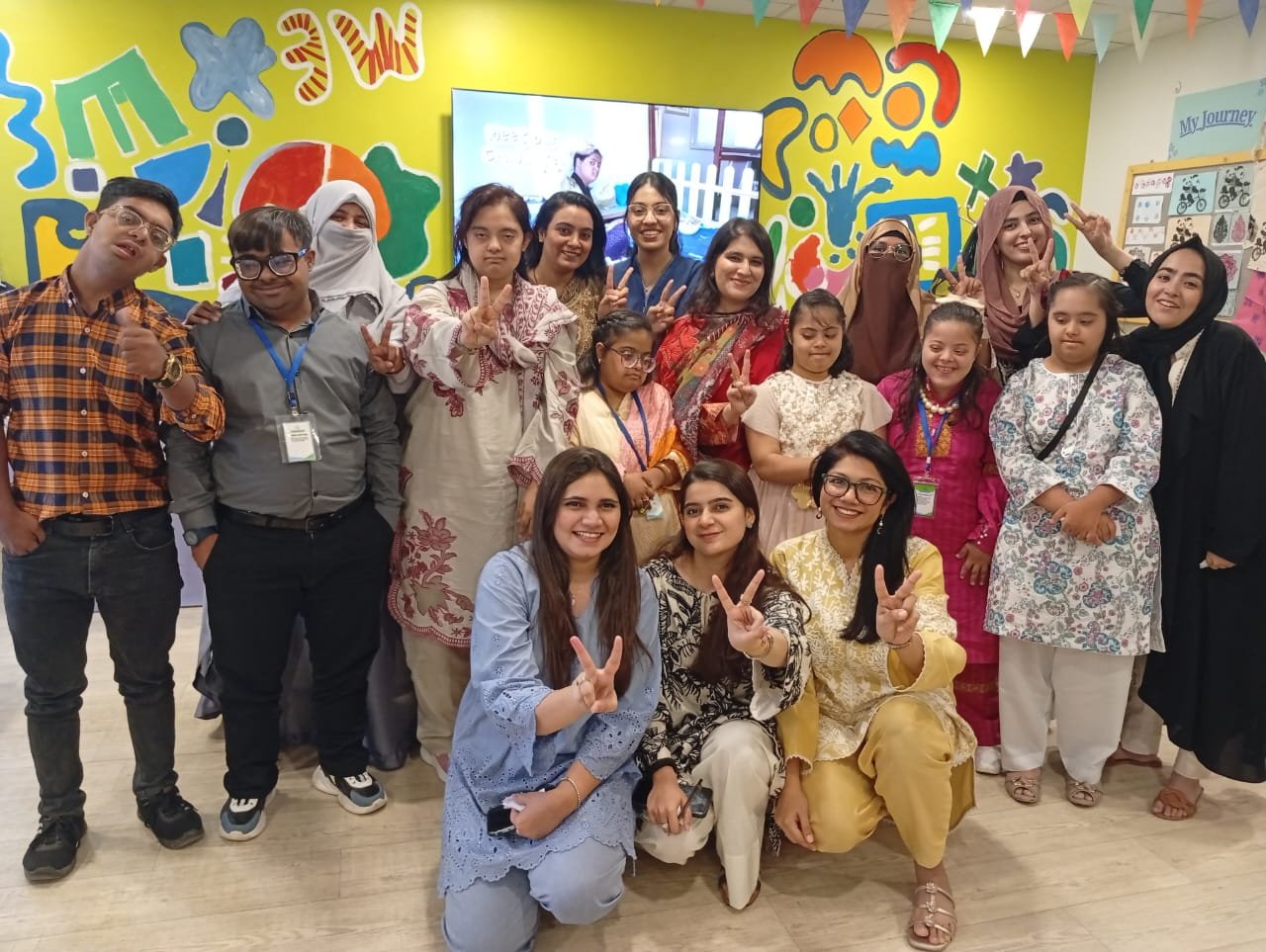
KARACHI: The room was loud with pride. Eight students stood by tables displaying tote bags, paintings, screen-printed handbags, painted canvases, cushion covers, and pouches stitched with their own names on them.
This is KDSP’s idea of a “thesis.” Not a paper. A proof. Proof that years of training can turn into a skill, and a skill can turn into independence.
It is easy to group all children under one word — “special.” But at the Karachi Down Syndrome Program, they don’t. Because a child with Down Syndrome learns differently than a child with CP. An autistic student needs a different kind of classroom than any other child.
Launched in March 2014, the Karachi Down Syndrome Program (KDSP) is a prominent non-profit organization advocating for the value, acceptance, and inclusion of individuals with Down syndrome. Based in Karachi, KDSP operates as a “one-stop solution” providing comprehensive, highly subsidized developmental services to individuals and their families.
But “special” is not a plan. And it is not the same for everyone:
We called them “special.” And then we used that word as a reason to keep them on the margins. Out of regular schools. Out of job lists. Out of the story we tell about who gets to be useful.
A child with CP faces physical challenges and needs mobility support. An autistic child navigates the world differently and needs structure and sensory understanding. A child with Down Syndrome often learns at a different pace and needs repetition, speech therapy, and patience — but also gives back warmth, honesty, and a remarkable ability to master routine work. Their needs are not the same. So their training cannot be the same either.
The moment we start calling everyone by one word, we stop seeing the person.
A room where ability is displayed, not debated:
Last week I had the opportunity to visit the graduation exhibition of 8 students who completed KDSP’s 3-year Education For Life, EFL Graduation Program.
In a city with hundreds of NGOs, very few truly invest in the development of individuals. KDSP is among those few. Here, funding does not end at a ceremony. It becomes years of therapy. It becomes a classroom. It becomes a young adult learning to count change, write an invoice, and stand behind a table that says “Made by me.”
CEO: “We don’t do one-size-fits-all”
While explaining the mission and vision of KDSP, CEO Ms. Tabish Shahzad said their entire focus is on developing an inclusive society.
“From early childhood development to adolescence and beyond, our goal is to take each child to a place where they are fully independent and can be a useful citizen,” she explained.
“Every child with Down Syndrome has challenges — speech or communication, lack of focus, behavioral and mental health issues. For each challenge we have diversified programs and counselling sessions. We don’t do one-size-fits-all,” Tabish added, head held high.
Different Needs, Different Names, Same Dignity
We cannot call everyone “special” and think the job is done. Ms. Sidra Sajid, Skill Development Facilitator for Education For Life, EFL, explained how that works on the ground.
“We have a proper organizational structure to support the ultimate EFL program,” she said. “For every vocation and skill, we have trained vocational teachers. It’s not volunteers coming once a month. It’s daily, structured training.”
Supporting them are Managers and Assistant Managers who oversee every faculty: Ms. Umaima Shafqat, Ms. Ayesha Shahid, Ms. Sania Siddiqui, Ms. Mahzeb Fahim, and Ms. Asma Urooj. They put in all their efforts in various skill development programs and maintain keen observation of students’ challenges, how to resolve them, and facilitate them through various programs.
Ms. Sidra explained that the KDSP EFL Graduation Program reflects a philosophy with two clear dimensions.
First, Life: Basic academics. How to travel. How to manage money. How to carry out everyday chores without depending on anyone. The dignity of doing it yourself. It is obligatory to learn numeracy, computer literacy, cooking, and life skills.
Second, Livelihood: Vocational training and skills that actually sell. Baking. Stitching. Screen printing. Block printing. Weaving. Photography. Making clay items. Things that turn into a product, a service, and an income.
The room proved both. White tablecloths. Hand-written price tags. Students standing behind their own work, explaining it in their own words.
Talking about the graduates, Ms. Sania Siddiqui added with quiet pride: “Most of them are already earning for their families through their craft. Like Unzila, one of our graduates, who has excelled in splatter painting and has completed her internship at Engro Martin Dow and KDSP itself.
And Hasan Mansoor, who is a master of quilling craft. His products are already being offered for sale through KDSP’s own sales outlet, Lehr.”
Lehr, headed by Ms. Mehak, is KDSP’s retail space where students’ products — from baked goods to crafts like Hasan’s quilling — are sold to the public. It is the final step of the program: moving from classroom to customer.
A proud moment for mentors:
Ms. Sadia Navaid, Quilling Class mentor, who has been associated with KDSP for several years, stood by Hasan’s table watching visitors admire his work.
“I have seen these children struggle with paper strips in their early classes,” she said. “Tiny fingers, no focus, paper tearing. And today, to see them become masters and make such awesome products… it’s been a journey.”
She paused, eyes on Hasan as he explained his design to a customer.
“This journey has shown me several sides of life, and the blessings of Allah. These children are my pride and my medals of achievement. It was wonderful to see them grow, along with parents who put in their hundred percent to help them reach the summit.”
Chef Zainab served freshly baked items. Ms. Samina, their painting guru, watched her students with the same pride. It was indeed a proud moment for all of them.
From classrooms to job markets:
The validation came not just from families. While attending the thesis exhibition, I also met the CSR team of Younus Textile Mills. They spent a long time at each table, asking students about their process, pricing, and quality control.
They were highly impressed with the craft and products developed by the students. “These are market-ready skills,” one of them said. “We would like to offer an internship program for future graduates. If they can deliver here, they can deliver anywhere.”
That is the shift. From sympathy to apprenticeship. From charity to employment.
Finding confidence in every stitch: A mother’s journey
During my visit, I met a proud mother who said:
“My name is Nighat, and I’m the mother of Muhammad Munib, a child with Down syndrome. Since childhood, Munib has been differently-abled, and I was deeply worried about how he would live his life. Then we found KDSP’s Education for Life graduation program — EFL. EFL is unique because it explores the different abilities of every child, instead of focusing on limitations. Through EFL, Munib chose sewing and stitching, and with KDSP’s support at every step of his learning, he has grown not just in skills but in confidence. His learning process is slow, but every new thing he learns brings immense joy to our lives. KDSP showed us the way, gave us confidence and attention, and made us feel like a valued part of society.”
Wa Tilka’l Ayyaam. The days turn. And so do mindsets:
The word “thesis” usually means research papers. At KDSP, it means a child who once needed help tying shoelaces now presenting a portfolio, a product line, and a plan for their future. This was not a charity fair. This was proof. Proof that when you stop asking “what’s wrong with them” and start asking “what’s possible with them,” the answer is on the table.
Eight graduates: Muhammad Muneeb, Fariha Hasan, Hassan Mansoor, Sadia Wakani, Rifa Rehamatullah, Unzila Shah, Zainab Manzoor Memon, and Sara Javed walked out that day not as “cases” or as “special.” They walked out as people who can now earn bread and butter for their families.
And that, in the end, is what real investment looks like. A child who takes longer to speak is not a burden. For too long we have measured differently-abled children by what they lack, and forgotten to count what they carry — patience, honesty, craft, heart.
We left them out of classrooms, jobs, and stories. Then we called it “charity” when we let them in. But usefulness is not charity. Dignity is not a favor. When we make them an instrumental part of society, society becomes better for all of us.
NOTE: The writer is a senior journalist and columnist covering crime, law, social issues, governance, energy, health, literature, women and children’s rights across Pakistan’s leading English media houses.
Feedback:mediawomen2014@gmail.com

