
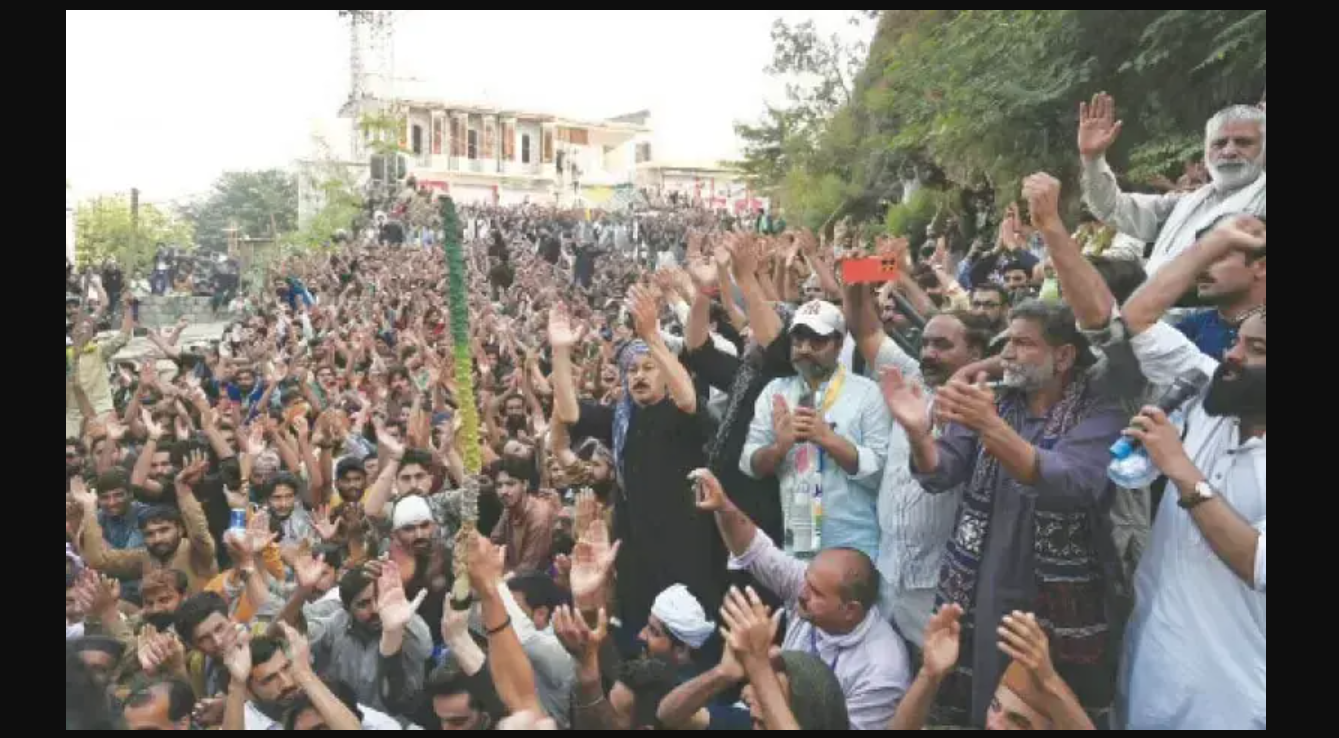

Tensions in Azad Jammu and Kashmir’s Poonch district escalated sharply as activists and supporters of the proscribed Joint Awami Action Committee (JAAC) suddenly dispersed from protest sites.
The withdrawal came late at night after fears of an imminent large-scale security operation. Authorities had reportedly intensified preparations for a decisive crackdown.
Sudden Dispersal of Protesters in Rawalakot Area
Officials confirmed that all three protest gatherings on the outskirts of Rawalakot were completely vacated shortly after midnight.
According to local administration statements, participants left the area and returned to their respective regions in a rapid and uncoordinated manner.
“There is not a single participant at any of the three sit-in sites on the outskirts of Rawalakot. All have unconditionally surrendered before the state and have returned, rather fled, back to their respective areas,” said the Poonch Divisional Commissioner.
The sudden dispersal followed reports of heightened security deployment and possible action against the protesters.
Heavy Security Deployment and Planned Operation
On Thursday evening, authorities reportedly mobilised a large security contingent for a potential operation.
The force included around 1,000 personnel from Rangers, Federal Constabulary, Islamabad police, and Azad Jammu and Kashmir police.
In addition, a flag march involving 70 to 80 armoured and operational vehicles was conducted in the region.
Officials described the preparations as a “decisive action”, which increased anxiety among protest participants.
The presence of such heavy deployment contributed to uncertainty among JAAC supporters gathered at multiple sit-in points.
Backchannel Communication and Negotiation Attempts
Before the dispersal, authorities attempted backchannel communication with JAAC-linked individuals.
This communication was facilitated through local leaders, including legal and district representatives.
Officials said messages were conveyed to encourage surrender to avoid further escalation.
During these exchanges, conditions and responses were discussed regarding the continuation or withdrawal of sit-ins.
Leadership Response and Shifting Positions
Authorities claimed that one of the key JAAC figures, Umar Nazir Kashmiri, indicated conditional willingness to surrender.
According to officials, he stated that if the notification banning JAAC was withdrawn, he would end sit-ins and surrender before the local SHO.
At one stage, officials reported that sit-in activities were expected to continue peacefully.
However, the situation changed rapidly after security movements intensified in Rawalakot.
When news of the large flag march reached protest sites, fear of a major operation reportedly increased.
Officials described this phase as one marked by “chaos and panic” within protest ranks.
Complete Evacuation of Protest Sites
By midnight, all protest locations were reported empty.
Authorities stated that not a single organised group remained at the original sit-in sites.
The remaining participants also dispersed after receiving information from other locations.
Officials confirmed that law enforcement teams later secured the areas for monitoring and further action.
Ongoing Legal and Security Measures
Authorities have directed district administrations to take further action against individuals named in various cases.
They also confirmed plans to raid residences of those involved in earlier FIRs.
In addition, CNICs of 31 core JAAC members were blocked, along with their travel documents.
Officials stated, “This time, there will be no compromise on the writ of the state.”
Background of Rising Tensions in the Region
The situation developed after repeated protests and a shutter-down strike in Rawalakot.
Violence was also reported during earlier clashes, resulting in casualties among both civilians and law enforcement personnel.
Subsequently, the regional government declared JAAC a proscribed organisation, citing security concerns.
Arrests, sedition proceedings, and financial rewards for information about key leaders were also announced during the crackdown.
Broader Political and Regional Context
The protests were linked to longstanding demands regarding legislative seats reserved for refugees in the region’s assembly.
These demands have remained a point of political dispute between authorities and JAAC representatives.
Meanwhile, federal officials have urged dialogue and public participation in resolving constitutional questions.
However, recent events have escalated tensions, leading to stronger security measures across the region.
Situation Remains Under Close Observation
Security forces continue to monitor developments in Poonch and surrounding districts.
Authorities maintain that stability and enforcement of law remain the top priorities.
Although protest sites are currently empty, officials remain cautious about potential regrouping or renewed activity.
The situation remains sensitive, with both security readiness and political uncertainty shaping the regional landscape.

