
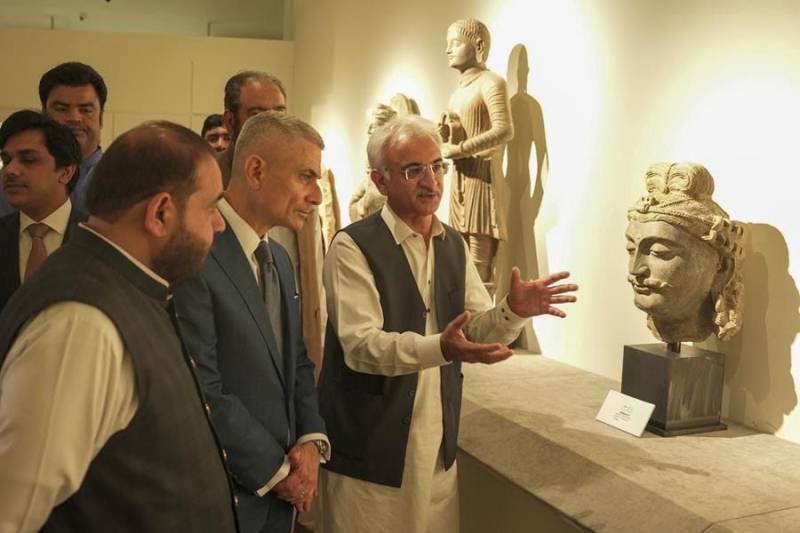

Pakistan received a major cultural victory on Wednesday after the United States officially returned hundreds of rare historical artifacts valued at more than $23 million. The handover ceremony took place at the Islamabad Museum and marked an important moment for the protection of Pakistan’s ancient heritage.
The returned collection includes 450 historical objects that were illegally smuggled out of Pakistan over the years. These artifacts date back thousands of years and reflect some of the earliest periods of human civilization in the region.
Officials described the recovery as one of the most significant cultural repatriation efforts between Pakistan and the United States in recent years. The return also highlighted growing international cooperation against illegal antiquities trafficking.
The ceremony was attended by senior diplomats, cultural experts, and government representatives. United States Assistant Secretary of State for South and Central Asian Affairs S. Paul Kapur addressed the gathering and emphasized the importance of preserving historical identity.
He stated that the ancient treasures had finally returned to their rightful home after years of illegal movement through international smuggling networks.
Ancient Artifacts Return to Their Original Homeland
According to officials, the recovered collection contains highly valuable historical objects, including clay figurines believed to be around 4,000 years old. Experts say some items belong to the earliest known human settlements in the region.
The artifacts represent different periods of Pakistan’s rich civilizational history. Archaeologists believe these items hold great importance for understanding early societies, trade routes, religious practices, and artistic traditions in South Asia.
S. Paul Kapur said the artifacts are not merely museum pieces. Instead, they are deeply connected to Pakistan’s identity, culture, and historical memory.
He explained that every object tells a story about past generations and ancient communities that once lived across the region.
“Everything belongs to the people of Pakistan, and now it has reached its home,” Kapur stated during the ceremony.
The official also stressed that cultural heritage plays a vital role in educating future generations. Therefore, preserving ancient objects remains essential for historical research and national identity.
Museum officials welcomed the development and called it a positive step for cultural preservation in Pakistan. They believe the returned artifacts will help researchers, historians, and students better understand ancient civilizations connected to the region.
International Cooperation Helped Recover the Priceless Collection
The recovery operation involved multiple American institutions and law enforcement agencies. Officials confirmed that the Manhattan District Attorney’s Office and United States Homeland Security played central roles in identifying and recovering the stolen items.
Authorities tracked the smuggled objects through international investigations targeting illegal antiquities markets.
Experts say the global trade in stolen artifacts generates billions of dollars every year. Criminal networks often traffic historical objects through secret auctions, underground collectors, and illegal international dealers.
Kapur warned that antiquities smuggling harms nations far beyond financial losses. He explained that illegal trafficking strips countries of their cultural memory and weakens their connection to history.
He also praised cooperation between Pakistan and the United States in combating heritage crimes.
Officials noted that the successful return of the artifacts reflects improving cultural collaboration between both countries. The two governments continue working together to identify stolen objects and stop future trafficking operations.
New Cultural Partnership Aims to Stop Illegal Antiquities Trade
During the ceremony, officials also highlighted the growing partnership between Pakistan and the United States regarding cultural protection.
Kapur said a bilateral agreement on cultural property will strengthen efforts to prevent illegally obtained artifacts from entering the American market.
The agreement is expected to improve monitoring systems, museum cooperation, and professional training opportunities for heritage experts.
In addition, both countries plan to expand collaboration in conservation projects and educational programs linked to archaeology and cultural preservation.
Experts believe stronger international partnerships are necessary because smuggling networks continue targeting ancient sites across developing countries.
Pakistan has faced repeated challenges involving illegal excavation and artifact theft from archaeological locations. Authorities hope stronger global coordination will reduce such crimes in the future.
The return of the ancient treasures also sends a strong message against illegal collectors and trafficking groups operating worldwide.
Cultural experts described the ceremony as more than a diplomatic event. They called it a symbolic restoration of history, identity, and national pride.
For Pakistan, the return of these priceless objects represents the recovery of an important part of its ancient legacy.

