
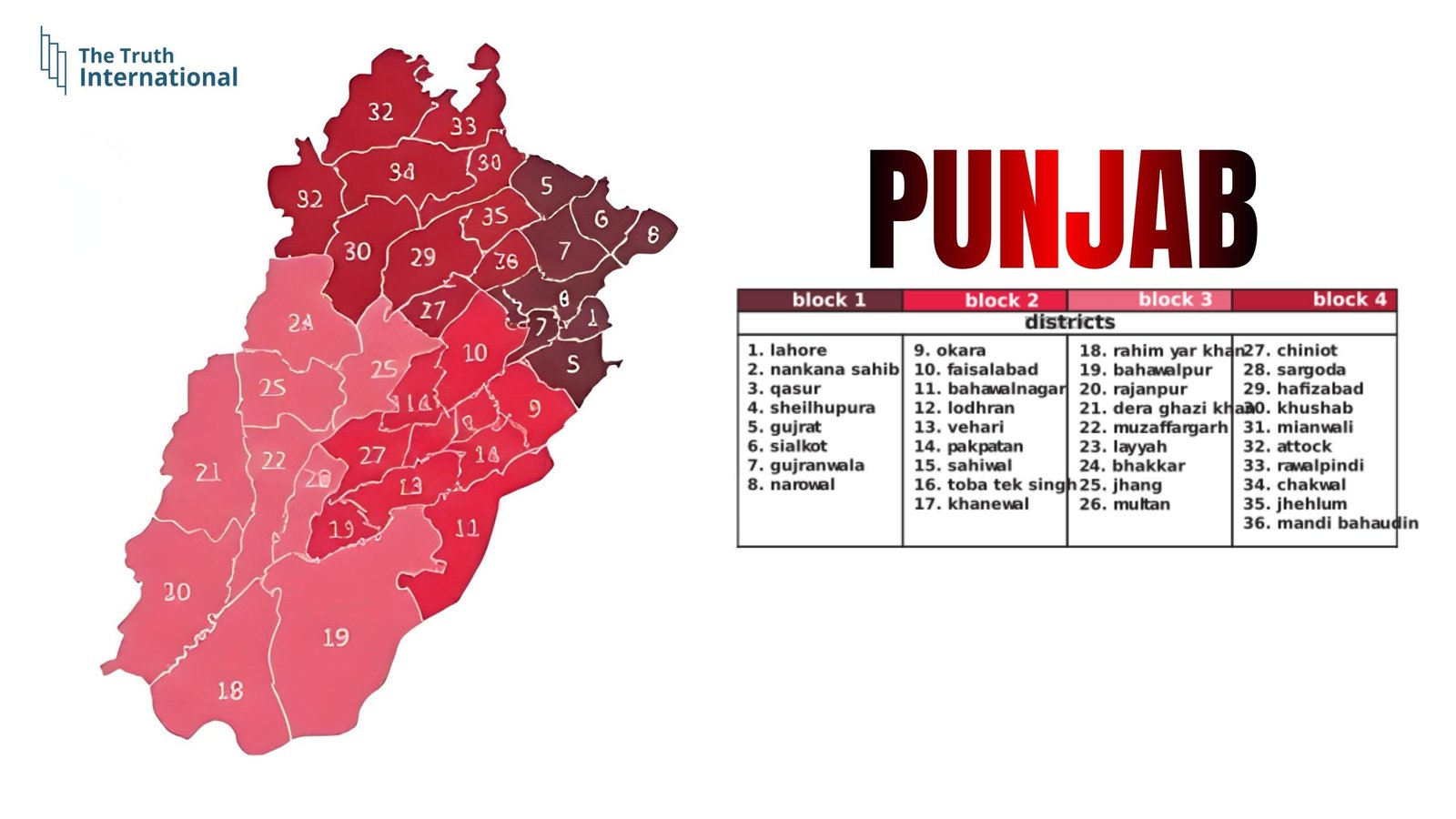

Can smaller administrative divisions make Punjab easier to govern and help unlock its vast economic potential?
The debate over creating smaller provinces and administrative units has raised an important question in Pakistan: can a different administrative structure improve governance? For Punjab, the question carries particular weight. The province has a vast population, a powerful economy and regions with very different social and economic needs. Managing all of them through one provincial centre remains a major governance challenge.
Punjab has more than 120 million people spread across metropolitan centres, agricultural districts, industrial cities and remote communities. While Lahore continues to grow as a major economic and administrative hub, many other parts of the province struggle with limited employment, weak infrastructure and inadequate public services.
That contrast raises a broader question: if Punjab remains one enormous administrative unit, can its government respond equally well to every region?
Punjab’s population gives it considerable economic strength, but it also puts pressure on public institutions. More people require more schools, hospitals, roads, housing, transport, clean water and jobs. Yet development remains uneven. Lahore and other major cities attract substantial investment, while several districts in southern and western Punjab continue to face gaps in healthcare, education, sanitation and employment.
Smaller administrative divisions could help address this imbalance by bringing decision-making closer to the regions that need it. Instead of relying on one provincial structure, smaller administrations could focus on local priorities and direct development towards their most urgent needs.
An agricultural region, for example, may need better irrigation and storage, while an industrial city may require improved energy supplies, transport and business facilities. A localized approach could therefore make development planning more responsive instead of applying one broad strategy across Punjab.
Population size also makes Punjab’s poverty challenge significant. Even a lower poverty rate translates into millions of people facing financial hardship because of the province’s enormous population. Rural families may struggle with low agricultural incomes, while urban households face rising living costs, low wages and insecure employment.
These differences require policies that recognize local realities. Smaller administrative units could identify areas facing the greatest hardship and direct resources towards healthcare, education, water supply and employment programmes. Closer decision-making could also make it easier for citizens to raise complaints and demand better services. However, boundaries alone cannot eliminate poverty. Smaller divisions would need capable administrations, transparent budgets and strong accountability. Otherwise, a new structure could simply reproduce existing weaknesses on a smaller scale.
The argument, therefore, is not about dividing Punjab for the sake of division. It is about creating a structure that can respond to a population whose needs continue to grow. That challenge becomes even clearer in the job market, where opportunities remain concentrated in a limited number of cities.
Punjab’s employment challenge cannot remain separate from its administrative structure. A province with such a large population needs economic opportunities across its regions. When jobs cluster around major cities, young people from smaller districts often move in search of work, putting additional pressure on urban housing, transport and public services.
Smaller administrative units could encourage regional employment strategies based on local resources, skills and industries. Agricultural districts could attract food-processing and livestock businesses, while industrial areas could expand manufacturing. Cities with universities and skilled graduates could develop technology and service-sector economies.
Such an approach could create employment closer to where people live and encourage young people to build businesses within their own regions.
Punjab’s agricultural strength offers another major opportunity. The province produces a significant share of Pakistan’s food, but farmers often depend on selling raw products. Regional administrations could strengthen agricultural value chains through food processing, packaging, cold storage, transport and modern farming technology.
This could create jobs beyond farming and help local economies benefit from the full value of agricultural production. Different agricultural belts could also receive policies based on their specific needs, whether irrigation, livestock, dairy or crop processing.
Punjab’s industrial potential deserves similar attention. Smaller administrative units could attract investment by improving infrastructure, business services and workforce development. Textile regions could move towards higher-value products, while cities with universities could expand technology, education and professional services.
Such diversification could gradually reduce pressure on Lahore and allow other cities to become regional centres of growth. Tourism could offer another source of employment, particularly in areas with historic sites and cultural attractions. Better roads, hospitality facilities and visitor services could help local businesses benefit from this potential.
The key advantage of smaller administrations would be their ability to focus. Regional governments could develop plans around the industries, resources and skills of their own populations instead of applying one broad strategy across the entire province.
Economic development, however, depends on governance. Investors need reliable infrastructure, businesses need predictable regulations and citizens need efficient services. Administrative restructuring could help if regional governments receive meaningful authority and adequate resources. Still, smaller divisions would not guarantee success. Without capable institutions, financial independence and accountability, new administrative units could simply create additional layers of government.
The potential lies in combining restructuring with wider reforms. If Punjab connects regional authority with economic planning, investment and accountability, its enormous population could become a greater source of growth rather than an administrative burden.
Punjab does not need smaller divisions simply to redraw its map. The real purpose would be to bring decision-making closer to people, spread investment beyond major cities and create stronger responses to poverty and unemployment. With its population, agricultural strength, industries and young workforce, Punjab has the resources to generate greater prosperity. Smaller administrations could help unlock that potential if they have adequate funds, capable institutions and clear accountability. Ultimately, success will not depend on new boundaries, but on whether people see better jobs, stronger services and more balanced opportunities in their own communities.

