
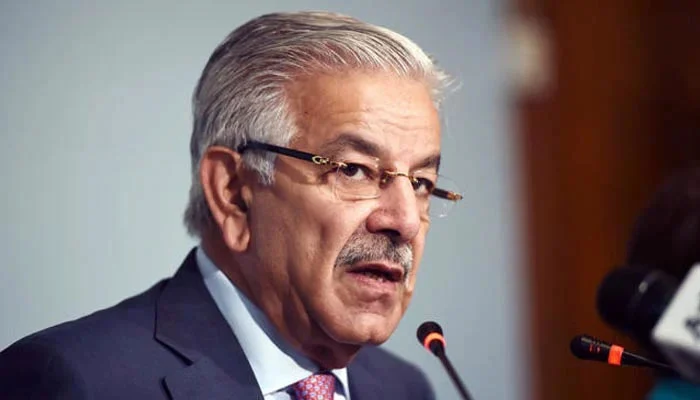

Defence Minister Supports Reform but Questions Naqvi’s Approach
Defence Minister Khawaja Asif has responded sharply to Interior Minister Mohsin Naqvi’s declaration that Pakistan’s governance system has collapsed.
However, Asif did not completely reject Naqvi’s criticism.
In a series of posts on X, the defence minister said he broadly agreed that Pakistan’s political and administrative system required major reforms.
Asif said institutional development had remained controlled by personal and group interests for decades.
He argued that the system must be freed from these pressures if Pakistan wants meaningful and lasting reform.
However, Asif questioned why Naqvi raised such a major constitutional issue before a gathering of business leaders instead of presenting it in Parliament or the federal cabinet.
He said Parliament and the cabinet were the proper forums for debating changes to Pakistan’s political and administrative structure.
According to Asif, conducting the discussion through constitutional institutions would strengthen both the reform process and the country’s democratic system.
He also described Naqvi as an influential member of the government who currently holds significant authority.
Asif said the interior minister had occupied powerful positions for around three and a half years and could have initiated governance reforms during that period.
He suggested that Naqvi should now use the authority already available to him before proposing a complete restructuring of the state.
Asif Tells Naqvi to Reform Interior Ministry and Implement NAP
Khawaja Asif urged Mohsin Naqvi to begin the reform process from the Interior Ministry.
He referred to the National Action Plan, which was introduced after the 2014 Army Public School attack to strengthen Pakistan’s counterterrorism framework.
Asif said security forces were implementing the part of the plan assigned to them while making significant sacrifices.
He claimed that several other parts of the plan fell under the Interior Ministry’s responsibility but had not been fully implemented.
The defence minister urged Naqvi to complete those responsibilities before calling for a broader national reset.
Asif said the entire country would support the interior minister if he began meaningful change within his own department.
He argued that stronger policing, intelligence coordination, counter-extremism measures and civilian administration were essential parts of governance reform.
His remarks placed direct pressure on Naqvi to demonstrate administrative improvement in the institution already under his control.
Asif also criticised the decision to raise such a major issue outside constitutional forums.
He said a statement about restructuring the system would carry greater authority if it were presented before lawmakers or discussed formally by the cabinet.
The defence minister’s response suggested that he supported reform in principle but disagreed with Naqvi’s method and timing.
He also appeared to question whether the interior minister had sufficiently used his existing authority to address institutional failures.
PCB Performance Becomes Focus of Political Exchange
In a separate post, Khawaja Asif advised Naqvi to introduce major reforms in the Pakistan Cricket Board.
Naqvi serves as both interior minister and PCB chairman.
Asif said governance systems should continue evolving and suggested that the cricket board offered Naqvi an opportunity to demonstrate his reform agenda.
He noted that many cricket supporters were dissatisfied with the PCB’s performance.
The defence minister said Naqvi possessed extensive authority within the board.
He argued that neither Parliament, the prime minister nor an outdated political structure prevented him from reforming cricket administration.
Asif therefore challenged Naqvi to deliver visible improvements in an institution where his authority faced fewer political or constitutional restrictions.
The remarks were widely interpreted as criticism of the PCB’s performance under Naqvi’s leadership.
They also highlighted growing political scrutiny over Naqvi’s simultaneous control of the Interior Ministry and the cricket board.
Asif’s comments suggested that successful reform at the PCB could strengthen Naqvi’s credibility when calling for wider institutional changes.
Failure to improve the board, however, could weaken his argument that Pakistan’s broader governance structure required a complete reset.
Naqvi’s System Failure Remarks Trigger National Debate
Mohsin Naqvi reignited the governance debate while addressing the Pakistan Economic Summit in Islamabad.
He said Pakistan’s existing system had lost its ability to resolve the country’s major problems.
Naqvi called for a broad administrative reset and the creation of smaller administrative units or additional provinces.
He argued that decentralisation could improve public services, accountability and access to justice.
The interior minister also said Pakistan required new leadership capable of addressing the needs of its expanding population.
He maintained that young people wanted employment, fairness and merit instead of temporary financial schemes.
His remarks produced mixed reactions across the political spectrum.
Some political figures supported the discussion on administrative reform.
Others questioned how a senior member of the existing government could describe the same system as a failure.
Pakistan Peoples Party leaders expressed concern over suggestions involving new provinces, particularly any proposal that could affect Sindh.
The Muttahida Qaumi Movement-Pakistan welcomed renewed discussion about smaller administrative units.
Director General Inter-Services Public Relations Lieutenant General Ahmed Sharif Chaudhry later said good governance was essential for Pakistan’s security and stability.
However, he described Naqvi’s comments as his personal opinion and said any administrative restructuring should follow constitutional and legal procedures.
Khawaja Asif also supported using constitutional institutions for the debate.
His response has therefore added a new dimension to the controversy.
The dispute is no longer only about whether Pakistan’s system requires reform.
It is also about who should lead that reform, where the debate should take place and whether current officeholders have effectively used the authority they already possess.

