
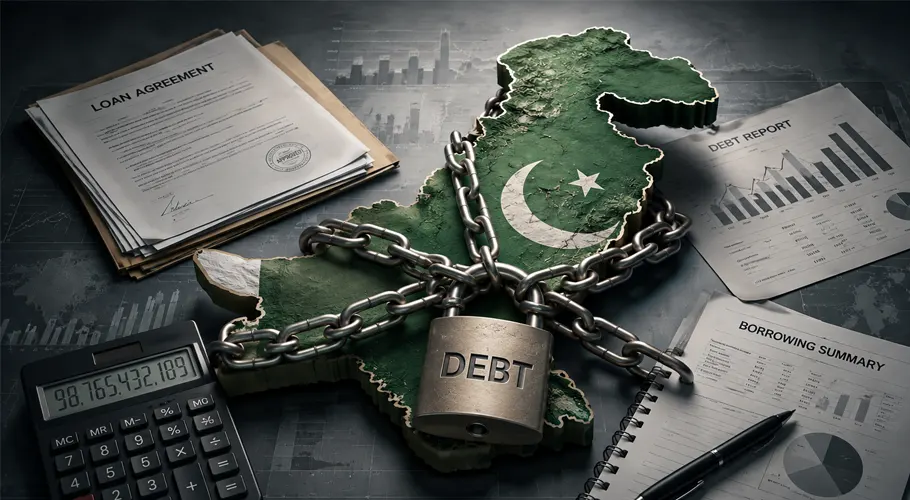

Pakistan’s government external debt has reached $92.2 billion by the end of March 2026, according to the Economic Survey of Pakistan.
The latest data highlights a continued rise in external borrowing, although the pace of accumulation has slowed compared to the previous year.
Pakistan External Debt Reaches $92.2 Billion
The Economic Survey shows that Pakistan’s total government external debt stood at $92.2 billion by March 2026.
During the first nine months of the fiscal year 2026, external debt increased by $364 million.
However, officials note that this increase is significantly lower than the previous year’s trend, indicating a slower pace of borrowing.
Federal Government Debt Breakdown
The federal government’s outstanding external debt was recorded at $82.26 billion.
Within this amount, Pakistan’s obligations to the International Monetary Fund reached $9.89 billion.
This represents around 11 percent of the country’s total external debt stock.
The data reflects Pakistan’s continued reliance on international financial institutions for external financing support.
Long-Term and Short-Term Debt Position
According to the survey, Pakistan’s long-term external debt rose to $68.41 billion.
At the same time, short-term external liabilities stood at $13.85 billion.
This structure shows a larger share of long-term obligations compared to short-term borrowing.
It also highlights the government’s continued dependence on extended repayment arrangements.
Multilateral and Bilateral Lending Sources
Loans from multilateral institutions, including the World Bank and the Asian Development Bank, reached $42.48 billion.
This accounts for approximately 46 percent of Pakistan’s total external debt stock.
In addition, debt owed to Paris Club countries increased to $5.49 billion, representing nearly 6 percent of the total.
Meanwhile, bilateral loans from non-Paris Club countries have crossed $19 billion.
These figures show a diversified but heavily weighted external borrowing structure.
Eurobonds and Commercial Borrowing
Pakistan’s outstanding Eurobonds and international Sukuk bonds stand at $6.3 billion.
Borrowing from foreign commercial banks is recorded at $6.32 billion.
These instruments reflect Pakistan’s engagement with international capital markets for financing needs.
Shift Toward Longer-Term Financing
According to the Economic Survey, the government is gradually shifting away from expensive short-term borrowing.
Instead, it is focusing more on longer-term financing arrangements to manage repayment pressure.
Officials believe that ongoing reforms and improved revenue collection could help ease the debt burden over time.
Moreover, the report suggests that structural economic adjustments may support medium-term debt stability.
The latest figures highlight both the scale of external obligations and the government’s ongoing efforts to manage financial sustainability.

