
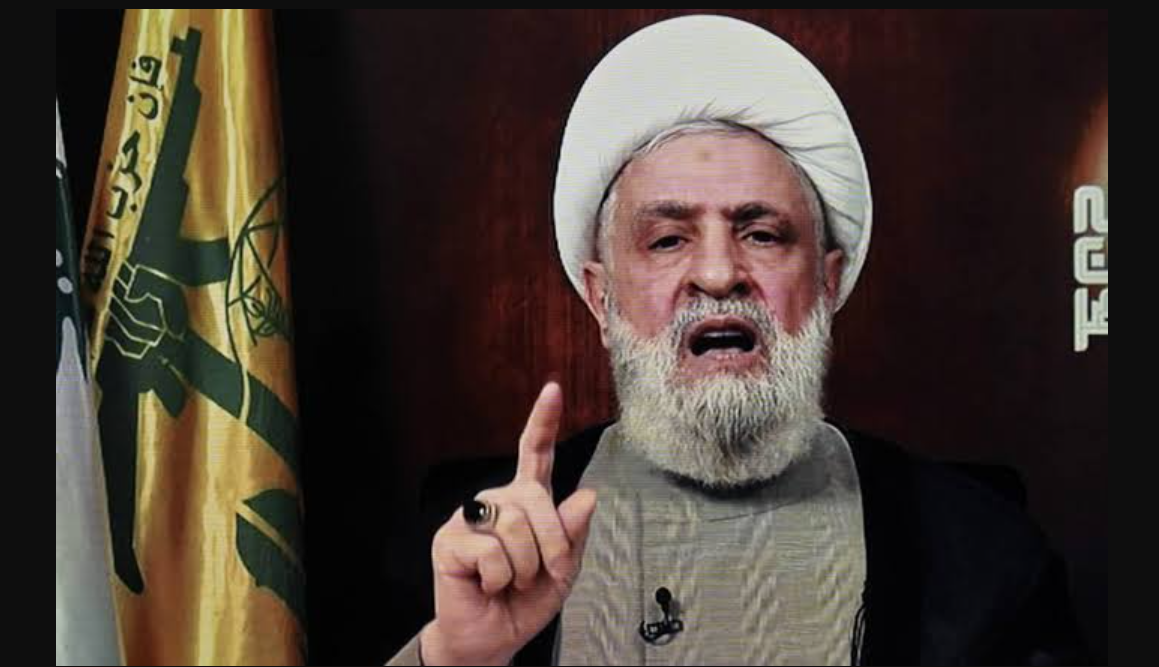

Hezbollah’s leadership has renewed its demand for a full and scheduled withdrawal of Israeli forces from southern Lebanon. The statement comes amid continued tensions, reported ceasefire violations, and ongoing diplomatic efforts involving regional and international actors.
Hezbollah Demands Timed Israeli Exit
Hezbollah chief Naim Qassem has insisted that Israel must withdraw from all Lebanese territory according to a clear timetable. He emphasized that no partial presence should remain in the south.
“We now have a ceasefire. The withdrawal must take place according to a timetable. Israel has no choice but to fully withdraw from all Lebanese territory, without retaining an inch,” Qassem said during a televised address.
He also stated that Lebanese forces should deploy south of the Litani River, a key area near the Israeli border.
“Israel withdraws and the Lebanese army deploys exclusively south of the Litani River,” he added.
Casualties Reported Amid Renewed Clashes
Despite a recent lull in fighting, reports from southern Lebanon indicate renewed incidents of violence. Two people were killed in Nabatieh al-Fawqa when Israeli forces allegedly opened fire near a road-clearing operation involving heavy machinery.
Lebanese health authorities later confirmed the fatalities. Local reports described the incident as occurring while workers were unblocking a road near an excavator.
Hezbollah condemned the attack, calling it a violation of the ceasefire and describing it as a “treacherous attack”.
Israeli military officials stated that their forces fired warning shots at individuals they identified as armed militants operating in a restricted security area. They also said additional fire was used to eliminate perceived threats.
Broader Military Activity in Southern Lebanon
Further incidents were reported in southern Lebanon, including drone activity targeting vehicles in separate locations. Some strikes reportedly missed their intended targets, according to local sources.
The United Nations peacekeeping force in Lebanon noted that no major strikes or launches had been observed for more than two days, suggesting a temporary reduction in large-scale escalations.
However, ground-level tensions remain high as both sides continue to accuse each other of violations.
Diplomatic Efforts and Ongoing Talks
Diplomatic discussions are ongoing in Washington involving Lebanese, Israeli, and international stakeholders. Mediators Pakistan and Qatar have reportedly supported efforts linked to recent US-Iran understandings aimed at reducing regional escalation.
A mechanism referred to as a “de-confliction cell” has been discussed to prevent further flare-ups in Lebanon as part of broader regional stability efforts.
Lebanese President Joseph Aoun has rejected any continued Israeli presence in southern Lebanon. He also dismissed foreign interference in Lebanese affairs, indirectly referring to regional influence dynamics.
“We accept nothing less than an end to the Israeli occupation and at the same time, the fall of foreign tutelage,” Aoun said.
He further expressed hope that ongoing talks would help restore full sovereignty and lead to a durable peace framework for Lebanon.
Continued Regional Uncertainty
The situation remains unstable despite temporary pauses in large-scale fighting. Israeli and Hezbollah positions remain firmly opposed on withdrawal terms, sovereignty, and military presence in border areas.
While diplomatic channels continue to operate, both sides maintain strong security postures. As a result, the future of the ceasefire remains uncertain, with international mediators working to prevent further escalation.

