

China has unveiled a new artificial intelligence chip that could reshape competition in advanced computing. Researchers at Peking University developed the processor and reported remarkable gains in specialized AI workloads. As a result, the breakthrough highlights China’s growing innovation in semiconductor technology despite global restrictions on advanced chip manufacturing.
Breakthrough Performance Through New Architecture
The research team said the neuromorphic chip reconstructed complex brain surfaces in less than half a second. Moreover, it delivered performance up to 478 times faster than Nvidia’s A100 processor for this specific task. The impressive result came from a unique architectural design instead of advanced manufacturing methods.
UNUSUAL
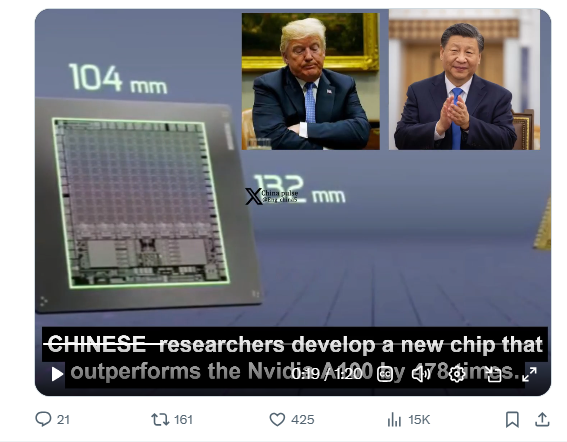
A new Chinese chip is pushing the West out of the AI competition.Researchers in China have developed an AI chip that outperforms the Nvidia A100 by 478 times.
A team from Peking University created a new neuromorphic chip capable of reconstructing complex brain… pic.twitter.com/wolAl66IkK
— China pulse 🇨🇳 (@Eng_china5) July 6, 2026
Unlike conventional processors, the new chip combines storage and computing within the same memory array. Consequently, it reduces the constant movement of data between memory and processing units. This design removes a major performance bottleneck while lowering power consumption. Therefore, the processor achieves higher efficiency in workloads that match its architecture.
Innovation Beyond Advanced Manufacturing
The researchers also manufactured the chip using a 40-nanometer production process. Although this technology is much older than today’s leading semiconductor nodes, the processor still achieved outstanding results. Therefore, the project demonstrates that innovative chip architecture can deliver major performance improvements without relying on the newest manufacturing techniques.
Industry observers believe the development reflects China’s expanding capabilities in artificial intelligence and semiconductor research. Furthermore, it highlights the country’s focus on creating competitive domestic technologies. Experts also note that specialized processors may increasingly challenge traditional graphics processing units in selected AI applications.
While the reported advantage applies to a specific computing task rather than every AI workload, the achievement signals meaningful progress. As research continues, China’s latest innovation could influence future chip design and strengthen competition in the global artificial intelligence industry.

