
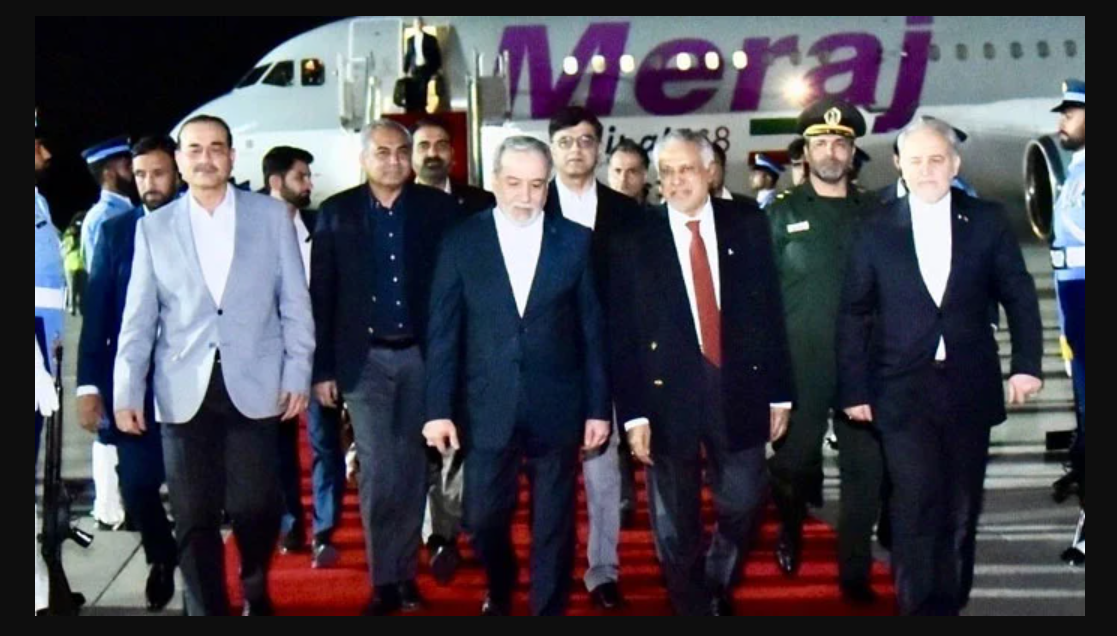

Iran’s Foreign Minister Abbas Araghchi arrived in Islamabad on Friday. His visit comes at a critical moment for regional diplomacy.
Moreover, his arrival signals renewed momentum in efforts to resolve the ongoing conflict involving Iran. High-level meetings are expected during his stay.
He was received by Deputy Prime Minister and Foreign Minister Senator Ishaq Dar. Field Marshal Asim Munir and other senior officials also welcomed him.
High-Level Meetings Planned During Visit
During the visit, Araghchi will meet Prime Minister Shehbaz Sharif. He will also hold talks with Senator Ishaq Dar.
These discussions will focus on regional developments and peace efforts. Both sides aim to strengthen diplomatic engagement.
In addition, the visit forms part of a broader regional tour. The Iranian foreign minister is also expected to visit Muscat and Moscow.
“The purpose of this visit is to hold bilateral consultations and discuss current developments in the region, as well as the latest situation in the war imposed by the United States and the Israeli regime against Iran,” the state news agency IRNA said.
US Envoys Set to Arrive for Fresh Talks
Meanwhile, the United States is preparing to send a delegation to Pakistan. Special Envoy Steve Witkoff and Jared Kushner are expected to arrive for talks.
“I can confirm Special Envoy Witkoff and Jared Kushner will be off to Pakistan again tomorrow morning to engage in talks,” White House Press Secretary Karoline Leavitt said.
However, Vice President JD Vance will not join the delegation at this stage. Officials stated that he remains on standby if needed.
“Everyone will be on standby to fly to Pakistan if necessary,” she said.
Additionally, a US logistics and security team has already reached Islamabad. Preparations are underway for a possible second round of negotiations.
Pakistan’s Role in Facilitating Dialogue
Pakistan continues to play a central role in diplomatic efforts between Iran and the United States. Officials have maintained active engagement with both sides.
Earlier, Ishaq Dar emphasised the importance of dialogue. He called for continued engagement to resolve ongoing disputes.
During a phone call with Araghchi, both leaders discussed the ceasefire situation. They also reviewed ongoing diplomatic efforts.
The Iranian foreign minister acknowledged Pakistan’s role in facilitating talks. He praised its consistent and constructive approach.
Background of Previous Negotiations
The upcoming discussions follow an earlier round of talks held in Islamabad. That meeting took place after a ceasefire was mediated on April 8.
However, the first round did not result in a permanent agreement. Differences remained over key issues, including actions around the Strait of Hormuz.
Subsequently, tensions escalated again in the region. Iran blocked the strategic waterway after earlier military strikes.
Although the strait briefly reopened, it was closed again following new developments. These actions reflected ongoing instability in the region.
Ceasefire Extension and Ongoing Efforts
Despite challenges, diplomatic efforts have continued. Pakistan has remained engaged in bringing both sides back to the table.
Hours before the ceasefire expired on April 22, the United States announced an extension. The decision aimed to allow more time for negotiations.
In a public statement, the US leadership indicated that the move followed Pakistan’s request. It was intended to support ongoing discussions and avoid escalation.
Uncertainty Surrounding Next Round of Talks
Although preparations are underway, uncertainty still surrounds the next phase of negotiations. Key disagreements remain unresolved between the parties.
Therefore, the success of upcoming talks will depend on mutual understanding and compromise.
At the same time, regional stability continues to hinge on diplomatic progress. Any breakthrough could significantly reduce tensions.

