
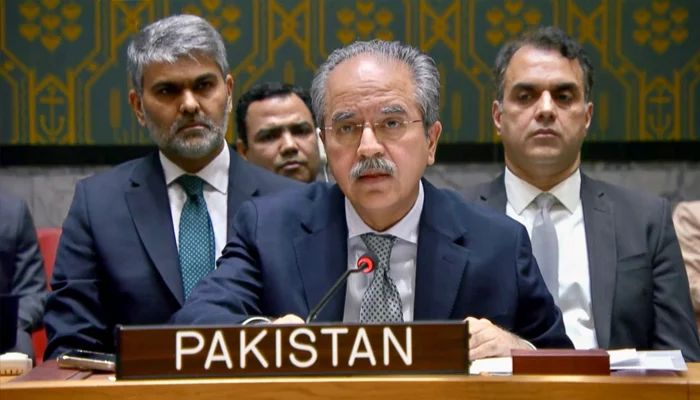

KARACHI: Pakistan’s Permanent Representative to the United Nations, Ambassador Asim Iftikhar Ahmad, has rejected India’s bid for permanent Security Council membership. He questioned whether India has the credentials required to seek a permanent seat.
Ahmad said countries seeking permanent membership face scrutiny over their voting records and compliance with Security Council resolutions. Their commitment to the UN Charter also remains an important consideration.
“There are several countries, including our neighbour obviously, which has no credentials whatsoever to even stake a claim for permanent membership of the Security Council,” he said.
Pakistan Questions Push for Permanent Seats
Ahmad said the G4 grouping has driven the campaign for additional permanent seats. The group includes India, Germany, Japan and Brazil.
According to Ahmad, the demand has contributed to the lack of progress on Security Council reform. He argued that granting permanent status would create an unfair advantage for selected countries.
“This is like seeking a certain privilege from this whole process. We believe that is an unjust demand, and not just unjust, it is unfeasible,” he said.
He also pointed to the Council’s repeated inability to resolve major international crises. According to him, disagreements among the existing permanent members often contribute to this paralysis.
More Veto Powers Could Increase Deadlock
Ahmad highlighted the Council’s handling of crises including Gaza and Ukraine. He attributed much of the deadlock to the positions of the five permanent members and their veto power.
“If the council is deadlocked often because of the positions of five permanent members, you can imagine that it will be even more deadlocked if you have eight, nine or 10 permanent members instead of the current five,” he said.
He argued that expanding the number of veto-holding countries could make decision-making even harder.
Adding more permanent members, according to Ahmad, would therefore create additional obstacles rather than solve existing problems.
“more problems, not less problems.”
The envoy also criticised the veto as an “undemocratic… unilateral blocking power” within the Council. However, he noted that permanent members still require nine affirmative votes to pass their own resolutions.
Pakistan Backs Elected Seats Model
Ahmad presented an alternative proposal supported by the Uniting for Consensus group. Pakistan leads the group alongside Italy, Canada, Turkey, South Korea, Mexico and Argentina.
The proposal calls for ten additional elected seats on the Security Council. This would create a 25-member Council where elected members would outnumber permanent members by four to one.
Under this model, countries could still prevent unwanted resolutions from passing. However, they would need to collectively deny the required votes rather than rely on additional permanent veto powers.
Pakistan’s position reflects its opposition to expanding permanent membership. Instead, the country supports a system that gives greater representation to elected members.
Ahmad’s comments highlight the continuing disagreement over how the UN Security Council should be reformed. The debate remains focused on balancing representation, accountability and decision-making power within the international body.

