

Military exchanges intensify while both sides accuse each other of violating ceasefire memorandum
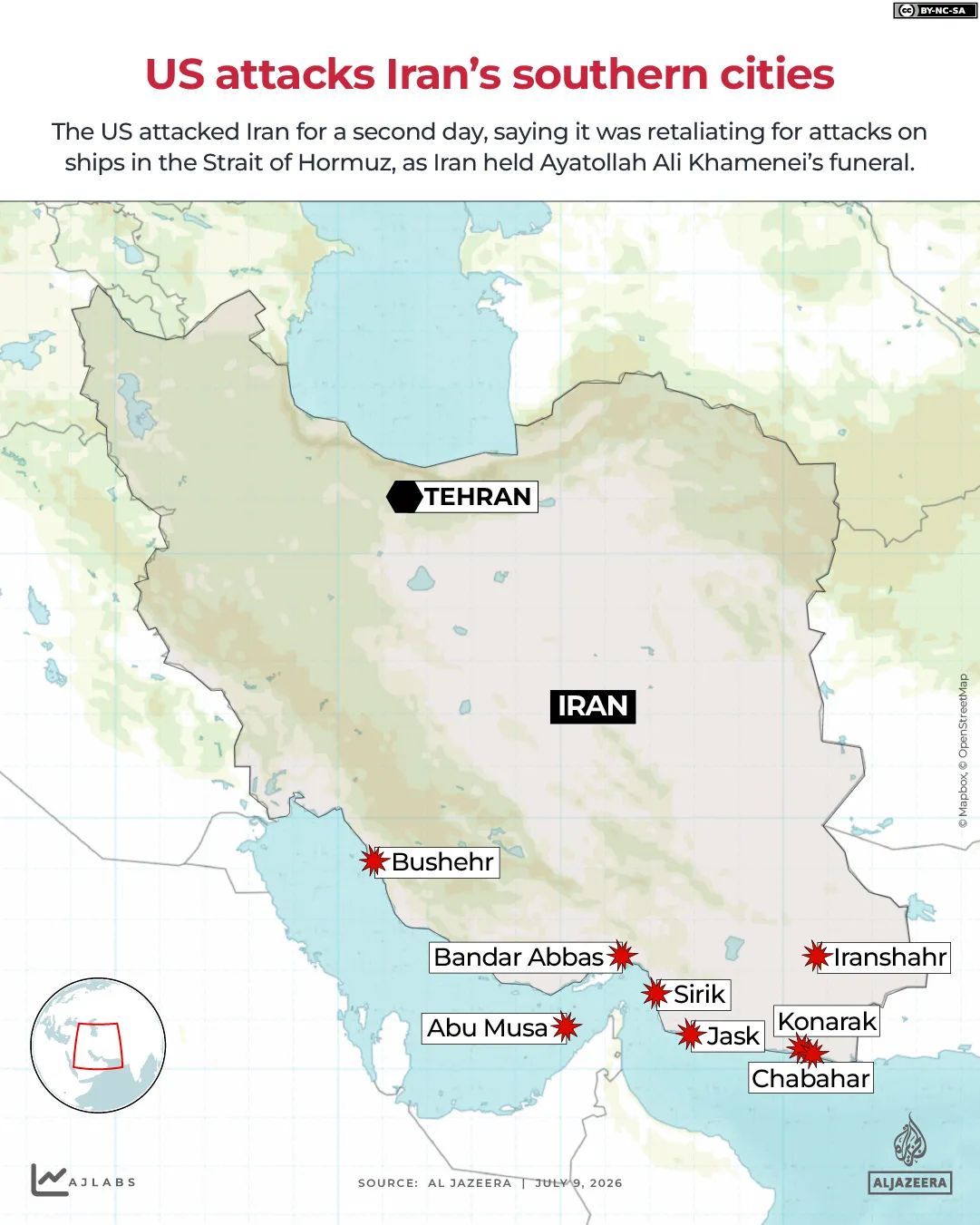
TEHRAN: The United States launched a second and larger wave of airstrikes against Iran within two days, intensifying tensions and placing the fragile peace process between Washington and Tehran under renewed strain.
US Central Command (CENTCOM) said American forces struck around 90 military targets across Iran, including air defence systems, missile and drone storage sites, coastal surveillance facilities, naval assets and logistics infrastructure. The strikes followed earlier attacks on approximately 80 Iranian targets after Tehran allegedly targeted commercial vessels transiting the Strait of Hormuz.
Iranian media reported explosions in Tehran, Bandar Abbas, Bushehr, Chabahar, Jask, Konarak and other southern locations. Authorities said at least 14 people were killed and dozens injured during the two days of attacks. Railway services between Tehran and Mashhad were also suspended after reported damage to bridges, while officials accused the United States of attempting to disrupt funeral ceremonies for former Supreme Leader Ali Khamenei.
Iran launches retaliation and files UN complaint
Meanwhile, Iran’s Islamic Revolutionary Guard Corps (IRGC) responded by launching missile and drone attacks targeting US military installations in Bahrain, Kuwait and Qatar. Air defence systems were activated across the Gulf, while Kuwait confirmed intercepting several missiles and drones.
In addition, Tehran formally lodged a complaint with the United Nations Security Council, accusing Washington of violating the Pakistan-mediated Memorandum of Understanding designed to halt hostilities. Iranian officials argued that repeated US strikes undermined ongoing diplomatic efforts and breached international law.
Diplomatic uncertainty grows
US President Donald Trump declared the memorandum effectively “over” while simultaneously suggesting negotiations could continue if Iran demonstrated willingness to reach a lasting agreement. However, Iranian leaders rejected Washington’s position, insisting the United States had violated its commitments.
Analysts say the dispute over navigation rights in the Strait of Hormuz remains the central obstacle to future negotiations. Although neither side has formally withdrawn from the memorandum, the renewed military exchanges have significantly increased uncertainty over whether diplomacy can still prevent a broader regional conflict.

