
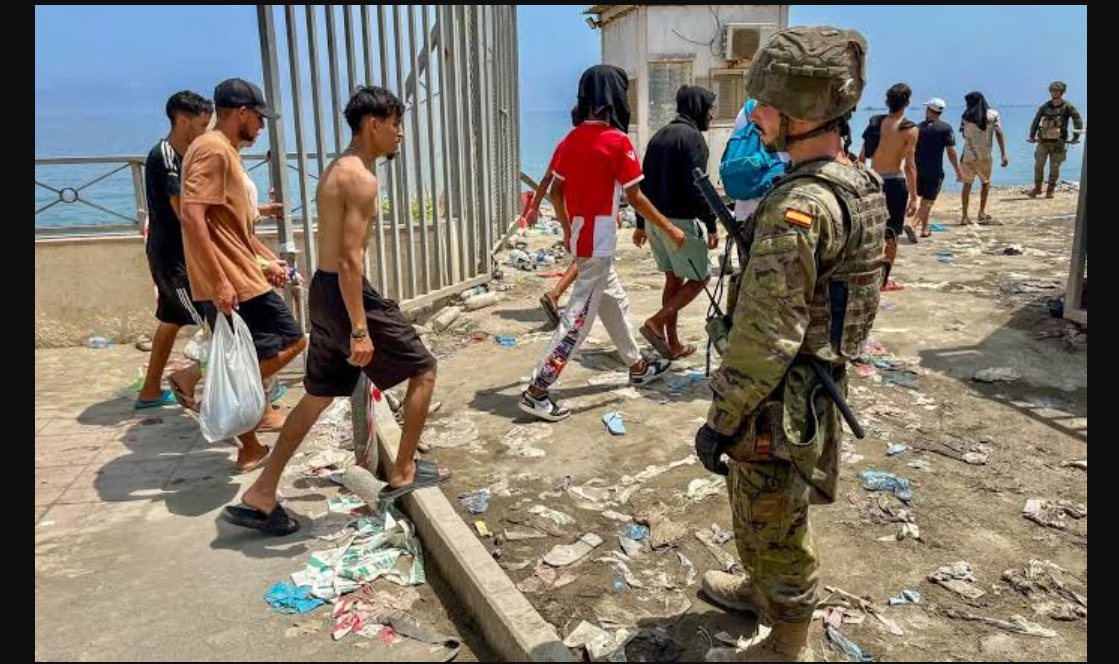

Spain has reaffirmed that its sovereignty over Ceuta and Melilla remains beyond dispute after tens of thousands of migrants entered the North African territory from Morocco last week.
The statement came as Spanish authorities continued managing the aftermath of the unprecedented migrant surge. Although most migrants have already returned to Morocco, thousands are still believed to be in Ceuta.
Meanwhile, European officials are preparing further discussions on the border situation as concerns over migration and humanitarian conditions continue to grow.
Spain Reaffirms Sovereignty Over Ceuta
Spain’s Foreign Minister Jose Manuel Albares reiterated Madrid’s position during televised remarks on Monday.
He said, “That Ceuta and Melilla are an integral part of Spain’s territory is unquestionable, for the whole world.”
His remarks came after questions regarding the recent mass crossings into Ceuta and the political implications surrounding the incident.
Morocco does not recognize Ceuta and Melilla as Spanish territory. Instead, Rabat has claimed sovereignty over both enclaves since gaining independence in 1956.
Despite the latest developments, Madrid has avoided publicly criticizing Morocco over the large-scale migrant arrivals.
Thousands Crossed Into Ceuta
Last week, an estimated 60,000 migrants entered Ceuta irregularly. Most crossed by swimming around the border barrier separating the territory from Morocco.
Since then, the majority have returned to Morocco. However, Spanish officials say several thousand migrants remain inside the enclave.
Miguel Angel Perez, the Spanish central government’s delegate in Ceuta, estimated that around 2,500 migrants were still in the territory.
Meanwhile, Ceuta’s top official, Juan Jesus Vivas, placed the figure between 3,000 and 5,000.
Spanish police and military personnel have continued patrolling the area. In addition, security forces have escorted small groups of migrants back to the border.
Concerns Grow Over Unaccompanied Minors
Humanitarian concerns have also intensified following the migrant influx.
According to Save the Children, around 1,000 of the remaining migrants are minors who are currently “unprotected”.
The organization said Ceuta’s child protection system has the capacity to accommodate only 100 children.
Many children have reportedly been left without adequate shelter or support. Earlier reports also indicated that hundreds of minors were staying in a warehouse complex near the border.
Government Cites Lack of Advance Warning
Spain’s Migration Minister Elma Saiz acknowledged the scale of the challenge facing authorities.
She said, “There was no report alerting us to the size of the numbers that we had to respond to.”
She also added, “Of course, this response would not have been possible without Morocco’s collaboration.”
Her remarks highlighted both the unexpected nature of the migrant surge and the cooperation between Spanish and Moroccan authorities during the response.
Political Questions and EU Response
The sudden influx has also triggered political debate.
Some analysts have suggested Morocco may have allowed migrants to cross in an effort to increase diplomatic pressure on Spain. The speculation comes after Spain recently strengthened relations with Algeria, Morocco’s regional rival.
However, Spanish officials have instead blamed criminal networks for spreading false claims. According to the authorities, these groups circulated rumors suggesting that a recent Spanish Supreme Court immigration ruling would make entry into Spain easier.
Meanwhile, the European Union is closely monitoring the situation.
EU interior ministers are scheduled to hold a video conference on Tuesday to discuss the migrant surge in Ceuta and consider the next steps in addressing the evolving border situation.

