

US Targets Iranian Coastal and Military Infrastructure
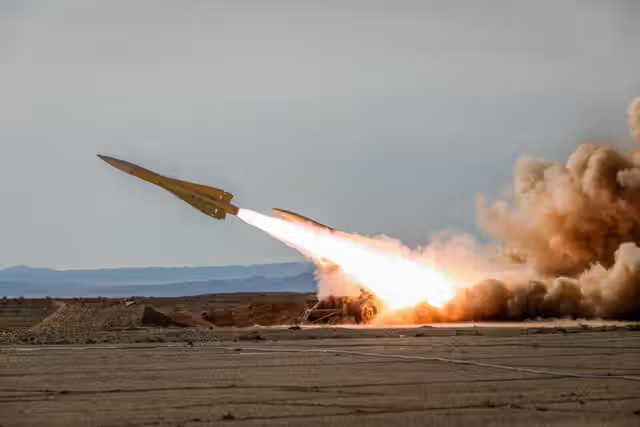
Iran launched a fresh wave of missile and drone attacks against US facilities across the Gulf on Friday. The retaliation followed a sixth consecutive night of American strikes on Iranian military sites.
The renewed fighting has further weakened last month’s truce. Daily attacks and counterattacks have raised fears of a wider regional war involving Gulf states that host American military facilities.
The US military said its latest operation was ordered by President Donald Trump. US Central Command said fighter aircraft, aerial drones and warships used precision weapons against dozens of Iranian targets.
The strikes reportedly targeted coastal surveillance systems, air-defence sites, military logistics infrastructure and maritime capabilities. The US said the operation aimed to further weaken Iran’s ability to conduct military action along its southern coastline.
American weapons struck Qeshm Island and locations near Bandar Abbas. The area contains Iran’s largest commercial port and important naval and Revolutionary Guards facilities along the Strait of Hormuz.
The attacks formed part of a broader US effort to reduce Iran’s ability to monitor, control and target vessels moving through the strategic waterway.
Iranian media reported that several bridges were struck during the latest attacks. Reports also said a railway station in Bandar Khamir and Iranshahr Airport in southeastern Iran were hit.
Iran’s state news agency reported that seven people were killed in strikes on bridges in Bandar Khamir. However, Reuters said it could not independently verify the Iranian reports or casualty figures.
Iran Targets US Facilities Across Gulf States
Iran’s military said it attacked American facilities in Bahrain and Kuwait during the early hours of Friday.
Tehran has also launched missiles and drones towards US military bases in Jordan and other neighbouring countries. Iran says the attacks are retaliation for continued American military operations on its territory.
Several explosion-like sounds were heard in Doha during the latest escalation. Qatar’s defence ministry said its forces intercepted an Iranian missile attack.
The Qatari Interior Ministry reported that a child was injured by shrapnel produced during the interception operation. No deaths were immediately reported in the Qatari capital.
The attacks have increased security concerns in Gulf countries hosting American troops, weapons systems and military command centres.
Bahrain, Kuwait, Qatar and Jordan are important US security partners. Iranian attacks against facilities in those countries risk drawing regional governments more directly into the conflict.
Iran has argued that military sites supporting American operations are legitimate targets. Gulf states, however, face the danger of civilian casualties and infrastructure damage even when Iranian weapons are aimed at US installations.
The latest exchanges come after a memorandum of understanding temporarily reduced hostilities last month. That arrangement has now largely collapsed as both governments accuse the other of violating previous commitments.
Strait of Hormuz Disruption Pushes Energy Prices Higher
The fighting has again severely disrupted shipping through the Strait of Hormuz. The narrow waterway is one of the world’s most important routes for oil and liquefied natural gas exports.
Iran has resumed restrictions on shipping through the strait. The United States has also reimposed its blockade on Iranian ports, adding further pressure on commercial traffic and regional supply chains.
Tehran wants ships crossing the strait to use a route closer to the Iranian coastline. Iran also intends to introduce passage fees after the end of a 60-day negotiation period included in last month’s memorandum.
Washington has encouraged commercial vessels to use a route farther south near Oman. American forces say strikes on Iranian coastal sites are intended to weaken Tehran’s control over shipping.
Iranian Army spokesperson Brigadier General Mohammad Akraminia said attacks on coastal military sites would not prevent Iran from controlling the strait. He argued that Iranian forces could target the waterway from different locations across the country.
Traffic restrictions have already affected global energy markets. Brent crude rose to nearly $85 per barrel on Friday, while US crude increased to almost $80. Both benchmarks had gained close to 12 percent during the week.
Energy traders are concerned that the conflict could disrupt two major maritime routes at the same time.
Iran has reportedly told its Houthi allies in Yemen to prepare to close the Bab al-Mandeb Strait if the United States attacks Iranian power infrastructure. The passage connects the Red Sea with the Gulf of Aden and is another essential route for international energy and cargo shipments.
A simultaneous disruption of the Strait of Hormuz and the Bab al-Mandeb could force ships to take longer and more expensive routes. Such a development could increase fuel prices, freight costs and insurance charges worldwide.
Trump Threatens Further Escalation but Leaves Door Open to Talks
Trump has not ruled out the use of American ground forces. He has also raised the possibility of taking control of Kharg Island, where Iran’s main oil export terminal is located.
The US president has threatened to target Iranian power plants and bridges unless Tehran returns to negotiations. These warnings have increased concerns about attacks on infrastructure used by civilians.
International humanitarian law places restrictions on attacks against infrastructure essential to civilian life. Legal experts have previously warned that deliberate attacks on protected civilian systems could violate the laws of war.
Despite the military escalation, the White House has said Trump remains open to diplomacy. Iran has also indicated that it does not want the conflict to completely destroy the possibility of negotiations.
However, neither side has announced a clear plan for restoring the truce. Continued strikes, maritime blockades and threats against energy infrastructure are making a return to talks increasingly difficult.
The latest fighting has therefore created two parallel risks. The conflict could expand militarily across the Gulf, while disruption to major shipping routes could produce serious consequences for the global economy.

