
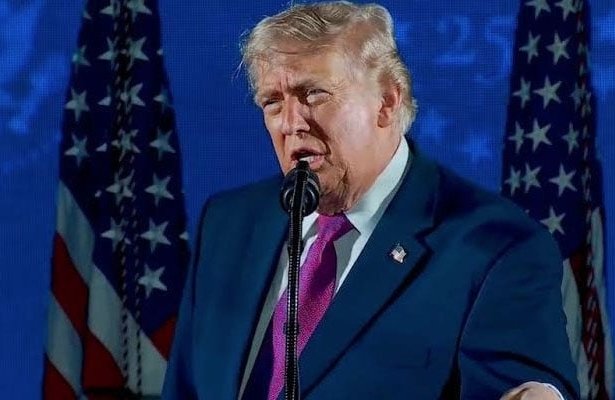

US President Donald Trump has announced that frozen Iranian assets under American control will be used to compensate for damage caused to ships and cargo operating in and around the Gulf.
The announcement came as military tensions between the United States and Iran continued to escalate. Meanwhile, Tehran strongly condemned the proposal, calling it a dangerous step with serious international implications.
At the same time, fresh military strikes, renewed threats to commercial shipping, and rising oil prices have intensified concerns about regional stability.
Trump Announces New Policy on Frozen Iranian Assets
President Trump made the announcement through a post on Truth Social.
He declared:
“Please let this statement serve to represent, until further notice, that from this point forth, any and all damages done to Ships, Cargo, or anything related thereto, will be paid for by Iranian Money that the United States has in its possession, and controls.”
The statement signals a significant shift in Washington’s response to attacks on commercial shipping in the Gulf region.
Iran Rejects Trump’s Statement
Iran reacted swiftly to the announcement.
Iranian Foreign Minister Abbas Araghchi criticized the proposal in a post on X.
He wrote:
“Seizing another nation’s assets to pay for unrelated future claims is an incendiary precedent.”
His response reflects Tehran’s strong opposition to the proposed use of frozen Iranian funds.
Fresh US Strikes Target Iranian Military Sites
Meanwhile, the United States launched another wave of strikes against Iranian military targets early Friday.
The attacks marked the thirteenth consecutive night of military operations in the region.
According to Iranian state media, missiles struck the southwestern city of Ahvaz. Explosions were also reported near Omidiyeh, the port city of Bandar Abbas, and Qeshm Island in the Strait of Hormuz.
The US Central Command (CENTCOM) said the operation targeted threats linked to the Islamic Revolutionary Guard Corps (IRGC).
According to CENTCOM, the strikes “aimed to hold Iran accountable and diminish threats from the Islamic Revolutionary Guard Corps to commercial shipping”.
Shipping Security Concerns Intensify
The latest military action followed new attacks on shipping in the Red Sea.
Iran-backed Houthi forces in Yemen expanded the conflict by launching attacks on oil tankers operating in key shipping lanes.
Following these developments, President Trump warned that both Iran and the Houthis would face further consequences.
He stated that they would receive a “major military punishment”.
The growing security risks have increased concerns over the safety of one of the world’s busiest energy corridors.
Oil Prices Climb Above $100
The worsening security situation immediately affected global energy markets.
Brent crude oil climbed above $100 per barrel for the first time since May after concerns grew over disruptions to international oil supplies.
Analysts linked the price surge to increasing risks surrounding shipping through the Strait of Hormuz and the Red Sea.
World Leaders Express Concern
International leaders also voiced concern over the rapidly escalating conflict.
United Nations Secretary-General Antonio Guterres warned:
“The situation is getting out of control. It is teetering on the edge of the unimaginable.”
He further added:
“One crisis feeds another. One escalation triggers the next.”
Meanwhile, European Central Bank President Christine Lagarde cautioned that rising energy prices could intensify inflationary pressures.
German Defence Minister Boris Pistorius also warned of “dire consequences” for oil-importing economies.
He added that “nothing — absolutely nothing — suggests that a ceasefire, let alone peace, could be reached”.
Conflict Continues After Ceasefire Collapse
The fighting resumed after a brief ceasefire ended earlier this month.
Since then, military operations have continued around the strategically important Strait of Hormuz.
Iran’s military said its response would continue as long as American attacks persisted.
According to military spokesperson Mohammad Akraminia:
“The armed forces’ retaliatory attacks will continue as long as the US attacks on the country’s infrastructure and coastal areas continue.”
Houthis Expand the Conflict
The Houthis have now opened another front by targeting Saudi-linked shipping in the Red Sea.
The group announced attacks on two Saudi oil tankers after declaring a blockade of Saudi ports.
British maritime security authorities also reported that a tanker was struck by an unidentified projectile southwest of Al Shuqaiq, causing a fire onboard.
Saudi Arabia later confirmed that the tanker Encelia had been hit.
The latest attacks have heightened fears that shipping disruptions could spread beyond the Strait of Hormuz.
Regional Tensions Continue to Rise
Iran’s Revolutionary Guards also claimed they had stopped three oil tankers from transiting the Strait of Hormuz as competition for control of the strategic waterway intensified.
Meanwhile, Jordan and Kuwait reported intercepting missiles and drones during the latest escalation.
US Secretary of State Marco Rubio accused Iran of encouraging Houthi attacks on Red Sea shipping.
Speaking on the sidelines of a regional meeting in Manila, he said:
“The Houthis largely were smart and stayed out of all this throughout the conflict, but they now apparently have gotten themselves suckered into this, going after Saudi Arabia and their ships.”
At the same time, Oman confirmed it is working to revive dialogue between Saudi Arabia and the Houthis while expressing “great concern” over the deteriorating security situation in the Red Sea.
As military operations continue and diplomatic efforts struggle to gain momentum, uncertainty across the Middle East remains high. The conflict continues to threaten global shipping routes, energy supplies, and wider regional stability.

