
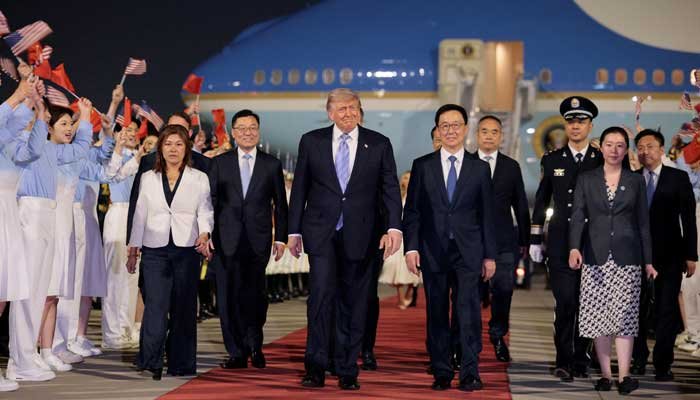

United States President Donald Trump arrived in Beijing on Wednesday for a major summit with Chinese President Xi Jinping. The high-stakes visit comes during rising global tensions, fragile trade negotiations, and uncertainty surrounding the Tehran-Washington ceasefire.
Trump landed in China alongside several powerful business leaders and technology executives. The delegation included Nvidia CEO Jensen Huang and Tesla chief Elon Musk. Their presence highlighted the strong economic focus of the trip.
The summit marks the first visit by a US president to China in nearly ten years. Political experts believe the outcome could reshape global trade, technology cooperation, and international diplomacy.
At the same time, concerns over Iran continue to grow. The ceasefire between Tehran and Washington remains unstable, increasing pressure on both China and the United States to prevent further escalation.
Trump Pushes for Greater Access to Chinese Markets
Trade and business discussions remain the top priority during the Beijing summit. President Trump publicly stated that he plans to encourage China to provide greater access to American companies.
Before arriving in Beijing, Trump praised Chinese President Xi Jinping while stressing the importance of opening Chinese markets to US firms. He specifically pointed to technology and innovation sectors as key areas for cooperation.
Trump wrote on social media that he wants American companies to “work their magic” inside China. He described Xi as a respected global leader but also signaled that trade fairness would dominate discussions.
Several business executives joined the delegation because their companies face major regulatory and market challenges in China. Nvidia remains one of the most closely watched firms during the visit.
The company has struggled to secure approval for selling advanced artificial intelligence chips in the Chinese market. Reports suggest Trump personally invited Jensen Huang to join the delegation shortly before departure.
Meanwhile, Tesla continues expanding its manufacturing and sales operations in China. Elon Musk’s participation added more attention to the economic side of the summit.
US officials also hope to increase exports of aircraft, energy products, and agricultural goods to reduce the trade imbalance with Beijing. China, however, seeks relief from restrictions on semiconductor technology and chipmaking equipment.
Both countries appear eager to preserve the tariff truce agreed upon last year. The agreement temporarily reduced trade tensions after months of economic conflict between the two superpowers.
Iran Conflict and Taiwan Tensions Add Pressure to Talks
Although trade dominates headlines, security issues remain central to the summit agenda. Trump and Xi are expected to discuss the growing crisis involving Iran and the Middle East.
The US president reportedly wants China to encourage Tehran toward a diplomatic settlement with Washington. China maintains strong economic relations with Iran, especially through oil imports and energy cooperation.
Despite this, Trump stated before the visit that the United States does not necessarily require Chinese help regarding Iran. Still, analysts believe Beijing could play an important mediation role if tensions worsen again.
The ceasefire between Tehran and Washington currently appears fragile. Diplomatic uncertainty continues raising fears of renewed conflict across the region.
Taiwan is another major issue expected to dominate discussions. China strongly opposes US military support and weapons sales to Taiwan. Beijing views the self-governed island as part of its territory.
Chinese officials repeated their opposition to American arms packages for Taiwan shortly before Trump’s arrival. Reports indicate that a multibillion-dollar military deal still awaits final approval from Washington.
Experts believe the Taiwan issue may become one of the most difficult parts of the summit. Any disagreement could affect broader US-China relations in the future.
Business Leaders and Global Markets Watch Summit Closely
The global business community is monitoring the Beijing summit carefully. Investors hope the talks will reduce uncertainty surrounding trade and international markets.
Before Trump reached China, US Treasury officials held preparatory negotiations with Chinese representatives in South Korea. Both sides described the discussions as constructive and productive.
The summit schedule includes formal meetings, a state banquet, and cultural events in Beijing. Trump and Xi are also expected to hold several private discussions during the two-day visit.
However, analysts believe Trump enters the talks under political pressure. Rising inflation, global instability, and domestic political concerns continue affecting his administration.
Meanwhile, China faces economic challenges of its own, including weak domestic spending and pressure in the property sector. Still, many experts argue that Beijing currently holds a stronger negotiating position.
Residents in Beijing expressed mixed feelings ahead of the summit. Some hope the talks will improve stability and support international trade. Others remain cautious about future US-China relations.
As the world watches closely, the Trump-Xi summit may shape the direction of global politics, economic cooperation, and security diplomacy for years ahead.

