
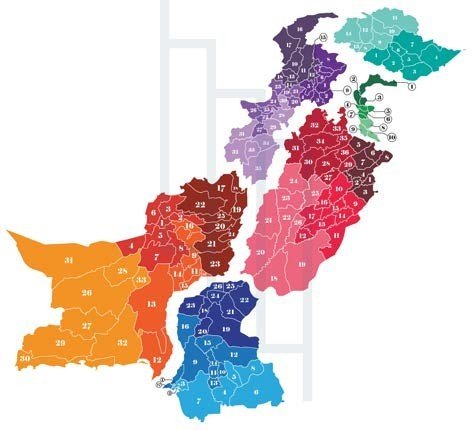

Every major crisis in Pakistan eventually ends with the same conclusion: more resources are needed. More funding for flood relief. More investment in policing. More spending on healthcare, education and infrastructure. Yet despite billions of rupees spent over successive governments, the country continues to confront the same structural failures with alarming regularity.
Every monsoon season exposes overwhelmed institutions. Every terrorist attack revives questions about governance in neglected regions. Every economic downturn highlights widening regional inequalities. Despite the diversity of these challenges, an increasingly influential school of thought believes they share a common denominator—not simply a shortage of resources, but a governance system struggling to manage one of the world’s largest and fastest-growing populations.
That debate has acquired fresh urgency following recent remarks by Interior Minister Mohsin Naqvi, who bluntly declared that Pakistan’s existing administrative system had effectively “collapsed” and argued that governance must be taken “to the level of the people.” His remarks echoed an argument that has gradually moved from academic circles into mainstream policy discussions: a country of more than 241 million people can no longer rely on an administrative framework designed for a vastly smaller nation.
The discussion has also gained momentum after recent observations by DG ISPR Lieutenant General Ahmed Sharif Chaudhry, who has repeatedly emphasised that while security operations remain essential against terrorist organisations, lasting peace depends equally upon effective governance, institutional strength and socio-economic development. His remarks reinforce a growing recognition within Pakistan’s policy and security community that terrorism cannot be addressed solely through military means if governance deficits continue to persist.
For years, The Truth International (TTI) has approached this debate not as a political slogan but as a governance question. Through policy research, special magazine editions and analytical publications, TTI has consistently argued that Pakistan’s administrative architecture deserves serious national discussion, particularly as the country’s demographic, economic and environmental realities have changed dramatically over the past seven decades.
A State Built for Another Era
Pakistan inherited its provincial structure at a time when the country’s population was barely one-quarter of its current size. According to the 2023 Population and Housing Census, Pakistan’s population now stands at approximately 241.5 million, making it the world’s fifth-most populous country.
Yet the federation continues to function through only four provinces.
Punjab alone is now home to nearly 127.7 million people, representing almost 53 percent of Pakistan’s total population. To place that figure in perspective, Punjab’s population exceeds that of many sovereign nations while occupying just over one-quarter of Pakistan’s total land area. At the other end of the spectrum lies Balochistan, covering approximately 44 percent of the country’s territory but home to barely 6 percent of its population.
These numbers are not merely demographic curiosities. They illustrate the extraordinary administrative burden placed upon provincial governments responsible for territories and populations that differ enormously in geography, infrastructure and development needs.
Over the decades, districts and administrative divisions have multiplied to accommodate population growth. Yet the federation’s highest tier of governance has remained virtually unchanged, leaving provincial administrations responsible for increasingly complex responsibilities ranging from policing and education to healthcare, irrigation, environmental protection and disaster management.
Climate Change Has Changed the Debate
If there was one event that fundamentally altered Pakistan’s governance debate, it was the catastrophic floods of 2022.
What began as an exceptionally intense monsoon evolved into one of the worst climate disasters in the country’s history. More than 33 million people—roughly one in every seven Pakistanis—were affected. Ninety-four districts were officially declared calamity-hit. More than 1,700 people lost their lives, millions were displaced, over 1.7 million homes were damaged or destroyed, and agricultural losses stretched across millions of acres.
The economic cost exceeded US$30 billion, with Sindh and Balochistan bearing the greatest burden.
While climate scientists linked the disaster to increasingly extreme weather patterns intensified by global warming, the floods also exposed another uncomfortable reality: administrative capacity had become as critical as physical infrastructure.
In province after province, the challenge extended beyond rising water levels. Relief distribution, inter-agency coordination, damage assessments and reconstruction efforts revealed the enormous difficulty of governing vast territories from distant provincial capitals. Communities located hundreds of kilometres from Lahore, Quetta, Karachi or Peshawar often waited longer for assessments, rehabilitation and public services than districts located closer to administrative centres.
Climate change is now accelerating faster than governance reforms.
Pakistan possesses more than 7,200 glaciers, among the highest concentrations outside the polar regions. Sea-level rise continues to threaten the Indus Delta, while increasingly erratic monsoon systems are expected to intensify flooding, droughts and water insecurity over the coming decades. Studies suggest that by 2050, climate change could displace millions of Pakistanis, creating new pressures on already strained provincial administrations.
Against this backdrop, governance is no longer simply a constitutional or political issue. It has become a climate adaptation issue.
Increasingly, experts argue that resilience cannot be measured solely by the number of embankments constructed or reservoirs built. It must also be measured by the state’s ability to make decisions quickly, coordinate institutions efficiently and deliver services where they are needed most.
That is why administrative reform—once dismissed as a peripheral political debate—is steadily entering the mainstream policy conversation. The question is no longer whether Pakistan needs stronger institutions. The more difficult question is whether those institutions remain organised in a way that reflects the realities of a nation that has quadrupled in population, urbanised rapidly and entered an era where climate shocks and security challenges demand faster, more localised governance.
Can Smaller Administrative Units Deliver Better Governance?
If Pakistan’s governance challenges stem from an administrative structure struggling to keep pace with demographic and geographic realities, the obvious question is what reform should look like.
There is no universal model for organising a federation. Countries design their administrative systems according to their geography, history, population and constitutional evolution. Yet one pattern is remarkably consistent across the world’s major federations: as populations expand and governance becomes more complex, administrative systems evolve alongside them.
Pakistan, however, has largely retained the same provincial architecture it inherited after independence despite experiencing one of the fastest rates of population growth in the world.
Today, Punjab governs nearly 128 million people—more than the population of Japan. Balochistan administers almost 44 percent of Pakistan’s landmass, stretching from the Arabian Sea to the Afghan and Iranian borders, yet remains home to fewer than 15 million people. Sindh simultaneously manages one of South Asia’s largest megacities and vast rural districts with entirely different economic and social realities, while Khyber Pakhtunkhwa combines densely populated urban centres with some of the country’s most remote mountainous regions.
Such diversity is not inherently problematic. The challenge lies in governing these vast territories through provincial administrations that must simultaneously oversee disaster management, policing, education, health services, infrastructure, irrigation, environmental protection and economic development across hundreds of thousands of square kilometres.
The result is a familiar complaint heard across Pakistan’s peripheral regions: decision-making appears distant, resources appear concentrated around provincial capitals, and development often arrives later than expected.
The Distance Between Government and Citizens
In public administration, distance is measured not only in kilometres but also in responsiveness.
When district administrations must wait for approvals from provincial capitals located several hundred kilometres away, bureaucratic delays become inevitable. Whether the issue concerns repairing a washed-away bridge in Chitral, strengthening coastal embankments in Gwadar, expanding hospitals in Bahawalpur or improving irrigation infrastructure in Dera Ghazi Khan, the further decisions travel, the longer communities often wait.
This phenomenon has become increasingly visible during climate-related disasters.
Pakistan’s 2022 floods affected 94 districts across all four provinces, demonstrating that disasters rarely respect administrative boundaries. The scale of destruction exposed weaknesses not only in physical infrastructure but also in institutional coordination. Recovery required multiple provincial departments, federal ministries, district administrations, international donors and humanitarian organisations to operate simultaneously under immense pressure.
As climate change accelerates, these challenges are expected to become more frequent rather than exceptional.
Recent studies assessing disaster resilience across Pakistan’s districts found that more than half scored below average in overall resilience, while institutional and economic capacities varied significantly between regions. These findings suggest that improving resilience will require not only investment in infrastructure but also stronger local administrative capacity capable of responding quickly to emerging crises.
This has led many governance specialists to argue that climate adaptation should no longer be viewed solely as an environmental challenge. It is equally an administrative challenge.
A Debate That Has Been Building for Years
Long before administrative restructuring entered mainstream political discussion, The Truth International (TTI) consistently examined the issue through its research publications and special magazine editions.
Rather than framing new administrative units as an ethnic or regional demand, TTI approached the subject from the perspective of governance, institutional efficiency and national integration. Its central argument has remained consistent: governments function more effectively when they are physically and administratively closer to the people they serve.
This thinking has gained renewed relevance as Pakistan confronts multiple overlapping crises—climate change, rapid urbanisation, fiscal pressures, internal security challenges and widening regional disparities.
One model increasingly discussed in policy circles proposes reorganising Pakistan’s existing administrative divisions into smaller federating units rather than redrawing entirely new boundaries. Because these divisions already function as administrative headquarters, proponents argue that such restructuring could minimise territorial disputes while improving governmental responsiveness.
The objective, they contend, is not to create new identities but to create governments that are better equipped to serve existing communities.
Lessons From Other Federations
Pakistan would not be the first country to adapt its administrative structure to changing national realities.
India inherited 14 states at independence. Today it comprises 28 states and eight Union Territories, with states such as Uttarakhand, Chhattisgarh, Jharkhand and Telangana created primarily to improve governance and administrative effectiveness rather than to redraw the country’s national identity.
Indonesia, another geographically diverse nation confronting natural disasters, has gradually expanded to 38 provinces as governance demands evolved.
Nigeria increased its federating units from three regions at independence to 36 states, partly to improve administrative representation across a large and diverse population.
These examples do not provide a blueprint for Pakistan. Every federation has unique constitutional, political and historical circumstances. They do, however, demonstrate that administrative structures are not static institutions. Successful states periodically reassess whether governance arrangements continue to reflect demographic realities.
The Fiscal Debate
Critics of administrative restructuring raise legitimate concerns.
Creating additional provinces would require constitutional amendments, political consensus and significant transitional planning. New legislatures, administrative secretariats, judicial infrastructure and civil institutions would involve considerable financial costs at a time when Pakistan is already facing fiscal constraints.
Others argue that strengthening local governments could achieve similar outcomes without creating additional provincial administrations.
These concerns deserve serious consideration.
Administrative reform should never become an exercise in expanding bureaucracy or creating new political offices. If restructuring merely reproduces the inefficiencies of existing provincial governments at a smaller scale, the exercise would offer little benefit.
The objective must therefore be institutional efficiency rather than institutional expansion.
A well-designed administrative system should reduce duplication, improve coordination, strengthen accountability and bring decision-making closer to citizens while maintaining fiscal discipline.
Governance Is Becoming a National Security Issue
Perhaps the most significant shift in Pakistan’s policy discourse is that governance is no longer viewed solely through the lens of public administration.
Increasingly, it is being recognised as a national security issue.
Whether discussing terrorism in Balochistan, climate resilience in Sindh, water security in southern Punjab or development in the merged districts of Khyber Pakhtunkhwa, policymakers are returning to the same principle: lasting stability depends upon effective institutions.
Military operations can neutralise terrorist networks, but they cannot replace functioning schools, hospitals, courts, municipal services or responsive civil administrations.
Similarly, billions invested in flood reconstruction will yield limited long-term results if governance systems remain unable to anticipate, coordinate and respond effectively to future disasters.
Security, development and governance are becoming increasingly inseparable.
A Choice That Cannot Be Deferred Forever
Pakistan is projected to approach 330 million people by the middle of this century. Climate change is expected to intensify floods, droughts and heatwaves. Rapid urbanisation will place additional pressure on housing, transport, healthcare and education, while technological transformation will create entirely new governance demands.
Against this backdrop, maintaining the status quo may prove as consequential a decision as pursuing reform.
The debate over administrative restructuring is therefore not simply about drawing new lines on a map. It is about whether Pakistan’s institutions are capable of governing a nation that bears little resemblance to the country that emerged in 1947.
For years, The Truth International has argued that governance reform deserves a central place in Pakistan’s national conversation. Recent remarks by senior civilian and military leadership, coupled with the country’s growing climate and security challenges, suggest that this conversation is no longer confined to academic circles.
The question facing Pakistan is no longer whether governance matters—it unquestionably does.
The real question is whether the country’s administrative architecture can continue to meet the demands of a rapidly changing nation, or whether the time has come to redesign governance itself before future crises make that decision unavoidable.

