

There is a striking irony in world football that continues to draw attention every four years, especially when the FIFA World Cup begins and global audiences focus on the game’s biggest stage. Pakistan, which sits far from football’s elite and has never qualified for a World Cup, still plays a defining role in the tournament through manufacturing rather than competition, and that contribution comes from a single city that has become central to the sport’s global supply chain.
Every goal at the 2026 FIFA World Cup will be played with a football made in Sialkot, which means that every decisive moment, whether it is a last-minute strike or a pressure-filled penalty, will be connected in some way to Pakistan’s manufacturing industry, even if the national team remains absent from the competition itself.
Behind this global presence stands Khawaja Masood Akhtar, a civil engineer by training who once worked for Pakistan Railways before entering an industry he never originally planned to join, and his journey reflects how unexpected paths can reshape entire industries over time.
The Rise of Forward Sports in Sialkot
Khawaja Masood Akhtar founded Forward Sports Private Limited in 1991 in Sialkot with only 20 employees working from a single room, and at that time, the company had no global footprint or recognition in the sports manufacturing sector. Over the next three decades, however, the business expanded significantly and now produces approximately 20.5 million footballs every year, supplying both training and professional-level markets across the world.
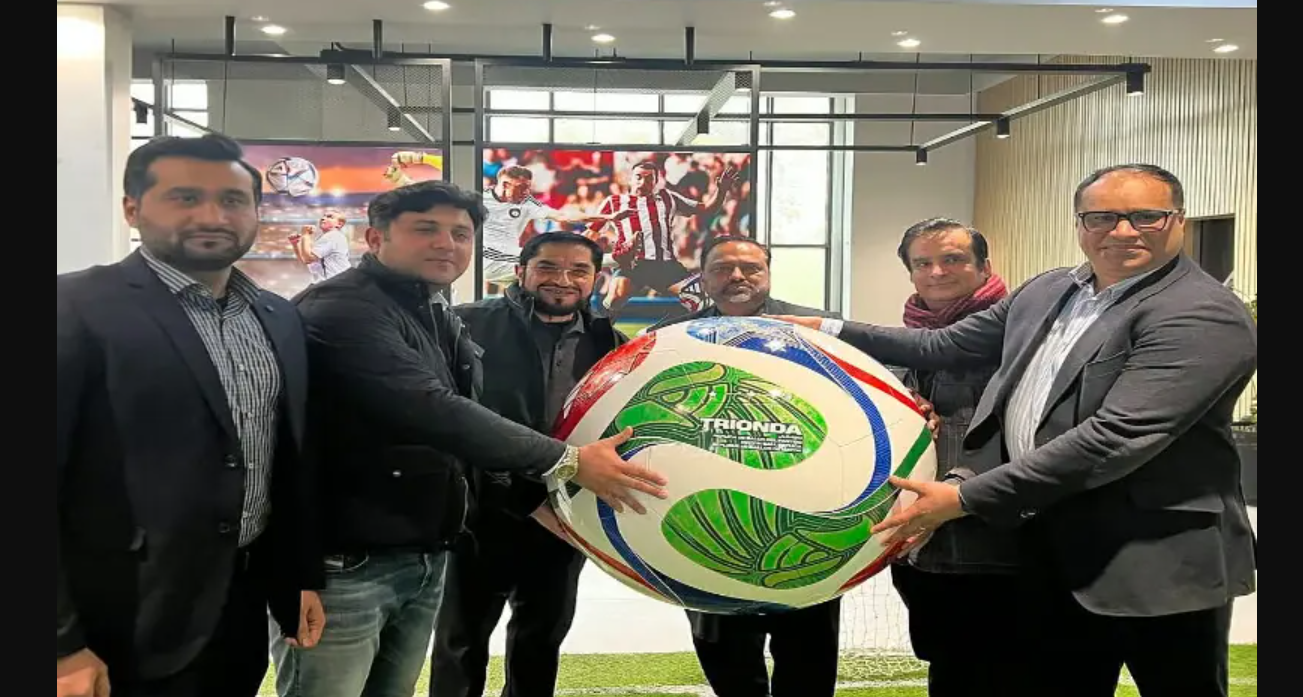
Forward Sports has also achieved a rare milestone in global sports manufacturing by producing official FIFA World Cup match balls for four consecutive tournaments, including Brazuca for Brazil 2014, Telstar 18 for Russia 2018, Al Rihla for Qatar 2022, and Trionda for the 2026 World Cup hosted across the United States, Canada, and Mexico, which highlights its consistent presence at the highest level of international football.
Sialkot as the Global Football Manufacturing Hub
Sialkot has earned the global identity of the “Football Factory of the World” because it produces nearly 70 percent of all footballs used internationally, ranging from professional match balls to training equipment used at grassroots level, and this industrial ecosystem has developed over decades of specialization and export growth.
Pakistan exports around 40 million footballs every year, while nearly 300,000 footballs leave factories in Sialkot daily, and despite this massive output, the city’s contribution to global football often remains underappreciated outside manufacturing and sports industry circles.
Official FIFA World Cup match balls have been produced in Sialkot since 1982, which shows a long-standing relationship between the city’s manufacturers and international football authorities, even though this fact is not widely known among general audiences.
Swiss photographer Stefan Bohrer, who documented the industry, described its scale with clear astonishment, stating, “The sheer scale of football production in Sialkot is astonishing,” and further added, “Knowing that around 300,000 balls leave these factories every day makes you pause and wonder where they all end up. These balls will be kicked, shared, and celebrated by millions of people around the world, carrying with them the passion of the game and the craftsmanship of the people who make them.”
From Civil Engineering to Global Sports Manufacturing
The journey of Khawaja Masood Akhtar into football manufacturing began unexpectedly after his career in civil engineering at Pakistan Railways, when his uncle, already involved in the sports goods business in Sialkot, encouraged him to explore the industry, although he initially had no direct experience in sports production.
“I never imagined I would end up manufacturing footballs,” he said, adding, “I had no experience in the industry, but I had a technical mindset and a close relationship with my uncle, so I accepted the challenge.”
He initially started as a production manager, and over time he built his own company despite facing early challenges, including low production levels of around 1,000 balls per month and strong competition from established manufacturers in the region.
The Breakthrough Through Global Partnerships
The company’s turning point came in 1994 when it partnered with Adidas, which marked a major shift in its growth trajectory and global recognition, and this collaboration helped Forward Sports scale its operations and improve its manufacturing standards.
“A major breakthrough came when Adidas partnered with us.”
“From that point onward, I never looked back. There were setbacks, failures and difficult periods, but with hard work and perseverance, we continued moving forward.”
This partnership not only strengthened production capacity but also positioned the company as a trusted supplier for elite international tournaments, including the FIFA World Cup.
Innovation, Technology, and Manufacturing Evolution
Forward Sports has remained competitive by continuously upgrading its manufacturing technology, starting from hand-stitched footballs and gradually transitioning to thermo-bonded designs in 2007, followed by machine stitching, laminated structures, and modern sensor-integrated football technology used in the Trionda ball for the 2026 World Cup.
The production of a World Cup football typically takes three to four years, involving detailed testing for seam precision, durability, shape consistency, and performance across different environmental conditions, while modern automation and laser cutting technologies have reduced production timelines significantly from nearly 90 days to as low as 15 days.
“Technology changes everything.”
“Football manufacturing was changing too. If we had not adapted, we would have been left behind.”
Akhtar continues to prioritize research and development, visiting the R&D department every morning, and he has repeatedly emphasized that innovation remains a central reason behind the company’s long-term success.
Women in Manufacturing and Workforce Development
A significant part of Forward Sports’ workforce includes women, who contribute directly to production through hand-stitching panels, applying logos and colors, and conducting final quality inspections before global shipment, while the company has also introduced transport facilities and healthcare support to improve working conditions and encourage female participation.
“Women have played a major role in our success.”
“When given opportunities and respect, they deliver outstanding results.”
Conclusion
Pakistan may not yet appear on the World Cup pitch as a competing nation, yet its industrial presence remains deeply embedded in the tournament itself, and Sialkot continues to serve as a silent but essential contributor to global football.
As Khawaja Masood Akhtar summarized, “There is no secret formula behind success.”
“Anything is possible when there is will. Where there is a will, there is a way.”

