
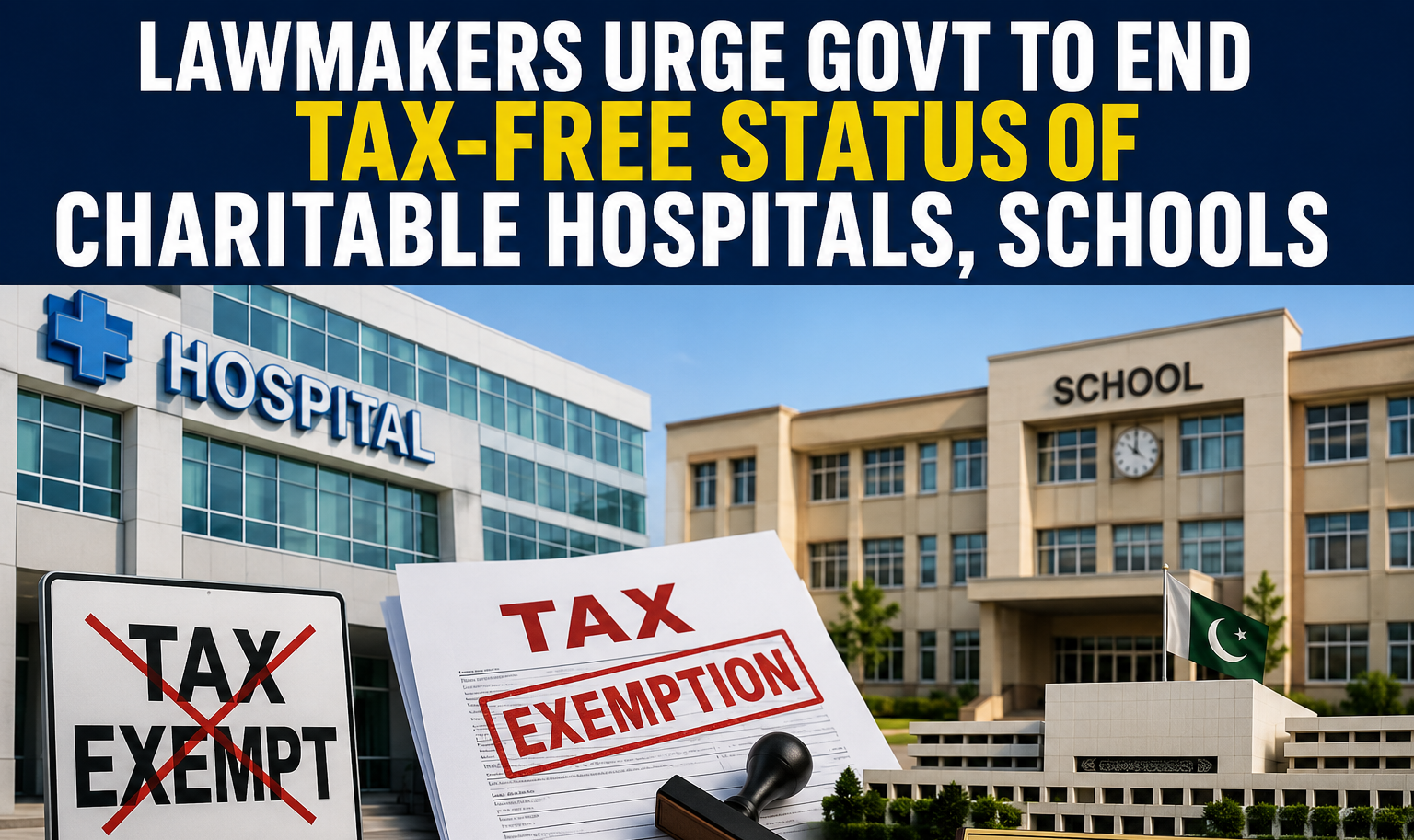

A parliamentary finance committee has reopened debate on Pakistan’s tax structure, particularly focusing on exemptions granted to charitable hospitals and educational institutions. Lawmakers raised concerns that the current system may no longer reflect financial realities or fairness in taxation.
At the same time, members also discussed reducing the cost of education by removing sales tax on stationery items, highlighting a dual focus on relief for families and scrutiny of institutional exemptions.
The discussion signals a broader reassessment of how tax benefits are distributed across social and private sectors.
Push to Remove Tax on Educational Stationery
During the meeting, lawmakers emphasized that education costs continue to rise for ordinary households. As a result, they proposed eliminating sales tax on stationery products.
Senator Mohsin Aziz strongly advocated for relief, arguing that education should not become financially burdensome due to taxation policies.
He urged authorities to bring the sales tax rate on educational stationery items down to zero, stressing affordability as a key concern for families across the country.
His remarks reflect growing concern over inflationary pressure on basic education-related expenses, particularly for lower and middle-income households.
Scrutiny of Tax Exemptions for Charitable Hospitals and Schools
While stationery taxation was one part of the discussion, attention quickly shifted toward institutions operating under charitable or non-profit status.
Senator Farooq H. Naek raised questions about whether hospitals and schools benefiting from tax exemptions are truly operating on a non-profit basis.
He argued that several institutions collect significant fees and additional charges while still enjoying tax concessions under existing laws.
His remarks raised concerns about whether current exemptions are being applied fairly or are being misused by institutions with strong financial inflows.
Concerns Over Cash-Based Revenue and Transparency Gaps
Officials from the tax policy department acknowledged concerns raised during the discussion regarding large cash transactions within some institutions.
They noted that substantial cash collections often remain outside fully documented financial records, raising transparency and compliance issues.
This acknowledgment added weight to concerns that the existing regulatory framework may not be sufficient to ensure financial accountability in all cases.
The issue also highlighted challenges faced by tax authorities in monitoring hybrid financial systems where both documented and undocumented transactions may coexist.
Calls for Stronger Oversight and Reform of Tax Exemption Rules
Committee Chairman Saleem Mandviwalla emphasized the need to revisit tax exemption provisions for charitable institutions.
He noted that earlier recommendations, including proposals to eliminate cash counters at such institutions, had not been implemented.
According to him, resistance from influential stakeholders had slowed down reform efforts in this area.
He stressed that exemptions should not remain permanent without review and called for stronger oversight mechanisms to ensure accountability and transparency.
The chairman’s remarks reflected a broader concern that tax exemptions must align with actual operational practices rather than assumed non-profit structures.
Balancing Education Relief and Tax Fairness
The committee’s discussions highlighted two parallel policy directions.
On one hand, lawmakers pushed for reducing costs in the education sector by eliminating taxes on stationery items. On the other hand, they questioned whether certain institutions continue to deserve tax-free status under current conditions.
This dual focus reflects a broader effort to balance public relief with fiscal responsibility.
Policymakers appear to be weighing whether exemptions are achieving their intended social goals or unintentionally creating uneven advantages within the system.
Potential Impact on Future Fiscal Policy
The proposals discussed in the committee could influence upcoming fiscal decisions, particularly in areas related to education affordability and institutional taxation.
If adopted, changes may affect both consumer-level taxation on school supplies and structural tax exemptions for large institutions operating under charitable labels.
The debate also signals a potential shift toward tighter regulatory oversight and a more transparent tax framework.
As discussions continue, the future of tax exemptions for hospitals and schools remains uncertain, but clearly under renewed scrutiny from lawmakers seeking greater accountability and fairness in the system.

