
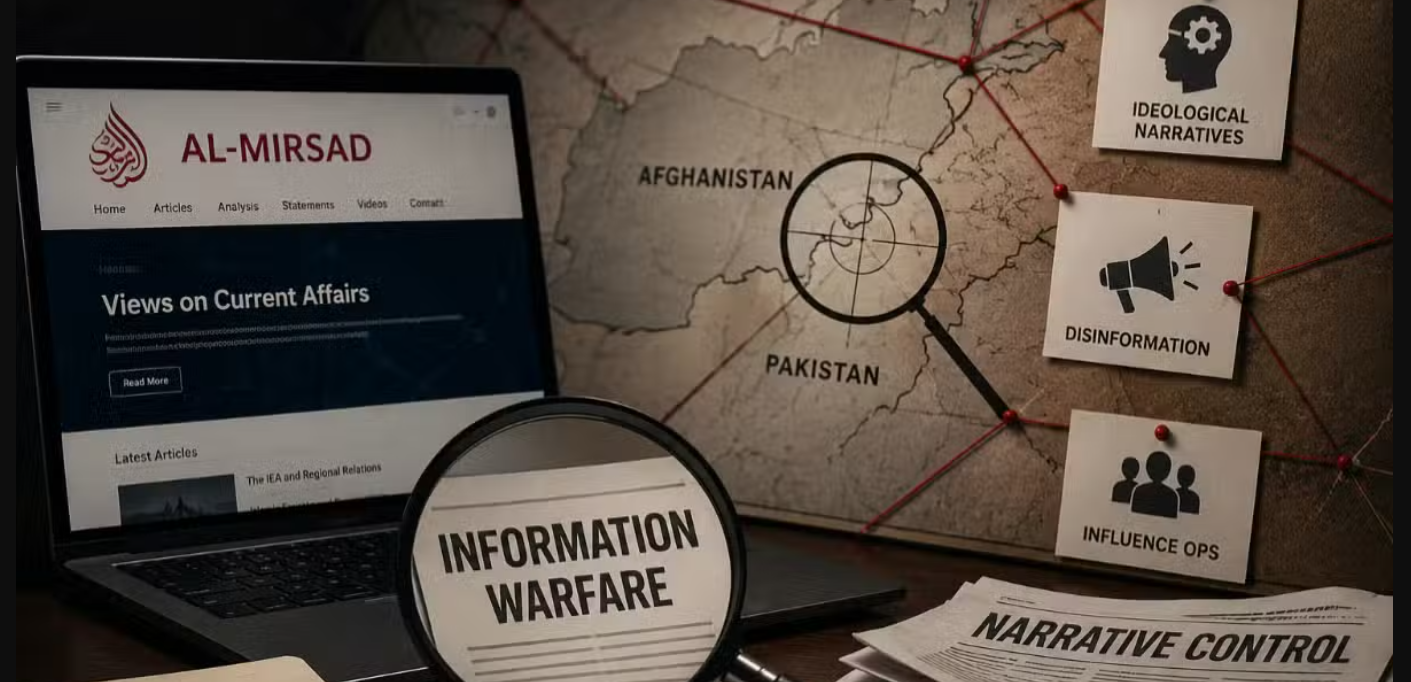

A recent analytical study has examined the role of Al-Mirsad and its position within a broader strategic communication framework reportedly linked to the Taliban authorities in Afghanistan.
Moreover, the report describes the platform as part of a coordinated messaging structure aimed at shaping international perceptions.
The findings are based on a 17-page study authored by researcher Joey Moran, which reviewed English-language publications spanning from January 2025 to March 2026.
Findings Based on Extensive Content Review
According to the analysis, the study evaluated 137 English-language articles published over the specified period.
It argues that Al-Mirsad does not function as an independent media outlet. Instead, it operates as a structured communication channel designed to influence global narratives and political legitimacy.
Furthermore, the report highlights how repeated messaging patterns appear across multiple articles.
Key Objectives Identified in the Report
The study outlines three primary objectives attributed to the platform.
Firstly, it seeks to delegitimize the Islamic State Khorasan Province (ISKP).
Secondly, it aims to reposition Pakistan as a central regional adversary in its narrative framing.
Thirdly, it promotes recognition of the Islamic Emirate of Afghanistan as a sovereign political authority.
Narrative Framing and Information Strategy
The report states that ISKP is frequently portrayed as an externally influenced militant organization.
In addition, ideological labels are used to weaken its perceived legitimacy in international discourse.
At the same time, Pakistan is often presented in a negative context, with claims linking it to regional instability.
Meanwhile, Afghanistan’s governing authorities are described as acting in response to cross-border security threats.
Selective Presentation of International Engagement
Researchers also note that the platform highlights selective diplomatic interactions and recognition narratives.
However, it reportedly omits or reduces coverage of developments that could challenge its political legitimacy.
This selective framing, according to the study, contributes to a controlled narrative environment.
Communication Style and Global Audience Targeting
The analysis further observes that Al-Mirsad combines ideological messaging with modern English-language communication techniques.
As a result, the content appears designed not only for local audiences but also for international policymakers, analysts, and observers.
Moreover, the structured tone and consistent framing suggest a deliberate effort to influence global discourse.
Broader Implications for Regional Information Space
The report concludes that future regional information conflicts are likely to focus heavily on narrative control.
In particular, legitimacy, sovereignty, and perception management are expected to play a central role in digital information environments.
Additionally, it recommends stronger coordinated strategic communication and counter-disinformation efforts by affected states.
Conclusion
The study highlights how modern information platforms may operate as tools of narrative influence in sensitive geopolitical environments.
It also underscores the growing importance of media literacy and strategic communication in shaping regional and international perceptions.

