
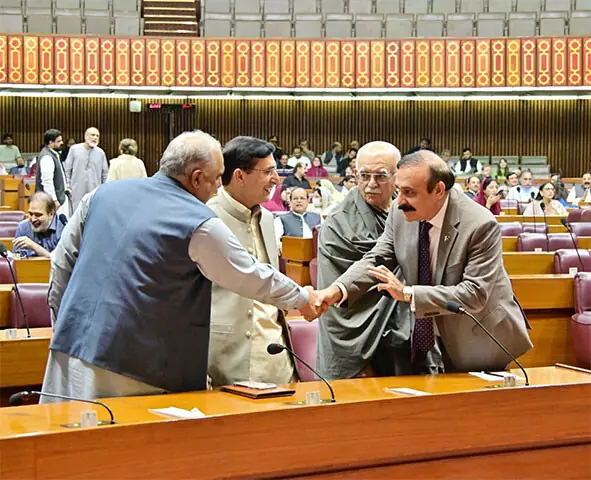

ISLAMABAD: The National Assembly faced an unusual disruption on Tuesday as 43 members spoke on points of order. The development effectively stalled the government’s planned legislative business for the day.
The ruling Pakistan Peoples Party (PPP) raised concerns with the government and prevented the house from moving forward with its agenda. The schedule included 62 items, including 21 bills.
After the disruption, National Assembly Speaker Sardar Ayaz Sadiq allowed members to speak on various public and political issues.
A PPP source said the party would continue withholding support for legislative business until the government addressed its concerns. The session began at 2:17pm instead of its usual 11am start.
The house was later adjourned until 2:30pm on Wednesday. The delay appeared to provide more time for negotiations between the government and the PPP.
PPP Raises Concerns Over Proposed Legislation
PPP members did not allow the government to table reports from standing committees listed on the agenda. When the speaker asked a lawmaker to present a committee report, PPP chief whip Syed Naveed Qamar approached the speaker’s dais.
Qamar requested that the house not proceed with legislative business. The limited attendance of PPP members further indicated the party’s position.
A PPP leader said the party had several grievances against the government. These reportedly included concerns over alleged election rigging in Azad Jammu and Kashmir and non-compliance with agreements in Punjab.
The party also raised issues involving new provinces and proposed legislation. PPP members have also indicated that they will not support constitutional amendments that undermine fundamental rights.
MNAs Demand Debate on Rising Terrorism
Terrorism emerged as one of the major issues discussed during the session. Opposition Leader Mehmood Khan Achakzai urged the speaker to allow a detailed debate on the security situation.
“Here members are highlighting petty problems of their own constituencies, but the main problem is increasing terrorism in the country as about 40 to 50 people, including innocent citizens and law enforcement personnel, are killed every day,” he said.
“Give two or three days specifically to the matter so that all members can speak on terrorism. Maybe we will find the solution.”
PTI MNA Sahibzada Sibghat Ullah also highlighted increasing terrorism in Khyber Pakhtunkhwa. He called for a review of the National Action Plan and said residents in his constituency had taken up arms against militants.
“But it is the responsibility of the state and not the people to fight against terrorists,” he added.
Other lawmakers highlighted security incidents, blocked highways and the impact of terrorism on local communities.
Government Offers Parliament Debate on Security
Minister of State for Interior Tallal Chaudhry said the government was ready to hold a detailed parliamentary debate on terrorism and law and order.
He said lawmakers could discuss all 14 points of the National Action Plan without political blame or point-scoring. He also criticised opposition members for not attending some security-related meetings.
Chaudhry stressed that political forces needed to support security institutions with a unified approach. He also raised concerns about Afghan nationals obtaining Pakistani identity documents through illegal means.
According to him, around 5,000 Pakistani passports obtained illegally by Afghan nationals had been surrendered in Saudi Arabia.
Lawmakers Highlight Medicine Shortages
PPP MNA Sharmila Faruqi raised concerns about shortages of essential and life-saving medicines. She called for immediate government intervention to address the issue.
“Price-revision cases of 105 hardship-category medicines remained pending for more than two years despite recommendations by DRAP’s Drug Pricing Committee. As a result, these medicines could not be marketed,” she said.
Reported shortages include oral morphine, streptokinase injections, cisplatin and carboplatin. Doxorubicin, paediatric digoxin liquid and pilocarpine eye drops are also reportedly affected.
Other medicines include yellow fever vaccines and certain immunoglobulin products.
Faruqi noted that the Cabinet Committee on Drug Pricing approved prices for 52 newly registered life-saving medicines on July 24. She urged authorities to complete final approvals and notifications quickly.
Meanwhile, PPP’s Dr Mirza Ikhtiar Baig raised concerns about loadshedding in Karachi. He proposed a meeting involving the federal power minister, Karachi-based MNAs and K-Electric’s senior management.
Lawmakers Raise Concerns Over UAE Deportations
Several MNAs also criticised the UAE’s treatment of Pakistani nationals following the start of the Middle East conflict. PTI leader Asad Qaisar claimed that hundreds of Pakistanis had been deported.
Defence Minister Khawaja Asif responded by explaining the reported reasons behind some deportations.
“They (deported Pakistanis) had supported a specific country during the war.”
Lawmakers also discussed floods, damaged highways, electricity and gas shortages, poor internet access in remote areas and problems affecting former tribal areas.
The wide-ranging debate highlighted several challenges facing citizens across the country. However, the PPP’s resistance kept the government from advancing its planned legislative agenda, leaving negotiations between the ruling parties crucial for the next sitting.

