
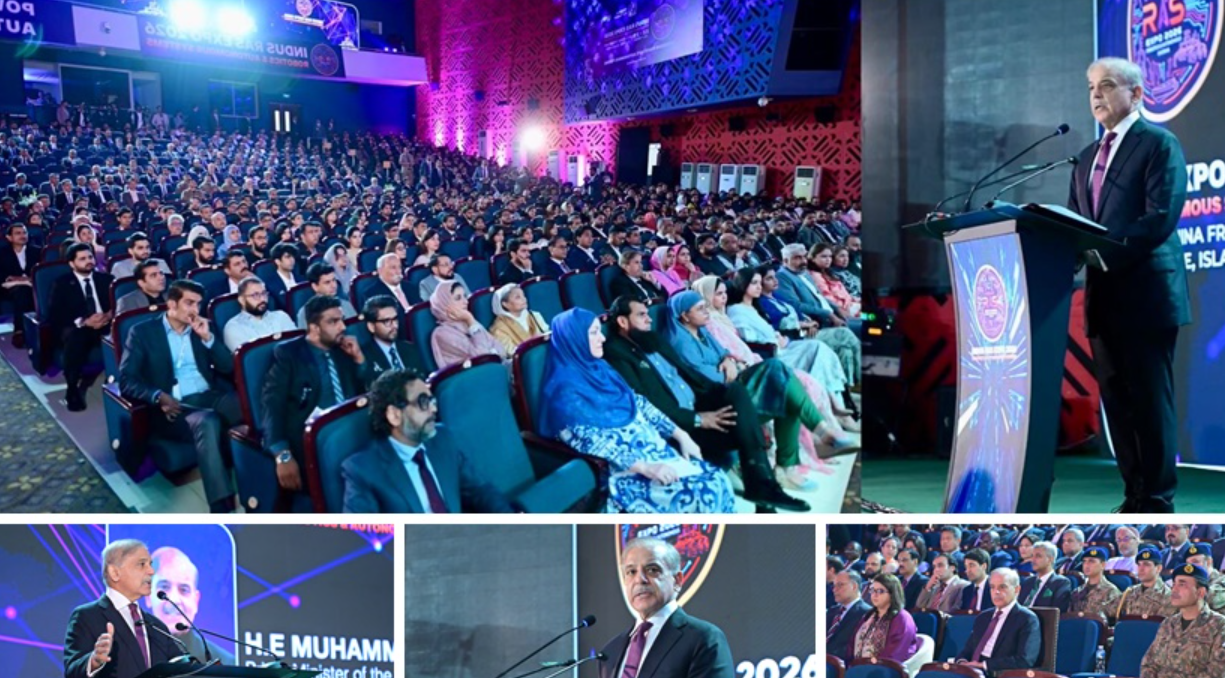

Prime Minister Shehbaz Sharif inaugurated the Indus Robotics and Autonomous Systems Expo 2026 in Islamabad, highlighting Pakistan’s ambition to emerge as a key player in advanced technologies. During the opening ceremony, he said the exhibition reflects the country’s determination to become a leader in innovations that will shape the 21st century.
The prime minister emphasized that robotics and autonomous technologies are transforming industries worldwide. Therefore, Pakistan must strengthen its innovation ecosystem to remain competitive in the evolving global technology landscape.
Robotics to Transform Agriculture and Disaster Response
Addressing the gathering, the prime minister explained that robotics and autonomous technologies can significantly improve Pakistan’s agricultural sector.
He noted that advanced systems enable farmers to detect crop stress at an early stage. Moreover, these technologies help optimize the use of water, fertilizers, and pesticides. As a result, farmers can improve productivity while responding more effectively to climate-related challenges.
The prime minister also highlighted the role of autonomous systems during emergencies. According to him, robotics can improve access to disaster-hit areas and support relief operations more efficiently.
Pakistan Expands Indigenous Technological Capabilities
Shehbaz Sharif said Pakistan has achieved remarkable progress in indigenous technological development, particularly in the fields of defence and security.
He stated that the country’s armed forces, under the leadership of Field Marshal Syed Asim Munir, have successfully adopted advanced technologies developed within Pakistan.
Furthermore, he said several sophisticated simulators are now manufactured and assembled locally. He also noted that drones have achieved more than 60 percent indigenization, reflecting the country’s growing engineering capabilities.
The prime minister praised scientists, engineers, technocrats, and researchers for their contributions to strengthening Pakistan’s technological future.
Innovation Should Benefit Every Pakistani
Referring to the success of Marka-e-Haq, the prime minister said the world witnessed Pakistan’s effective use of advanced autonomous systems to safeguard both physical and cyber frontiers.
He stressed that universities, research institutions, startups, industries, and the farming community must work together to build a strong national innovation ecosystem.
Moreover, he emphasized that technologies developed in Pakistan should remain indigenous, nationally owned, and continuously improved.
The prime minister also called for inclusive technological growth. He said robotics and autonomous systems should benefit farmers, small businesses, women entrepreneurs, young innovators, and underserved communities across the country.
Government Announces New Technology Initiatives
To accelerate innovation, the prime minister announced two major initiatives during the event.
First, he introduced the Spark and Elevate Programme, which aims to transform research into globally competitive technologies, successful enterprises, and high-quality employment opportunities.
In addition, he announced the establishment of the Pakistan Venture Fund with an initial commitment of $20 million. According to the prime minister, the fund will help catalyse investment in Pakistan’s growing technology ecosystem and support innovative startups.
Focus on Safe and Responsible Technology
The prime minister also highlighted the importance of responsible technological development.
He stressed the need to establish clear regulatory and ethical frameworks so autonomous systems remain safe, secure, transparent, and are used solely for the benefit of humanity.
According to him, technological progress must go hand in hand with accountability to ensure long-term public trust.
Pakistan Eyes a Technology-Driven Future
The inauguration of the Indus Robotics and Autonomous Systems Expo 2026 signals Pakistan’s increasing focus on innovation, robotics, and emerging technologies.
With new investment initiatives, expanding indigenous capabilities, and greater collaboration between academia and industry, the government aims to strengthen Pakistan’s position in the global technology landscape while creating opportunities for future generations.

