

Manila Demands Immediate Removal of Controversial Content
The Philippines has filed a formal diplomatic protest against China over a video published by Chinese state-run newspaper China Daily.
Manila described the video as racist, dehumanising and deeply offensive. It demanded the immediate removal of the content from the newspaper’s social media platforms.
The Philippine Department of Foreign Affairs said the video crossed the limits of legitimate political debate. It argued that portraying Filipinos as monkeys was insulting and inconsistent with the respect expected between neighbouring countries.
Philippine Foreign Undersecretary Leo Herrera-Lim raised the issue directly during a meeting with Chinese Ambassador to Manila Jing Quan. He conveyed the government’s strong objection and warned that such material could damage efforts to manage bilateral relations peacefully.
The Philippine Embassy in Beijing also reportedly sent a letter to the editor-in-chief of China Daily. The diplomatic mission demanded that the video and related cartoons be removed immediately.
The controversial video was posted on the newspaper’s Facebook page on July 10. The Philippines said it would not tolerate propaganda that humiliates its citizens or encourages hostility against its armed forces and maritime personnel.
Cartoon Shows Philippines as Monkey Controlled by US and Japan
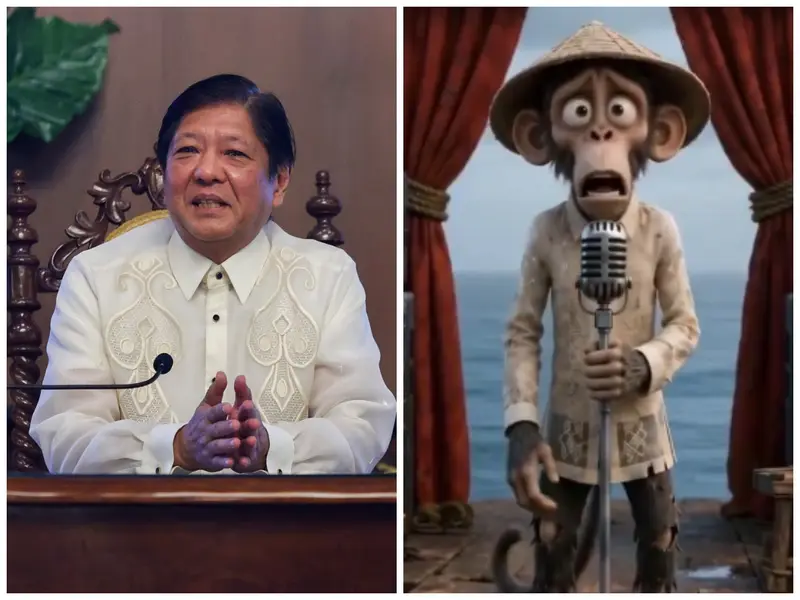
The approximately one-minute animated video depicts a frightened monkey wearing a barong, the traditional formal shirt of the Philippines.
The character is pushed onto a karaoke stage located on a boat. It is then instructed by arms displaying the flags of the United States and Japan.
The monkey initially appears to sing lyrics supporting China’s position on recent maritime talks involving Manila and Tokyo. A voice then tells the character that it is singing the wrong song.
The monkey is handed another sheet carrying the words “South China Sea Arbitration Award.” It is then placed into a catapult and thrown towards a water cannon.
Chinese coast guard vessels have repeatedly used water cannons during confrontations with Philippine ships, sailors and fishermen in disputed waters.
Philippine officials said the video did more than criticise government policy. They argued that it depicted violence against Filipinos and presented the country as weak, unintelligent and controlled by foreign powers.
Defence Secretary Gilberto Teodoro described the material as contemptible propaganda. He said the video exposed what he called the moral failure of a propaganda campaign based on racism, threats and manufactured hatred.
Teodoro also criticised the video for mocking the 2016 international arbitration ruling and appearing to celebrate violence against Philippine citizens and soldiers.
Video Deepens South China Sea Dispute
The controversy emerged during events marking the tenth anniversary of the 2016 South China Sea arbitration ruling.
The tribunal rejected the legal basis for China’s extensive historical claims over most of the strategic waterway. Beijing has refused to recognise the decision and continues to describe it as invalid.
The Philippines maintains that the ruling is final and legally binding. Manila has repeatedly used it to support its claims and challenge Chinese activity in disputed maritime areas.
The Philippine government recently issued a joint statement with 13 other countries, including the United States and Japan, supporting the arbitration decision.
China responded by accusing those countries of distorting facts and using the ruling to attack Beijing’s regional position.
The video appeared to portray the Philippines as acting under instructions from Washington and Tokyo rather than defending its own maritime rights.
Tensions between Manila and Beijing have increased following repeated confrontations involving coast guard vessels, supply missions and fishing communities.
Recent disputes have also involved aggressive ship movements and barriers placed near contested areas, including Scarborough Shoal.
China claims sovereignty over most of the South China Sea. The Philippines, Vietnam, Malaysia, Brunei and Taiwan also have overlapping claims in different parts of the region.
Chinese Embassy Notes Philippine Reaction
A spokesperson for the Chinese Embassy in Manila said it had noted the Philippine government’s response to the China Daily video.
However, Beijing did not immediately announce whether the material would be removed.
The video remained part of a wider propaganda dispute between the two countries. Both governments have accused each other of spreading misleading or offensive content during periods of increased maritime tension.
China previously filed its own diplomatic protest after Philippine Coast Guard spokesperson Commodore Jay Tarriela delivered a presentation containing humorous images of Chinese President Xi Jinping.
The latest dispute shows how online content has become another area of confrontation alongside diplomatic protests and encounters at sea.
Philippine officials stressed that political disagreement should not be expressed through racial insults or dehumanising images.
Manila said such content could encourage hostility and make diplomatic efforts more difficult at a time when both countries need communication to prevent confrontations from escalating.
The diplomatic protest is expected to add pressure on Beijing to address the video while the wider South China Sea dispute remains unresolved.

