
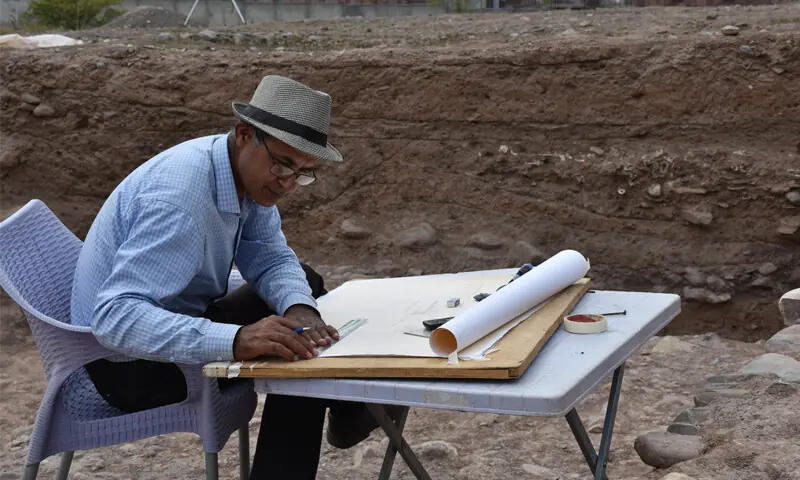

International Award Recognises Study of Medieval Female Rulers
Professor Gul Rahim Khan of the University of Peshawar has received the Oriental Numismatic Society’s Ashoka Prize 2025.
The international honour was announced in London.
The award recognises the best research paper published during 2025 in the Journal of the Oriental Numismatic Society.
Professor Khan received the prize for his paper titled Attribution of Coins to the Queens of the Utpala Dynasty of Medieval Kashmir.
The research appeared in issue 260 of the society’s journal.
His study examines ancient coins linked to women who ruled Kashmir during the medieval Utpala period.
The work offers new evidence about their political authority, governance and historical influence.
Professor Khan said ancient coins should be treated as historical records rather than simple objects of metal.
Coins can preserve evidence about rulers, political systems, economic activity and regional power.
They can also provide information when written historical accounts remain incomplete or silent.
His research challenges conventional narratives that have often overlooked the role of female rulers in medieval Kashmir.
By identifying specific coins with Utpala queens, the study opens new discussion about women’s participation in government and state authority.
Three Decades Dedicated to Archaeology and Numismatics
Professor Gul Rahim Khan is a senior academic in the Department of Archaeology at the University of Peshawar.
He holds a doctorate and specialises in archaeology, ancient coins and South Asian history.
His academic career spans more than three decades.
During this period, he has contributed to university teaching, archaeological fieldwork and research leadership.
His studies have focused on ancient monetary systems, regional trade routes and the history of Gandhara and surrounding areas.
He has also participated in international academic work connected with institutions including the British Museum.
The Oriental Numismatic Society has previously hosted Professor Khan at its academic meetings.
He presented research on excavations at Hayatabad in 2018 and discussed an Indo-Greek archaeological site in the Peshawar Valley in 2019.
His publications are used by researchers studying ancient coins, archaeology and political history.
Numismatic research can help scholars establish the chronology of rulers and identify changes in government.
Coin inscriptions, symbols, portraits, metals and minting techniques can reveal important historical details.
Hayatabad Excavations Strengthened Peshawar’s Archaeological Importance
Professor Khan has also played a major role in archaeological excavations at Hayatabad in Peshawar.
The work uncovered coins, pottery, figurines, beads and other archaeological material.
Researchers also identified evidence connected with early settlement and industrial activity at the site.
These discoveries strengthened understanding of Peshawar’s historical importance.
The region served as an important centre linking Central Asia, South Asia and surrounding trade networks.
Professor Khan said Pakistan’s soil contains valuable chapters of global history.
He stressed that young researchers must be trained to study and preserve this heritage.
Modern scientific methods are essential for documenting archaeological sites and protecting historical objects.
He said international recognition such as the Ashoka Prize demonstrated that Pakistani academic research could meet global standards.
The award highlights the international value of research being conducted at the University of Peshawar.
It also draws attention to Pakistan’s archaeological heritage and the contribution of local scholars to global historical studies.
Professor Khan described the honour as recognition of his long-standing commitment to numismatics.
The prize is also expected to encourage greater research into ancient coins, overlooked rulers and the political history of the wider region.

