
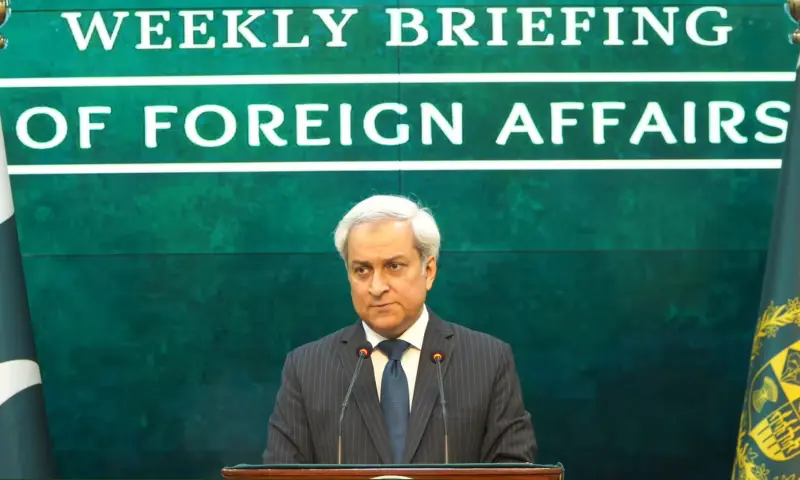

Pakistan has called on the United States and Iran to end ongoing violence and return to technical-level negotiations. The Foreign Office (FO) said diplomatic efforts remain important as the Pakistan-mediated peace agreement faces challenges.
FO spokesperson Tahir Andrabi shared these remarks during a weekly press briefing on Thursday.
Islamabad MoU Faces Implementation Challenges
The Foreign Office spokesperson said the implementation of the Islamabad Memorandum of Understanding (MoU) between the US and Iran is currently facing difficulties.
The agreement was signed last month with the aim of reducing tensions and encouraging dialogue between both sides.
Andrabi stated that Pakistan will continue encouraging all parties to stop violence and restart technical discussions under the MoU and the joint statement issued by Pakistan and Qatar on June 20.
He added that Pakistan hopes all sides will remain committed to diplomacy and peaceful negotiations.
Pakistan Calls for Restraint Amid New Attacks
The statement came as tensions continued between Washington and Tehran.
The United States reportedly carried out strikes on Iranian coastal defence systems and missile sites. In response, Iran targeted American military locations in nearby Gulf countries.
Andrabi urged all parties to show restraint and avoid actions that could further damage regional peace and stability.
He said, “Pakistan firmly believes that there is no alternative to sustained engagement, dialogue and diplomacy in pursuit of the shared objectives of lasting peace, stability and progress.”
Dialogue Remains Only Solution, FO Says
The FO spokesperson emphasized that conflicts and disputes can only find solutions through negotiations.
He described the Islamabad MoU as an important framework for promoting peace, mutual respect, and shared development.
According to Andrabi, continued engagement between countries remains necessary to achieve long-term stability in the region.
Renewed Conflict Raises Concerns Over Peace Deal
Fresh fighting since July 8 has created uncertainty about the future of the Islamabad agreement.
The MoU, signed on June 18, aimed to reopen the Strait of Hormuz and support efforts to end the conflict through further negotiations.
However, renewed military actions have increased tensions across the Gulf region.
Iran has targeted US military facilities in Bahrain, Jordan, and Kuwait, expanding the impact of the conflict beyond the two countries.
Regional Conflict Affects Global Markets
The ongoing tensions have also affected international energy markets.
The conflict began after US and Israeli strikes against Iran on February 28. Since then, instability in the Gulf has increased concerns about energy supplies.
Iran’s restrictions around the Strait of Hormuz have contributed to rising energy prices, creating additional pressure on global inflation.
Pakistan continues to emphasize diplomacy as the preferred path toward resolving disputes and restoring regional stability.

