

Pakistani Students Earn Five Awards in Colombia
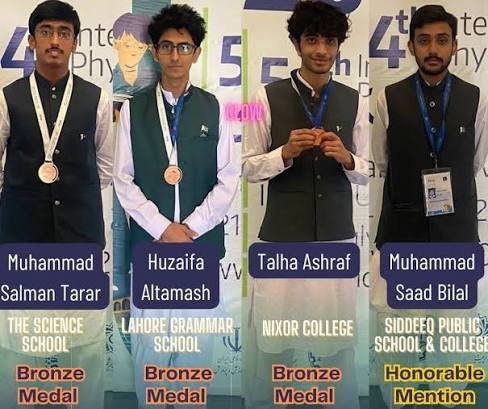
Pakistan achieved a major success at the 56th International Physics Olympiad by winning three bronze medals and two honourable mentions. The global competition was held in Bucaramanga, Colombia, from July 4 to July 12, 2026.
More than 400 outstanding students from over 90 countries took part in the prestigious event. Participants faced demanding theoretical and experimental examinations. The competition tested their knowledge of physics, analytical thinking and problem-solving skills.
Zulfiqar Ali of Government City Boys School in Dera Ghazi Khan won a bronze medal for Pakistan. Ali Hamdan Alvi of FG Sir Syed College in Rawalpindi also secured a bronze medal. Daniyal Shahzad Hamid of The Science School in Rawat, Islamabad, claimed Pakistan’s third bronze medal.
Two other team members also received international recognition. Hazza Mahmood of Aitchison College in Lahore earned an honourable mention. Abdullah Ejaz of Siddeeq Public School in Rawalpindi received the same award for his strong performance.
The results highlighted the ability of Pakistani students to compete against some of the brightest young scientists from around the world. Their success also brought recognition to the schools and institutions that supported their academic development.
Intensive Training Prepared Students for Global Competition
The students were selected through the 22nd National Science Talent Contest. The contest operates under the STEM Careers Programme, which is jointly managed by the Higher Education Commission and the Pakistan Institute of Engineering and Applied Sciences.
A rigorous nationwide selection process was used to identify the strongest candidates. Selected students later attended intensive residential training camps at the PIEAS campus.
During these camps, students received advanced lessons in theoretical and experimental physics. They also completed laboratory exercises, assessments and challenging problem-solving sessions. National and international experts provided specialised guidance throughout the programme.
The preparation helped the students understand the format and difficulty of international science competitions. It also strengthened their confidence before they represented Pakistan in Colombia.
Professor Dr Muhammad Irfan and Dr Muhammad Waseem of PIEAS led the Pakistani team. They guided the students during their training and supported them throughout the international competition.
PIEAS works under the Pakistan Atomic Energy Commission and organises the National Science Talent Contest every year. The programme covers physics, chemistry, biology and mathematics.
Students from Classes 9 and 10, O-Level, FSc Part-I and A-Level Part-I can participate in the national contest. The competition is conducted in 19 cities across Pakistan.
Pakistan Builds Strong Record at Science Olympiads
Top-performing students from the national contest are invited to advanced residential training camps. National teams are selected after several rounds of testing and preparation.
Different institutions provide specialised training for each subject. PIEAS manages the physics programme, while NIBGE-C at PIEAS supports biology training. The HEJ Research Institute of Chemistry at the University of Karachi prepares chemistry students. COMSATS University Islamabad’s Lahore campus manages mathematics training.
Pakistan has participated in the International Physics Olympiad since 2001. The country joined the International Mathematical Olympiad in 2005. It began participating in the international biology and chemistry Olympiads in 2006.
More than 365 Pakistani students have represented the country at International Science Olympiads since the STEM Careers Programme was launched. These students have won a total of 144 medals.
Over 5,000 students have also benefited from more than 256 advanced training camps. These programmes have helped identify and develop talented young scientists from different parts of Pakistan.
The latest medals demonstrate the value of sustained investment in science education. They also show that Pakistani students can perform successfully at the highest international level.
Continued support for science competitions can help Pakistan produce skilled researchers, engineers and technology specialists. Such investment is important for innovation, economic development and the country’s scientific future.

