
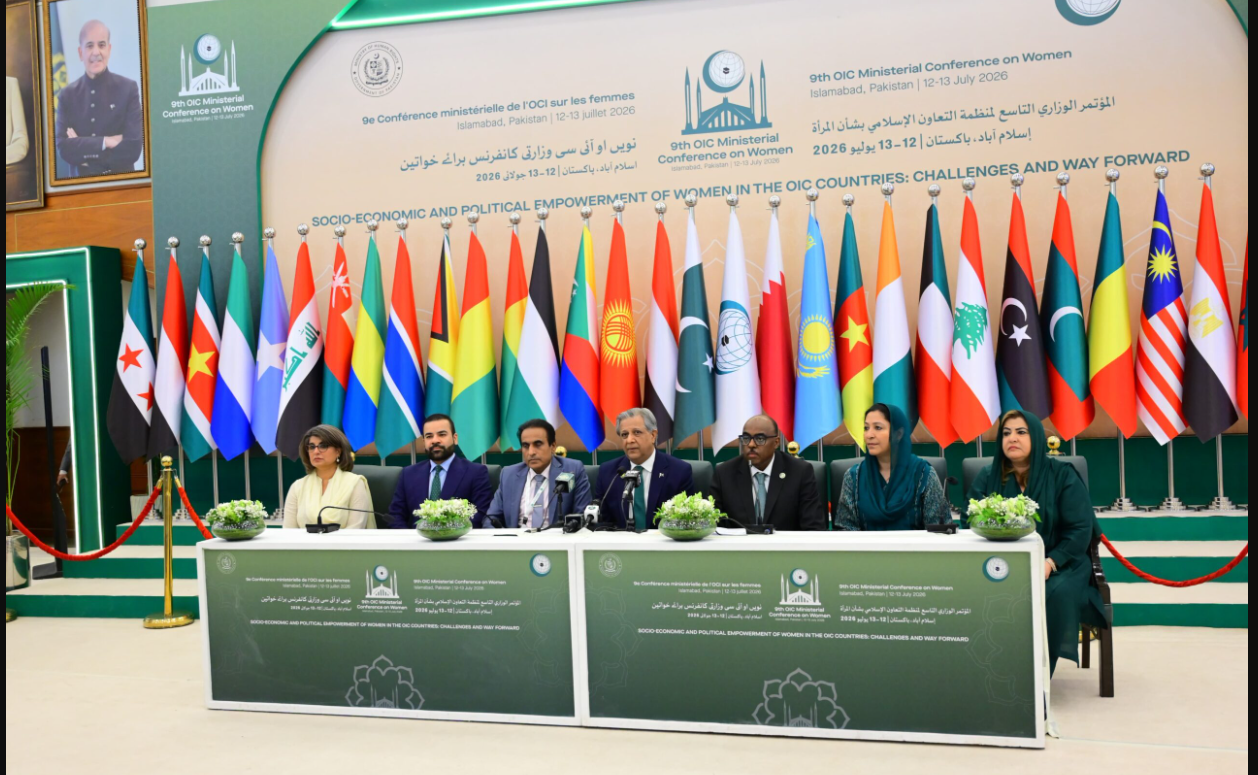

The Organisation of Islamic Cooperation (OIC) has adopted the Islamabad Declaration, reaffirming its commitment to advancing the socio-economic and political empowerment of women and girls across member states.
The declaration was adopted during the ninth Ministerial Conference on Women held in Islamabad. In addition, participating countries launched the Islamabad Initiative on Women’s Digital Inclusion, a new platform designed to expand digital opportunities for women throughout the Muslim world.
Together, the two decisions reflect the OIC’s renewed focus on education, employment, leadership, technology, and women’s participation in public life.
Islamabad Declaration Reaffirms Commitment to Women’s Empowerment
The Islamabad Declaration commits OIC member states to strengthening policies and institutional mechanisms that support women’s meaningful participation in political, economic, and public affairs.
Furthermore, it encourages governments to remove barriers that limit women’s access to education and employment.
The declaration also calls for expanding access to quality education, vocational training, and leadership development programmes.
At the same time, it urges member states to strengthen women’s economic empowerment by improving access to employment opportunities, financial services, entrepreneurship support, and social protection systems.
Greater Focus on Financial Inclusion
The declaration highlights the importance of building inclusive financial systems for women.
Therefore, it encourages member states to promote Islamic finance, microfinance, and digital financial services.
In addition, the declaration supports women-led small and medium-sized enterprises by encouraging better access to capital, innovation, and trade opportunities.
These measures aim to strengthen women’s participation in national economies across OIC countries.
OIC Launches Women’s Digital Inclusion Initiative
A major outcome of the conference was the launch of the Islamabad Initiative on Women’s Digital Inclusion.
The voluntary platform seeks to promote digital literacy among women and girls throughout OIC member states.
It also focuses on digital entrepreneurship, STEM education, artificial intelligence skills, cybersecurity awareness, and equal access to digital technologies.
Moreover, the initiative encourages participating countries to improve affordable digital infrastructure, internet connectivity, access to digital devices, and digital literacy programmes, particularly in rural communities.
Interested member states, OIC institutions, and development partners have also been invited to support the initiative.
Support may include training programmes, scholarships, mentorship opportunities, and the exchange of expertise and best practices.
Declaration Calls for Stronger Protection of Women
The Islamabad Declaration also urges member states to strengthen efforts against all forms of violence targeting women and girls.
These include cyber harassment, online abuse, exploitation, and technology-facilitated threats.
Furthermore, the declaration calls for stronger cooperation to combat Islamophobia, xenophobia, discrimination, and hate speech directed at Muslim women and girls.
Support Reaffirmed for Palestine and IIOJK
The declaration also reaffirmed solidarity with the women and girls of Palestine and Indian Illegally Occupied Jammu and Kashmir (IIOJK).
It called on the international community to provide legal, humanitarian, economic, educational, and psychosocial support to help address their ongoing challenges.
The declaration concluded that empowering women and girls through education, leadership, skills development, and economic participation remains essential for the resilience, progress, and prosperity of OIC societies.
It also expressed appreciation to the Government of Pakistan for hosting the ministerial conference and thanked Prime Minister Shehbaz Sharif for his patronage.
OIC Calls for Effective Implementation
The conference also adopted an omnibus resolution covering a broad range of issues related to women’s development.
Speaking at the closing session, OIC Assistant Secretary-General Ambassador Dr Tarig Ali Bakheet welcomed the adoption of the resolution and described it as an important milestone for member states.
“I commend the spirit of consensus and cooperation that has guided the adoption of this important resolution,” he said.
He also stressed that successful implementation would determine the conference’s long-term impact.
“The real measure of success would not lie in the resolutions adopted but in the collective commitment to implement them effectively and achieve measurable outcomes.”
Dr Bakheet urged OIC member states, institutions, international partners, and other stakeholders to work together to implement the conference’s recommendations.
He added that sustained cooperation and the sharing of successful experiences would help translate commitments into meaningful improvements for women and girls across the Muslim world.
Finally, he congratulated Pakistan on assuming the chairmanship of the Ministerial Conference on Women and reaffirmed the OIC General Secretariat’s commitment to supporting the implementation of the conference’s decisions.
He concluded by praying for greater unity among OIC member states while calling for continued joint efforts to promote the dignity, empowerment, and well-being of women across the Muslim world.

