
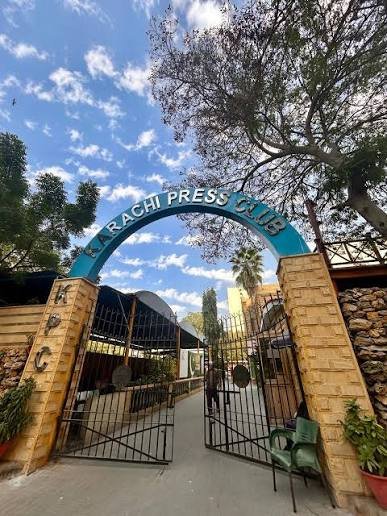

By Humaira Motala
KARACHI: The repeated closure of roads around the Karachi Press Club has once again drawn strong condemnation from journalists’ bodies, who termed it a direct assault on press freedom, the right to peaceful assembly, and constitutional guarantees for protest.
Media representatives warned that blocking access to the city’s premier press institution not only hampers journalistic work but also sends a chilling message to dissenting voices. “When movers and shakers do not allow dissent, it breeds anxiety and mistrust in society,” a senior journalist body representative said.
Karachi Press Club General Secretary Aslam Khan said “the barricading of roads leading to KPC is tantamount to gagging the voice of the people. ”
“The Karachi Press Club has always been a symbol of free expression and democratic protest. Shutting its access roads means shutting the door on public opinion,” he said, urging authorities to immediately restore access and ensure that journalists can perform their duties without fear or obstruction.
Journalists’ organizations cautioned that such measures set a dangerous precedent and called for dialogue instead of restrictions to address public grievances.
He acknowledged that the closures had caused significant inconvenience for journalists and members trying to access the Press Club, describing the situation as “highly deplorable”.
He said the issue had repeatedly been raised with senior police officials and representatives of the Sindh government, but authorities maintained that the restrictions were necessary for security reasons.
The criticism comes amid recurrent road closures around the Karachi Press Club whenever political or religious parties announce protests in the city.
It is to be mentioned that it was the second time on 05 August 2026, during the current week, that the roads heading towards the Karachi Press Club were barricaded as a political party announced their protest.
Responding to repeated sieges of press clubs following the announcement of protests from political and religious parties, said that every Pakistani has a constitutional and legal right to protest and to raise their voice for legitimate demands, regardless of whether they belong to a political or religious party.
He said that if movers and shakers do not allow dissenting voices, it creates anxiety in society. General Secretary PFUJ stressed that no one should be deprived of these constitutional and legal rights. If Section 144 is in force, he said, the law should be applied to those who violate it.
However, preventing people from exercising their lawful right to protest risks provoking tensions, adding that there are numerous examples of such situations escalating.
Replying to a question, A.H Khanzada said the Pakistan Federal Union of Journalists (PFUJ) follows the lead of its affiliated unions on such issues. He said it is primarily the responsibility of the local union to raise its voice against such incidents, after which the PFUJ extends its support.
Former Karachi Press Club president Saeed Sarbazi has condemned the repeated blocking of roads leading to the Karachi Press Club, saying the restrictions undermine freedom of expression and the right to peaceful assembly.
He said the Press Club, long regarded as a symbol of free speech and often described as Karachi’s “Hyde Park” for democratic dissent, was once again cut off after authorities placed containers and buses on surrounding roads to prevent political parties, civil society groups and others from holding rallies and protests.
He said the repeated closures had effectively isolated the Press Club, limiting access not only for protesters but also for journalists, activists and members of the public.
Authorities have imposed similar blockades on several occasions in recent years, citing security and law-and-order concerns.
For decades, the Karachi Press Club has served as a gathering place for political parties, trade unions, human rights organizations, civil society groups and representatives of marginalized communities, providing a platform for those seeking to highlight issues of public concern.
Sarbazi said it was ironic that an institution known for giving space to democratic debate was itself being surrounded by barriers.
He argued that preventing access to the Press Club in order to stop demonstrations weakened a long-standing democratic tradition associated with the institution.
Saeed Sarbazi called for the Karachi Press Club to remain accessible to journalists, protesters and the public.
Liaquat Kashmiri, General Secretary of the Karachi Union of Journalists (KUJ), also condemned the cordoning off of the Karachi Press Club, saying such restrictions had not been witnessed even during periods of military rule.
Criticizing the Pakistan Peoples Party (PPP)-led Sindh government, he said it was unfortunate that measures associated with authoritarian governance were being adopted under a democratic administration.
Liaquat Kashmiri said the Karachi Press Club was the only forum where people from every section of society could peacefully raise their voices, adding that placing such an institution under siege was deeply condemnable and contrary to democratic values.

