
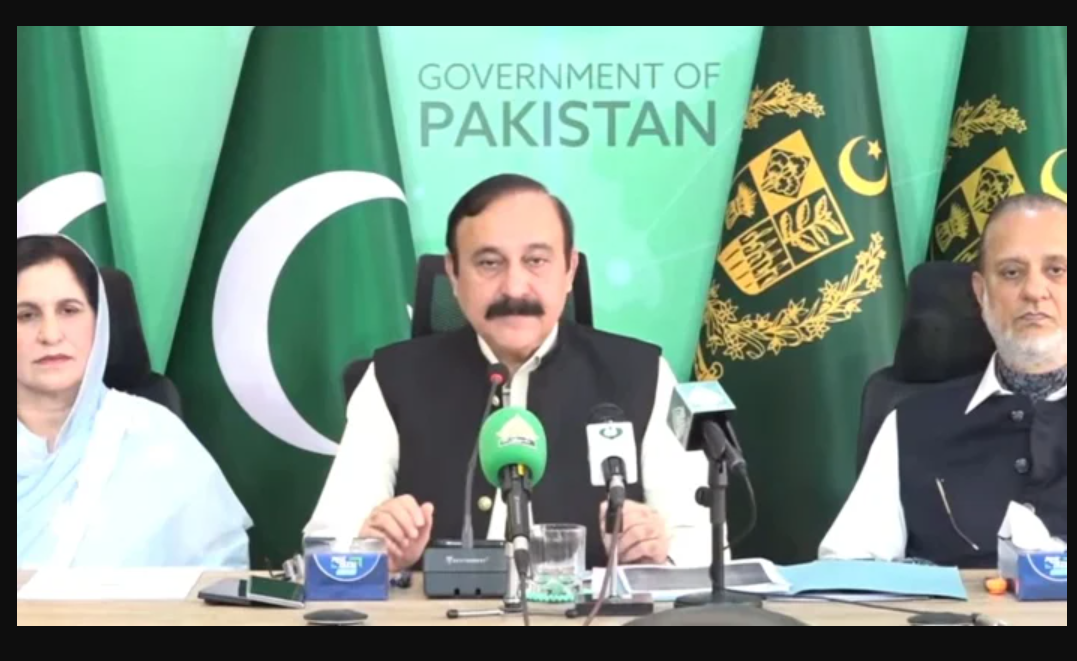

The federal government has accused the proscribed Jammu Kashmir Joint Awami Action Committee (JAAC) of attempting to create instability in Azad Jammu and Kashmir (AJK). Officials claim these actions continue despite the implementation of earlier agreements between both sides.
The statement comes amid rising political tension in the region and renewed calls for protest activity.
Government Claims Agreement Has Been Fully Implemented
Federal Minister for Parliamentary Affairs Dr Tariq Fazal Chaudhry stated that the government had already accepted most demands raised by the group.
He said that Prime Minister Shehbaz Sharif formed a high-level committee to engage in negotiations with JAAC. Additionally, a monitoring committee was established to ensure implementation of agreed points.
According to the minister, all clauses of the agreement have been implemented by the government.
However, he added that the group has still called for protests despite the settlement being carried out.
Allegations of Attempts to Disrupt Stability
Dr Tariq Fazal Chaudhry alleged that the banned group is continuing efforts to destabilise the region. He stated that such actions are being taken even after government compliance with the agreement.
The minister also said that there are attempts to undermine peace and disrupt administrative stability in AJK.
These remarks were made during a press briefing attended by political representatives from the region.
JAAC Declared a Proscribed Organisation
The statement follows a recent decision by the AJK government to declare JAAC a proscribed organisation under anti-terrorism laws.
This decision was taken ahead of a planned protest announced for June 9.
Authorities said the move was necessary in light of past incidents linked to protest activities.
History of Protests and Clashes
The JAAC has previously organised large-scale demonstrations over economic and political issues.
Some of these protests reportedly turned violent. Clashes between protesters and law enforcement led to fatalities in incidents during May 2024 and September 2025.
Officials have referenced these events while explaining the recent restrictions imposed on the group.
Subsidies and Development Claims in AJK
During the briefing, the minister highlighted ongoing development and welfare initiatives in AJK.
He stated that electricity is being supplied at Rs3 per unit in the region. Subsidies on flour and other essential commodities have also been introduced.
Furthermore, he said that steps have been taken to improve infrastructure development across AJK.
The government, according to him, is focused on long-term economic improvement in the region.
Withdrawal of Cases and Relief Measures
Dr Tariq Fazal Chaudhry stated that 170 cases registered during previous protest movements have been withdrawn.
He also said that commitments made to families of those killed or injured during protests have been fulfilled.
These measures, he added, were part of efforts to ease tensions and support reconciliation.
Concerns Over Election Stability
The minister claimed that efforts are being made to disrupt free and fair elections in AJK.
He pointed out that the AJK Legislative Assembly has completed its term. Therefore, preparations for upcoming elections are underway.
However, he expressed concern that certain groups may attempt to influence the electoral process.
Refugee Seats and Constitutional Position
Addressing demands to abolish 12 refugee seats in the AJK Legislative Assembly, the minister said that such changes cannot be made without legislation.
He noted that the court has clarified the constitutional status of these seats.
These seats represent refugees from Indian Illegally Occupied Jammu and Kashmir who migrated after 1947.
Development Projects and Long-Term Plans
The minister also discussed ongoing infrastructure projects in the region.
He said that practical steps have been initiated under agreed development points. However, he acknowledged that large-scale projects such as tunnel construction require time to complete.
He stressed that employment opportunities for local residents would be prioritised in development schemes.
At the same time, he argued that repeated protests are not a suitable approach for long-term development planning.
Conclusion
The government maintains that it has fulfilled its commitments under the agreement with JAAC. However, tensions remain as officials accuse the group of continuing to pursue destabilising actions.
With elections approaching in AJK, the situation remains politically sensitive. Authorities emphasise development progress, while concerns over protests and governance continue to shape the regional landscape.

