
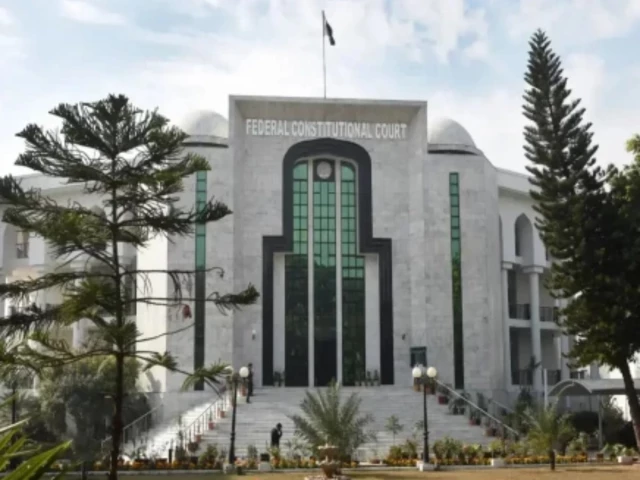

ISLAMABAD: The Federal Constitutional Court’s decision to introduce a digital stopwatch for lawyers has sparked a debate over courtroom efficiency and effective representation.
Chief Justice Aminuddin Khan has directed the installation of a stopwatch in Courtroom No 1. Under the new arrangement, lawyers initially receive 10 minutes each to present their arguments.
The measure aims to make hearings more focused and accelerate the disposal of cases. However, some lawyers have questioned whether strict time limits can work effectively in complex constitutional matters.
The FCC has also faced concerns over its growing workload. Its official website currently lists 23,409 pending cases, alongside 5,869 disposed cases and 5,723 instituted cases.
FCC Introduces 10-Minute Argument Limit
Under the new system, each lawyer receives 10 minutes to address the court. Once the allotted time ends, the stopwatch signals the lawyer that the prescribed period has expired.
However, the court retains discretion to provide additional time where a case requires longer arguments.
In major or complex matters, lawyers may receive up to 30 minutes through a judicial order, according to the reported arrangement.
The FCC says the initiative seeks to improve the use of judicial time and facilitate faster case disposal. The court has also highlighted technology and improved case management as part of its broader institutional development efforts.
Lawyers Divided Over Stopwatch
The new system has received mixed reactions from members of the legal community.
Former law officer Waqar Rana linked the move to the pressure created by the court’s workload. He also argued that the right of audience forms part of the constitutional guarantee of a fair trial under Article 10-A.
Rana said lawyers’ rights should receive greater attention from bar councils and questioned reliance on inexperienced law clerks in preparing judgments.
Meanwhile, lawyer Waqas Ahmad said speedy disposal remains important but argued that constitutional justice cannot be reduced to a stopwatch.
He said counsel should receive a meaningful opportunity to present their cases, particularly when proceedings involve fundamental rights or major constitutional questions.
According to Ahmad, efficiency should support justice rather than compromise effective representation and due process.
Time Management Could Improve Court Efficiency
Supreme Court lawyer Hafiz Ehsaan Ahmad Khokhar offered a more supportive view of the initiative. He described the countdown mechanism as a modern case-management tool that could promote disciplined advocacy and time-bound hearings.
Similar time-management practices exist in constitutional and superior courts in other jurisdictions. However, Khokhar stressed that such mechanisms should assist judges rather than unnecessarily restrict their ability to examine important constitutional questions.
He also pointed to the large number of cases reportedly transferred to the FCC following its creation.
The court was established in November 2025 under the 27th Constitutional Amendment and formally began its constitutional functions on November 13, 2025.
Calls for More FCC Judges
The debate over courtroom time has also revived questions about the strength of the Federal Constitutional Court.
According to Khokhar, the court needs a substantial increase in judicial capacity to handle its growing docket.
He suggested that appointments could include experienced constitutional lawyers and jurists, alongside serving or former judges, within the constitutional framework.
The FCC initially began with six judges appointed alongside Chief Justice Aminuddin Khan. Its official website currently lists seven judges in total, including the chief justice.
Khokhar further suggested that important constitutional questions should ordinarily be heard by benches of at least three judges.
For cases involving exceptional constitutional significance or conflicting interpretations, he said larger benches could provide broader judicial deliberation.
Article 189 Gives FCC Decisions Wider Importance
The composition and functioning of FCC benches carry particular significance because of the court’s constitutional role.
Article 189, as amended in 2025, provides that FCC decisions on questions of law or legal principles are binding on other courts, including the Supreme Court.
Therefore, Khokhar argued that the FCC needs to develop consistent and carefully reasoned constitutional jurisprudence.
He also called for a transparent system governing case fixation, judicial rosters and bench allocation.
Such a framework, he said, would provide greater predictability in the court’s functioning and strengthen institutional confidence.
Questions Over the Court’s Public Perception
Meanwhile, the FCC also faces what some lawyers describe as a challenge of public perception.
The concern partly stems from the circumstances surrounding the appointment of its judges and the nature of cases that may come before the court.
The federal government could become a litigant in several politically sensitive constitutional matters. As a result, some members of the legal community believe that institutional transparency will remain important for maintaining public confidence.
At the same time, the FCC has said it is working to strengthen its judicial and administrative systems.
During its September 15 full-court meeting marking the beginning of the 2026–27 judicial year, the court reviewed its first 10 months of performance and discussed technology, case management and institutional development.
Balancing Speed With Effective Representation
The stopwatch debate ultimately highlights a wider challenge facing the FCC: how to manage a substantial caseload without compromising the quality of constitutional adjudication.
Strict time limits can help lawyers focus their submissions and allow courts to manage hearings more efficiently. However, complex constitutional disputes may require more detailed arguments and judicial questioning.
The FCC has therefore retained the ability to extend speaking time when necessary.
As the specialised constitutional court continues to develop its procedures, the effectiveness of the stopwatch system will likely depend on how flexibly judges apply it.
For now, the debate reflects two competing priorities within the justice system: faster disposal of cases and sufficient time for meaningful legal representation.
For the latest updates, visit and follow The Truth International website (www.thetruthinternational.com) and subscribe to the YouTube Channel.

