
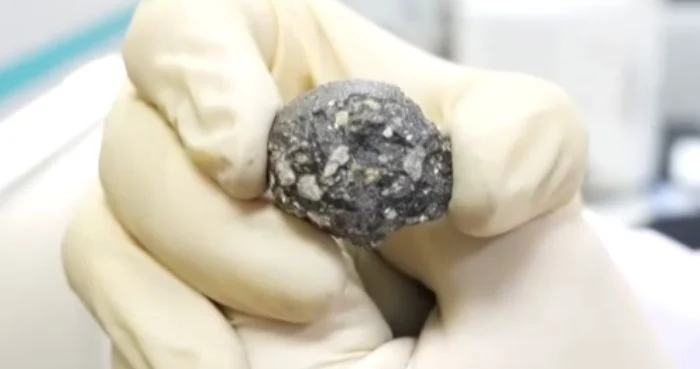

Beijing: Chinese scientists from the China Geological Survey have announced the discovery of a new lunar mineral, officially named Cerium-Magnesium Changesite. The finding marks the 11th identified lunar mineral and represents a significant advancement in space-based geological research.
Properties and composition of the mineral
According to researchers, the newly discovered extraterrestrial mineral appears completely colorless, transparent, and highly brittle. Moreover, it features a glass-like structure and exhibits noticeable fluorescence under specific conditions.
Its grain size measures between three and 25 micrometers, although most particles remain under 10 micrometers. As a result, the mineral is roughly one-twentieth the diameter of a human hair, making it extremely difficult to detect without advanced equipment.
Explaining its formation, associate researcher Che Xiaochao from the Institute of Geology of the Chinese Academy of Geological Sciences stated that the mineral formed under two distinct conditions involving temperature, pressure, and chemical composition. Furthermore, he noted that such discoveries indicate the presence of unique environmental conditions in space that do not exist on Earth.
Scientific significance and applications
Meanwhile, experts confirmed that the mineral was found inside the first lunar meteorite recovered in China. The 44-gram space rock features a dark molten outer shell, suggesting exposure to extreme space conditions during its journey.
In addition, scientists emphasized that identifying new lunar minerals expands understanding of celestial processes and supports the development of synthetic materials. Qu Kai, a member of the Commission on New Minerals and Mineral Names, highlighted that the mineral’s fluorescence could play a role in advanced LED manufacturing.
Consequently, researchers believe its rare-earth composition may provide valuable insights for future material innovation and space science applications.

