
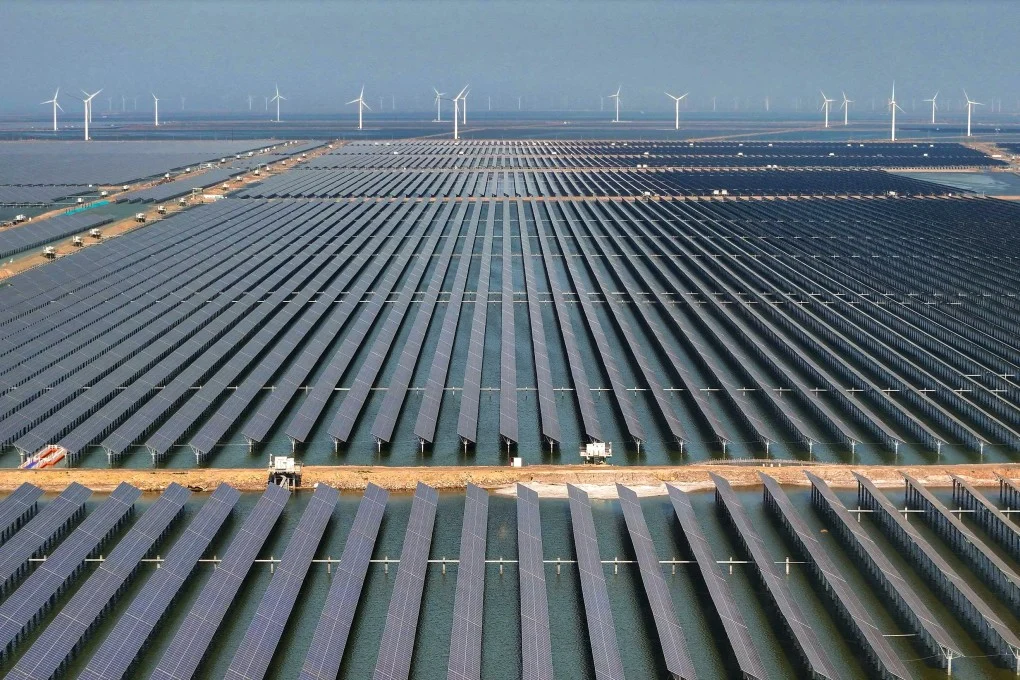

China Curtails 360 TWh of Wind and Solar Power in Six Months
China rejected an estimated 360 terawatt-hours of clean electricity during the first half of 2026 as its power grids struggled to absorb rapidly expanding wind and solar generation.
The amount of curtailed electricity was reportedly enough to power Mexico for an entire year.
Curtailment occurs when electricity generated by wind or solar projects cannot be accepted by the grid because transmission networks have reached capacity or supply exceeds immediate demand.
A new report by Global Energy Monitor and the Center for Research on Energy and Clean Air estimated that China’s renewable power curtailment increased by 49 percent compared with the same period last year.
China is the world’s largest producer of solar power and has added renewable generation capacity at unprecedented speed.
However, analysts say transmission infrastructure has not expanded quickly enough to move that electricity from renewable-rich regions to major centres of consumption.
The problem is becoming increasingly serious as China continues to install large volumes of wind and solar capacity.
Analysts also point to contracts guaranteeing operating hours for newly built coal-fired power plants.
Such arrangements can limit the amount of renewable electricity that grids are able to accept.
Wood Mackenzie analyst Yuan Ren said China’s curtailment problem appeared structural rather than a temporary bottleneck.
He warned that pressure could continue throughout the rest of the decade unless significant changes are made to grid infrastructure and power-market operations.
Official and Independent Curtailment Estimates Show Major Gap
China’s National Energy Administration has published significantly lower curtailment figures than those estimated by GEM and CREA.
According to the regulator, around 8.6 percent of solar generation and 9.1 percent of wind output were curtailed during the first six months of 2026.
However, GEM and CREA estimated that China rejected around 26.1 percent of its combined wind and solar generation during the same period.
The researchers used weather-adjusted calculations to estimate output that may not have appeared in officially reported curtailment data.
The difference between the two estimates highlights uncertainty surrounding the true scale of renewable power wastage.
China’s National Energy Administration stopped publishing monthly provincial curtailment data in March.
The growing problem is also affecting investment decisions.
Developers face greater difficulty estimating future revenue when there is a significant risk that electricity produced by renewable projects will not be purchased or transmitted.
China has also introduced a new policy removing guaranteed fixed prices for renewable electricity.
Together with worsening curtailment, the changes have contributed to a sharp slowdown in solar expansion.
New solar installations in China have reportedly fallen by 66 percent this year.
At the same time, coal-fired electricity generation is expected to increase again in 2026 after declining the previous year.
That potential rebound would reverse the first annual decline in coal power generation recorded in around a decade.
Renewable Developers Turn to Battery Storage as Global Problem Spreads
The growing risk of wasted electricity is pushing renewable investors toward projects that combine solar generation with battery storage.
Battery systems allow electricity generated during periods of excess supply to be stored and released later when grid demand increases.
This can reduce the amount of renewable electricity that must be curtailed.
However, China is not alone in facing the problem.
Curtailment is increasing across several major renewable-energy markets in Asia-Pacific and Europe.
Australia’s National Electricity Market curtailed around 2.93 TWh of wind and solar power during the first half of 2026.
That represented an increase of 37 percent from the previous year and approximately seven percent of total wind and solar generation.
Japan rejected around 2.35 TWh of renewable electricity during the same period.
That was a 34 percent increase and represented roughly four percent of renewable output.
India is also experiencing significant solar curtailment.
The country curtailed approximately 8.13 TWh of solar electricity during the quarter ending in June.
That accounted for around 14 percent of India’s solar output during the three-month period.
The June quarter normally produces higher solar generation in India, which can also increase the amount of power grids are forced to reject.
Energy analysts say electricity networks need major investment to keep pace with rapidly expanding renewable capacity.
Transmission lines, flexible power markets and large-scale energy storage are becoming increasingly important.
Ember analyst Kostantsa Rangelova said faster deployment of batteries could help reduce renewable curtailment worldwide.
She pointed to Chile as an example.
Chile added around four gigawatt-hours of battery storage during 2025, more than doubling its installed capacity.
Much of the new storage was built alongside solar projects, helping those plants retain electricity that might otherwise have been wasted.
Bulgaria has also been cited as an example of how storage and improved grid management can support renewable integration.
The challenge is becoming increasingly important as countries accelerate their transition away from fossil fuels.
Without sufficient grid upgrades and storage, large amounts of newly built renewable generation could remain unused even as electricity systems continue relying on coal and gas.

