
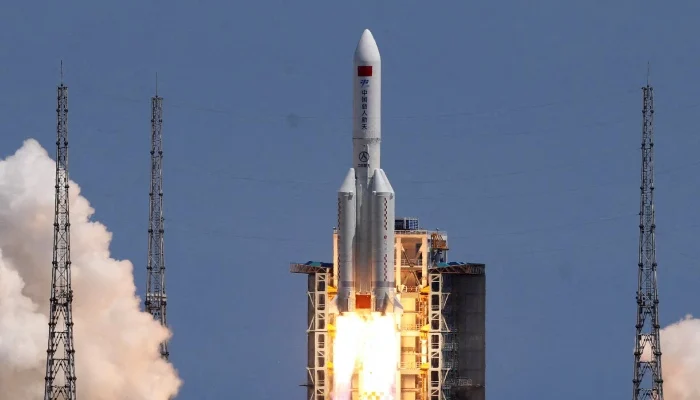

China has successfully tested an experimental rocket retrieval system that uses a net attached to an offshore platform, marking a significant step toward reusable rocket technology.
According to state media, the Long March 10B rocket lifted off from the Hainan commercial space launch site at 12:15pm local time on Friday. About six minutes after its booster separated from the upper stage, the booster returned vertically and successfully landed inside a net mounted on a sea platform.
The achievement marks China’s first successful recovery of an orbital-class rocket. As a result, the country has moved closer to developing reusable launch systems that can reduce the cost of future space missions.
Following the announcement, shares of several Chinese aerospace companies rose sharply, with China Spacesat and China Satellite Communications reaching their daily trading limits.
China Eyes Lower Launch Costs
The Long March 10B, developed by the China Academy of Launch Vehicle Technology, can carry at least 16 metric tonnes into low-Earth orbit. Although experts compare it with SpaceX’s Falcon 9, the Chinese rocket uses landing hooks to catch a net instead of landing on deployable legs.
China has invested nearly a decade in reusable rocket research through hover tests and booster recovery experiments. However, previous recovery attempts by private company LandSpace and the state-owned China Aerospace Science and Technology Corporation failed during the final landing stage.
The successful test could help China reduce launch costs for its expanding commercial satellite programmes. Moreover, the government has eased initial public offering rules to support companies developing reusable rockets.
The Long March 10B also forms part of the Long March 10 family designed for China’s planned crewed lunar missions before 2030. Therefore, the latest test may also support future Moon exploration technologies.

