
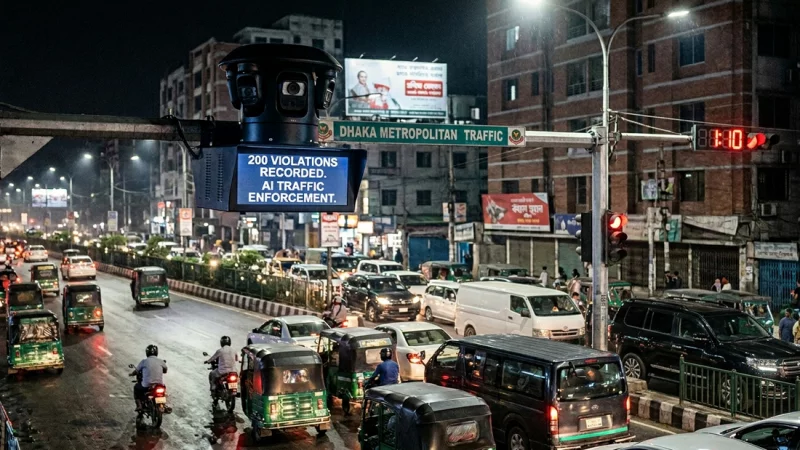

Bangladesh has launched an artificial intelligence-based traffic enforcement system in its capital Dhaka in an effort to tackle extreme congestion and restore order on overcrowded roads. The new system uses existing surveillance cameras combined with AI software to detect traffic violations in real time.
The initiative comes as Dhaka continues to struggle with severe traffic jams involving buses, cars, motorcycles, and rickshaws competing for space. Officials say the goal is to reduce violations, improve discipline, and ease one of the most congested urban transport systems in the world.
AI Cameras Detect Traffic Violations Automatically
Police officials said the AI system is integrated with existing traffic-monitoring cameras across key roads. The software automatically identifies violations such as signal jumping, illegal parking, and lane misuse.
The system sends instant alerts when a violation occurs. Vehicle owners then receive automated fines or warnings through digital notifications.
Authorities say the technology reduces direct confrontation between police and drivers. In the past, manual enforcement often led to disputes, resistance, and unsafe encounters on the road.
Traffic officers report that compliance levels have improved since the system was introduced. Drivers are becoming more cautious as surveillance coverage expands across the city.
Early Results Show Behavior Change Among Drivers
Police data shows that hundreds of violations have already been recorded since the AI system was activated. Officials confirmed that more than 300 vehicles have been fined so far under the automated system.
A traffic police spokesperson said the system is already producing measurable results in improving road discipline. Drivers who previously ignored signals are now following rules more carefully due to constant camera monitoring.
One motorist said he received a fine after running a red light, even though he was not stopped physically by police. The automated alert was sent directly to the vehicle owner, showing how digital enforcement is replacing traditional roadside checks.
Authorities believe this system will gradually reduce reckless driving behavior and improve overall traffic flow in the long term.
Challenges Remain Despite AI Integration
Despite early success, officials admit the system still faces technical and operational challenges. Poor visibility of number plates and low-quality images sometimes make identification difficult.
Experts also say enforcement must be consistent to achieve long-term results. Without strict application of rules, technology alone cannot solve Dhaka’s traffic crisis.
The system currently focuses on motor vehicles, while regulation of rickshaws remains under review. Authorities are also planning additional upgrades, including detection of sidewalk driving and more advanced monitoring tools.
Traffic experts say sustained policy enforcement, public discipline, and infrastructure upgrades will be necessary alongside AI deployment to fully address Dhaka’s congestion problem.

