
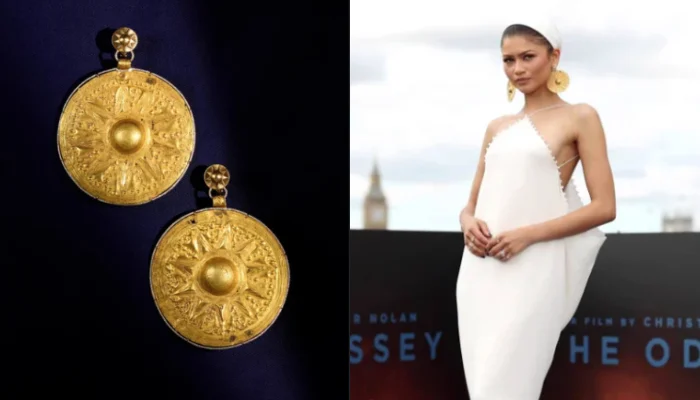

Ancient Iranian Gold Discs Worn at London Event
Zendaya has faced online criticism after wearing earrings containing ancient gold objects during a London promotional event for Christopher Nolan’s upcoming film, The Odyssey.
The actress wore the jewellery at an official London photocall ahead of the film’s premiere. The earrings featured genuine gold discs believed to be between 2,000 and 3,000 years old.
The ancient pieces reportedly date to the first millennium BCE. They are described as Ziwiye gold medallion plaques originating from ancient Iran.
British jewellery designer Glenn Spiro incorporated the historic discs into a contemporary design. They were mounted in 18-karat yellow gold and surrounded by diamonds.
The discs feature engraved sun motifs. The jewellery was sourced by Barron London, a Mayfair dealer specialising in antique jewellery, historic objects and valuable collectables.
Zendaya’s jewellery matched the ancient-world theme of The Odyssey. She portrays Athena in the film, which is scheduled for theatrical release on July 17, 2026.
However, attention quickly moved away from the actress’s fashion and towards questions about cultural heritage, ownership and the use of genuine archaeological objects as luxury accessories.
Experts Question Origins and Ownership History
Archaeologists and cultural heritage commentators questioned whether the ancient discs had a clearly documented ownership history.
This history is known as provenance. It records where an object was discovered, who owned it and how it moved between countries, dealers and private collections.
Critics said the publicly available descriptions did not provide a complete account of how the objects left Iran or entered the international antiquities market.
An archaeology content creator argued that the lack of detailed provenance created concerns that the objects may have been removed unlawfully. However, no publicly available evidence cited in the reports conclusively established that the discs were looted.
The difference is important. Questions about an object’s ownership history do not automatically prove illegal excavation, smuggling or theft.
Heritage specialists often demand clear documentation because ancient objects without reliable archaeological records can be difficult to trace. Their removal from original sites may also destroy valuable historical information about the societies that produced them.
Some critics asked why replicas were not used instead. They argued that modern copies could have created the same visual effect without turning genuine cultural objects into celebrity fashion accessories.
Others described the jewellery as an example of wealthy collectors and celebrities using the ancient heritage of other countries to display status and exclusivity.
Jeweler Says Artefacts Were Not Damaged
Barron London responded to the controversy by saying the earrings were not intended for sale and remained part of its private collection.
The company said the gold discs were secured through a simple, non-invasive claw setting. According to the dealer, the mounting process was designed to preserve the ancient objects without permanently changing or damaging them.
This response addressed concerns about physical damage but did not completely end the debate.
Critics said the main issue was not only whether the objects had been altered. They argued that the public also deserved clear information about where the artefacts came from and whether their removal and sale complied with cultural heritage laws.
Supporters of the design said historic objects have frequently been incorporated into jewelry and private collections. They viewed Zendaya’s earrings as a creative connection between the ancient world and modern fashion.
The controversy has highlighted a wider disagreement over whether archaeological objects should remain in museums, be returned to their countries of origin or be allowed to circulate through private collections.
Debate Expands Beyond Zendaya’s Fashion
Zendaya has not been accused of personally acquiring or removing the objects from Iran. The criticism has instead focused on the jewellery’s suppliers, its ownership history and the decision to wear ancient artefacts at a celebrity event.
The actress and her representatives had not issued a detailed public response to the provenance concerns covered in the available reports.
The debate also reflects growing scrutiny of museums, auction houses, private collectors and luxury brands that possess objects linked to countries affected by colonisation, conflict or illegal excavation.
Cultural heritage campaigners argue that ancient objects should not be treated simply as decorative materials. They say such pieces represent the history and identity of modern communities connected to the civilisations that produced them.
Others believe privately owned artefacts can be preserved and displayed responsibly, provided their ownership is legal, their provenance is documented and the objects are not damaged.
Zendaya’s appearance has therefore become part of a much larger discussion. The controversy is no longer only about a red-carpet outfit. It concerns who owns the past, who is allowed to profit from it and how ancient cultural objects should be treated in the modern luxury market.

