
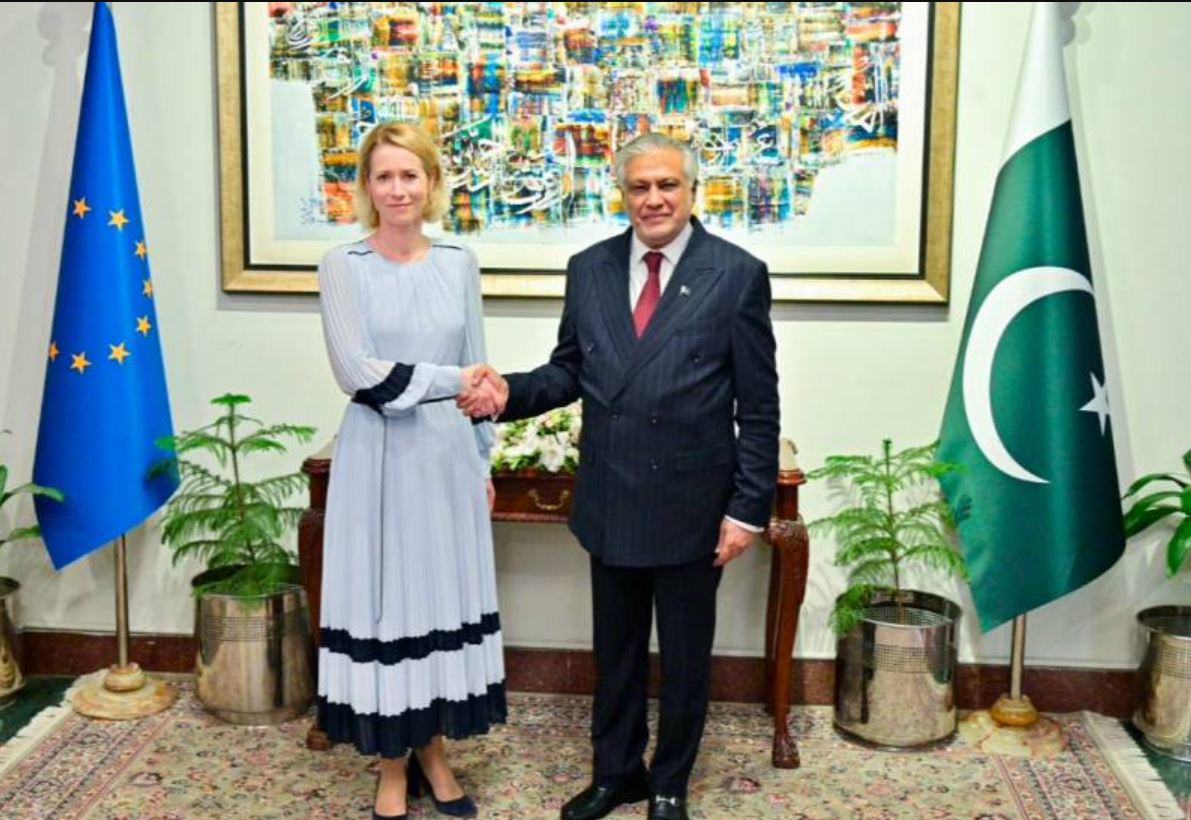

Pakistan and the European Union have reaffirmed their commitment to strengthening bilateral relations and transforming existing cooperation into a broader and more mutually beneficial partnership.
The commitment was expressed during the 8th Pakistan-EU Strategic Dialogue held in Islamabad, where both sides reviewed progress across a wide range of sectors and discussed opportunities for future collaboration.
Deputy Prime Minister and Foreign Minister Ishaq Dar and European Union High Representative for Foreign Affairs and Security Policy Kaja Kallas co-chaired the dialogue, which is regarded as the highest institutional forum between Pakistan and the European Union.
During the discussions, both sides emphasized the immense potential that exists for expanding cooperation in trade, investment, development, security, climate resilience, digital infrastructure, migration, and people-to-people exchanges.
Ishaq Dar Highlights Importance of Strategic Dialogue
Addressing a joint press interaction after the meeting, Ishaq Dar described the dialogue as a key platform for advancing Pakistan-EU relations and strengthening institutional engagement.
He noted that the previous strategic review had taken place in Brussels only a few months earlier, making it the shortest interval between such engagements in the history of Pakistan-EU relations.
According to Dar, both sides reviewed progress under the Pakistan-EU Strategic Engagement Plan 2019, focusing on areas including trade and investment, human rights, the rule of law, migration, mobility, security, and counter-terrorism cooperation.
He also highlighted the importance of economic cooperation, describing the GSP+ framework as a successful arrangement that has benefited both Pakistan and the European Union.
Furthermore, he stressed the need to continue expanding trade and investment opportunities in order to unlock the full potential of the relationship.
Regional and Global Issues Also Discussed
The dialogue extended beyond bilateral matters and included detailed discussions on several regional and international developments.
Both sides exchanged views on the situation in the Middle East, the US-Iran conflict, developments in Afghanistan, security challenges in South Asia, and broader international concerns.
Dar thanked the European Union for acknowledging Pakistan’s diplomatic efforts aimed at easing tensions between the United States and Iran.
He also reiterated Pakistan’s position on the Jammu and Kashmir dispute and emphasized the importance of resolving the issue according to the wishes of the Kashmiri people and relevant United Nations resolutions.
Additionally, he referred to Pakistan’s stance on the Indus Waters Treaty, noting that a supplementary award by the Court of Arbitration had reaffirmed limits on India’s control over the western rivers governed under the treaty.
Pakistan Raises Security Concerns
During the discussions, Dar highlighted Pakistan’s security concerns regarding militant groups operating from Afghan territory.
He emphasized the need for stronger international cooperation to address terrorism and stressed the importance of adherence to the United Nations Charter and the principles of multilateralism.
According to Dar, regional peace and stability require collective efforts and a rules-based international order that respects sovereignty and international law.
Kaja Kallas Calls Pakistan an Important Partner
In her remarks, Kaja Kallas described Pakistan as a major regional power and an important partner for the European Union.
She highlighted the significance of economic ties, noting that the European Union remains Pakistan’s largest export destination and that Pakistan continues to be the world’s leading beneficiary of the GSP+ scheme.
Kallas emphasized that the relationship extends beyond trade and serves as an important driver of economic growth and development.
She also acknowledged Pakistan’s diplomatic role in facilitating engagement between the United States and Iran.
Expressing appreciation for these efforts, she said they had helped prevent a wider conflict in the region and contributed to ongoing diplomatic engagement.
Referring to the broader regional situation, Kallas stated that Pakistan has the right to defend itself and its people in accordance with international law.
Expanding Cooperation Beyond Trade
While trade remains a cornerstone of the relationship, both sides agreed that future cooperation should encompass a much wider range of sectors.
Discussions focused on strengthening collaboration in climate resilience, renewable and clean energy, digital infrastructure, migration and mobility, and educational exchanges.
Particular attention was given to people-to-people connections, including the Erasmus Mundus scholarship programme, where Pakistan continues to rank among the leading participating countries.
Kallas also underlined the importance of promoting free and fair trade while developing sustainable connectivity and investment opportunities that can benefit both partners.
Strategic Vision for Future Relations
Earlier during the dialogue, Dar highlighted the importance of the EU Strategic Vision as a framework for deepening political understanding and strengthening institutional ties.
He explained that the vision builds upon the Strategic Engagement Plan 2019 and the Cooperation Agreement signed in 2004, providing long-term direction for future cooperation.
According to him, the continuation of the Strategic Dialogue demonstrates a shared commitment to building a forward-looking partnership capable of addressing emerging regional and global challenges.
Conclusion
The 8th Pakistan-EU Strategic Dialogue underscored the growing importance of relations between Islamabad and Brussels, with both sides expressing a strong desire to deepen cooperation across multiple sectors.
As the European Union described Pakistan as a major regional power and an important partner, the discussions reflected a shared commitment to expanding trade, strengthening security cooperation, promoting sustainable development, and addressing common regional and global challenges.
With both sides determined to build on existing momentum, the dialogue has laid the groundwork for a stronger and more comprehensive partnership in the years ahead.

