
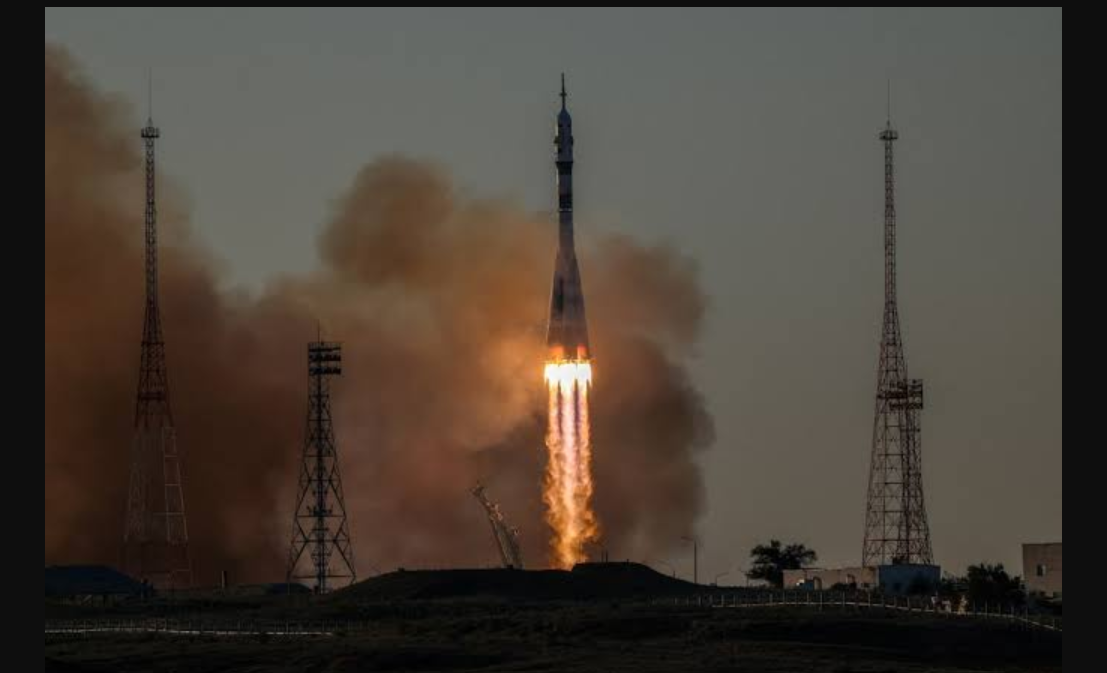

Russia successfully launched two cosmonauts and one American astronaut to the International Space Station (ISS) on Tuesday. The mission marked the return of crewed flights from the recently repaired Baikonur Cosmodrome launchpad in Kazakhstan. It also highlighted the continued cooperation between the United States and Russia in space exploration despite ongoing geopolitical tensions.
The Soyuz MS-29 spacecraft lifted off at 10:47 a.m. EDT (1447 GMT) from Baikonur Cosmodrome. Onboard were NASA astronaut Anil Menon and Roscosmos cosmonauts Pyotr Dubrov and Anna Kikina. The trio will spend about eight months aboard the ISS as part of the station’s 75th crew rotation.
Just over three hours after launch, the spacecraft successfully docked with the orbiting laboratory. At the time of arrival, the ISS was passing over the Mediterranean Sea. The new crew joined three American astronauts, two European astronauts, and two Russian cosmonauts already living and working aboard the station.
NASA and Roscosmos Chiefs Attend the Launch
The mission attracted significant attention because senior officials from both space agencies attended the launch together. NASA Administrator Jared Isaacman traveled to Baikonur to meet Roscosmos Director Dmitry Bakanov before witnessing the launch.
The visit marked the first time since 2018 that a NASA chief attended a launch from Russia’s historic spaceport. In recent years, tensions linked to the Russia-Ukraine conflict had largely prevented such high-level visits.
Expedition 75 Begins for the New Crew
The Expedition 75 mission is especially significant for NASA astronaut Anil Menon. At 49 years old, he completed his first journey into space after years of preparation.
Following the successful launch, Isaacman praised Menon in a message on X.
“Anil has spent his entire life preparing for this moment. He is a scholar, military officer, physician, pilot, husband, father and will undoubtedly become one of the great American astronauts.”
Menon also has a personal connection to NASA’s growing commercial space program. His wife, Anna Menon, a SpaceX engineer, participated in the Polaris Dawn private mission in 2024 alongside Isaacman and two other crew members.
Meanwhile, the mission represents the second spaceflight for both Pyotr Dubrov, 48, and Anna Kikina, 41. Kikina remains the only woman among Russia’s 23 active cosmonauts. She also became the first Russian cosmonaut to fly aboard a SpaceX Crew Dragon spacecraft during a 2022 mission that helped revive joint astronaut exchanges between the two countries.
International Space Station Cooperation Continues
Although political relations between Washington and Moscow remain strained, cooperation aboard the International Space Station continues. The partnership has survived years of disagreements because both countries depend on each other’s systems to keep the station operating safely.
The ISS relies on American solar panels for electrical power. At the same time, Russian thrusters play a critical role in maintaining the station’s orbit.
As a result, both NASA and Roscosmos continue working together to support human spaceflight operations aboard the orbiting laboratory.
Air Leak Challenges Remain a Concern
Despite ongoing cooperation, technical challenges have occasionally tested the relationship between the two agencies.
Air leaks aboard the aging International Space Station have led to disagreements over inspection methods and repair strategies. Last month, NASA instructed its astronauts to prepare for a possible evacuation during discussions with Russia over one of the leaks.
According to available information, a Russian cosmonaut planned to use a saw to reach a compartment believed to contain the leak. The proposal raised concerns among NASA officials regarding the repair approach.
The International Space Station is expected to remain operational until shortly after 2030. Therefore, maintaining its structural health remains a major priority for both agencies.
Discussions Focused on the Future of the ISS
The condition and future of the ISS were likely discussed during meetings between Isaacman and Russian space officials. A video shared by Roscosmos showed Isaacman meeting Dmitry Bakanov alongside senior agency representatives.
Neither NASA nor Roscosmos released details about the discussions.
Last summer, Bakanov also traveled to Florida to observe a joint American-Russian astronaut launch aboard a SpaceX capsule. During that visit, he met then-acting NASA chief Sean Duffy to discuss cooperation involving the ISS and future lunar exploration. However, the meeting did not produce any new agreements.
Baikonur Launchpad Returns to Service
The Soyuz MS-29 mission also marked an important milestone for Russia’s space program.
The previous crewed launch from Baikonur Cosmodrome’s Site 31 caused significant damage to the historic launchpad. The incident temporarily removed Russia’s only crew-capable launch facility from service while repairs were completed.
Earlier this year, Russia resumed operations at the site with an uncrewed cargo mission to the International Space Station. The successful launch of Soyuz MS-29 now confirms that the repaired launchpad has fully returned to crewed operations.
As the ISS approaches the final years of its operational life, missions like Soyuz MS-29 continue to demonstrate that scientific cooperation in space remains possible, even during periods of political tension.

