
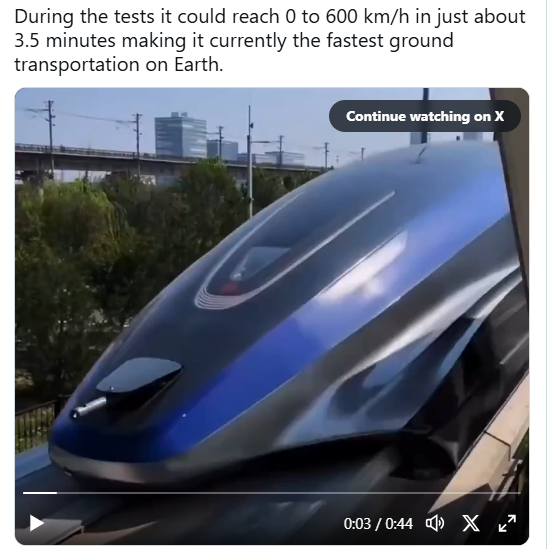

China has showcased its 600 km/h magnetic levitation (maglev) train prototype after several years of testing, highlighting progress in next-generation high-speed rail technology.
The prototype is designed to reach a top speed of 600 kilometers per hour, making it one of the fastest ground transportation systems developed to date. Maglev trains use magnetic levitation to eliminate contact between the train and the tracks, reducing friction and enabling higher speeds.
According to reports accompanying the announcement, the prototype can accelerate from 0 to 600 km/h in approximately 3.5 minutes under test conditions. Engineers have carried out multiple trials to evaluate the train’s performance, stability and safety.
China’s 600 km/h maglev prototype is ready after 5 years of testing.
During the tests it could reach 0 to 600 km/h in just about 3.5 minutes making it currently the fastest ground transportation on Earth. pic.twitter.com/rZMnF4p6T7
— Massimo (@Rainmaker1973) June 28, 2026
The latest update has attracted widespread attention on social media after a well-known influencer shared the development. The post quickly gained traction, with users praising China’s advances in high-speed transportation technology.
The maglev project has undergone years of research and testing before reaching its current stage. Developers say the technology is intended to provide faster intercity travel while maintaining passenger comfort and operational efficiency.
Unlike conventional high-speed rail, maglev trains float above the guideway using powerful magnets. Consequently, the absence of wheel-to-rail contact reduces mechanical wear and allows significantly higher operating speeds.
Although the prototype has demonstrated promising results during testing, it has not yet entered regular commercial passenger service. Further evaluation and infrastructure development will be required before large-scale deployment.
China already operates the world’s first commercial high-speed maglev line in Shanghai, connecting the city with Pudong International Airport. The new prototype represents the country’s continued investment in advanced rail transportation.
If introduced commercially in the future, the 600 km/h maglev could significantly reduce travel times between major cities and further strengthen China’s position in high-speed rail innovation.

