
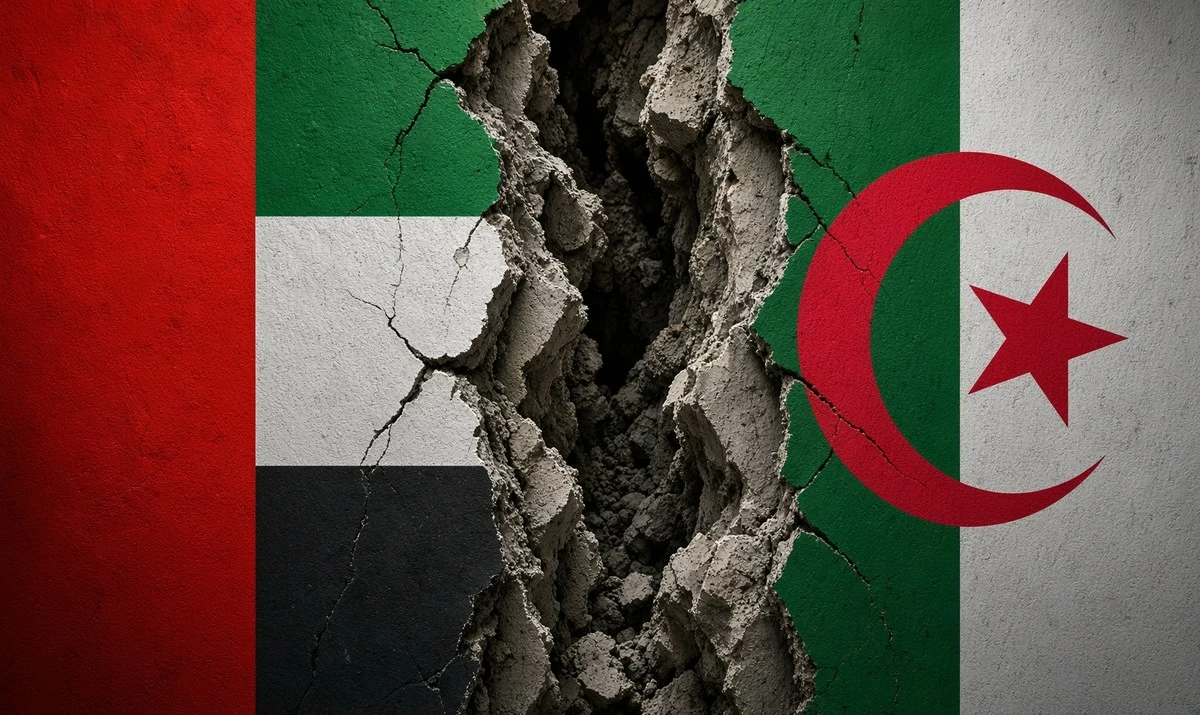

Algeria has formally severed diplomatic relations with the United Arab Emirates, marking a major escalation in tensions between the two countries.
The Algerian Foreign Ministry announced the decision on Thursday, September 10, saying relations had deteriorated following what it described as repeated “provocative or hostile” actions by Abu Dhabi.
Algerian authorities said they had exhausted efforts to preserve bilateral relations before deciding to cut diplomatic ties.
The UAE ambassador was summoned to the Algerian Foreign Ministry and formally informed of the decision. He was given 48 hours to leave the country, according to Algeria’s official announcement.
The move brings years of gradually worsening relations between Algiers and Abu Dhabi into the open.
Although Algeria has not publicly detailed every incident that led to the decision, political disagreements between the two countries have grown across several major regional issues.
Western Sahara and Israel Deepened Algeria-UAE Divide
One of the most significant sources of tension has been the Western Sahara dispute.
Algeria supports the Polisario Front, which seeks independence for Western Sahara.
The UAE, by contrast, supports Morocco’s claim of sovereignty over the disputed territory and has established a consulate there.
Morocco remains one of Algeria’s main regional rivals, making the UAE’s close relationship with Rabat a particularly sensitive issue for Algiers.
The countries have also taken sharply different positions over relations with Israel.
Algeria remains strongly opposed to normalization with Israel.
The UAE established diplomatic relations with Israel in 2020 under the US-brokered Abraham Accords.
Morocco later also normalized relations with Israel as part of the same wider diplomatic initiative.
Those developments further widened the political gap between Algeria and the UAE.
Growing Rivalry Extends Into Africa’s Sahel Region
Competition between Algeria and the UAE has also increasingly extended into Africa’s Sahel region.
The UAE has expanded diplomatic and economic relationships with several governments across the area in recent years.
Algeria has traditionally viewed the Sahel as strategically important because of its long southern borders and longstanding political and security influence there.
However, Algeria’s relations with some neighbouring countries have become increasingly difficult following military coups and political changes across the region.
These overlapping interests have added another layer of tension between Algiers and Abu Dhabi.
Algerian media outlets have also repeatedly accused the UAE of attempting to increase its influence in North Africa and contributing to regional divisions.
President Abdelmadjid Tebboune had previously signalled serious concerns about Algeria’s relationship with one Gulf country without publicly naming it.
He said Algeria maintained warm and “brotherly” relations with Saudi Arabia, Qatar, Kuwait and Oman, while accusing another unnamed Gulf state of interfering in Algerian affairs and seeking to destabilize the country.
The remarks were widely interpreted as referring to the UAE.
Diplomatic Breakdown Followed Earlier Warning Signs
The deterioration did not begin with Thursday’s announcement.
Earlier in 2026, Algeria started procedures to cancel an air services agreement with the UAE.
The agreement had originally been signed in Abu Dhabi in May 2013.
That decision was widely viewed as another indication that bilateral relations were entering a more difficult phase.
Thursday’s move has now transformed those tensions into a formal diplomatic rupture.
The Algerian Foreign Ministry said the UAE’s conduct had reached a point that could no longer be considered acceptable and that all available options for maintaining relations had been exhausted.
The UAE did not immediately issue a detailed formal response to Algeria’s announcement.
However, UAE presidential adviser Anwar Gargash later stressed the importance of diplomacy based on rational communication and clarity following the development.
The rupture could have wider consequences because both countries play influential roles in the Arab world and Africa.
Algeria is a major North African state, an important energy producer and a key diplomatic actor in African and Arab affairs.
The UAE has meanwhile expanded its economic, diplomatic and strategic presence across the Middle East and Africa.
The decision to cut relations could therefore affect cooperation in areas ranging from trade and aviation to regional diplomacy.
It may also deepen existing divisions over Morocco, Western Sahara and political influence across North Africa and the Sahel.
For now, Algeria has made clear that it considers diplomatic engagement with Abu Dhabi exhausted.
The decision represents one of the sharpest breaks between an Arab Gulf state and a major North African country in recent years.

