
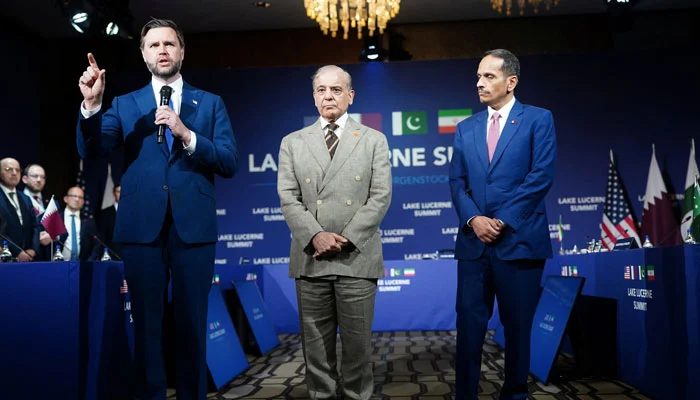

After hours of negotiations in Burgenstock, Switzerland, the United States and Iran agreed on a 60-day roadmap for a final peace deal. Pakistan and Qatar announced the breakthrough on Monday.
The talks began on Sunday and continued into Monday. They followed the Islamabad Memorandum of Understanding signed last week. Prime Minister Shehbaz Sharif also signed the interim peace agreement as a mediator.
Moreover, representatives from the US, Iran, Pakistan, and Qatar attended the first session under the Islamabad MoU. The joint statement described the discussions as positive and constructive.
Progress on Technical Talks
The mediators confirmed the creation of a high-level committee to oversee political negotiations. Chief negotiators will report regularly to the committee.
Furthermore, specialized working groups will address nuclear issues, sanctions, and dispute resolution. Technical teams will continue negotiations throughout the week in Burgenstock.
The parties also agreed to establish a direct communication line for 60 days. The measure aims to prevent misunderstandings and ensure safe commercial shipping through the Strait of Hormuz.
Regional Stability Measures
Additionally, the agreement includes a de-confliction cell involving Lebanon. Pakistan and Qatar will facilitate coordination to support the ceasefire and prevent military escalation.
The mediators praised both countries for maintaining their commitment to diplomacy. They also thanked friendly nations for supporting the peace process.
Meanwhile, Iran’s foreign minister welcomed the agreement on social media. He highlighted progress on sanctions relief, frozen assets, reconstruction plans, and maritime security.
Earlier, a US official confirmed discussions covered the nuclear agreement, the Strait of Hormuz, and ceasefire enforcement in southern Lebanon. Officials expect technical negotiations to build on this latest diplomatic progress.

