
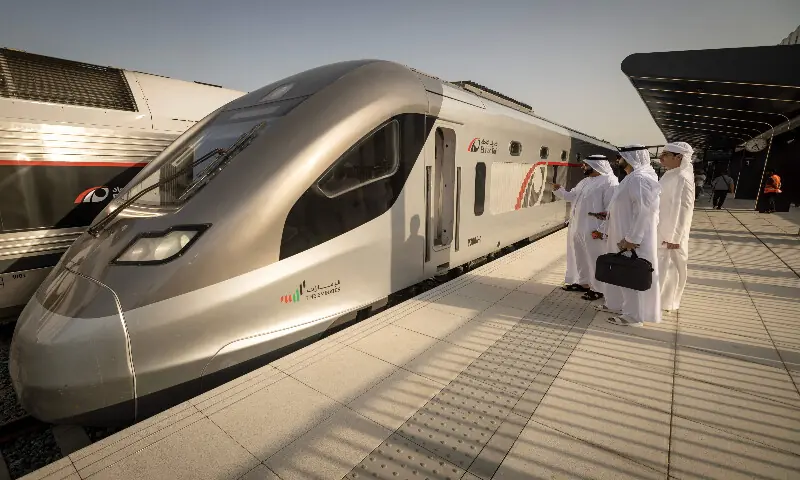

The United Arab Emirates has launched its first intercity passenger rail service, marking a historic milestone in the country’s transportation network and offering travellers a new way to explore the Emirates.
The inaugural Etihad Rail passenger service departed from the eastern emirate of Fujairah and arrived in Abu Dhabi on Thursday morning, carrying enthusiastic passengers across the desert landscape on the country’s first passenger train.
Among those on board was Gunjan Chaurasia, 42, who drove more than 100 kilometres from Dubai to Fujairah to be part of the historic journey.
“We got to see landscapes you do not usually see from the road,” Chaurasia said. “There were many sights you simply don’t experience during normal road trips.”
For many travellers, the new rail link represents more than just another mode of transport. Rawdha, a resident of Fujairah, said the service would significantly improve connectivity between the eastern emirate and the capital.
“For us in Fujairah, the journey used to feel very long,” she said after completing the one-hour-and-40-minute trip. “Now Abu Dhabi and the other emirates feel much closer, and travelling no longer seems as difficult as before.”
Although the train journey currently takes around an hour longer than driving, the service provides a comfortable alternative while strengthening links between the UAE’s seven emirates.
The diesel-powered trains can reach speeds of up to 200 kilometres per hour, with nine additional stations—including one in Dubai—scheduled to open by the end of next year.
Etihad Rail is also developing a separate high-speed electric railway connecting Abu Dhabi and Dubai, which is expected to enter service within the next few years.
Strengthening National Connectivity
Officials say the railway is intended not only to improve transportation but also to promote greater national cohesion by connecting emirates that have traditionally received less attention than Abu Dhabi and Dubai.
“This is a historic moment for the Emirates,” said Athraa Al Mansoori, Executive Director for Commercial and Support at Etihad Rail Mobility.
“It will transform the way cities are designed and how residents travel.”
According to Etihad Rail, the national railway is expected to generate economic benefits exceeding **90 billion dirhams (approximately $24.5 billion)** over the next 50 years.
## Regional Ambitions Remain Unfinished
Until now, the UAE’s approximately **900-kilometre** railway network had been used exclusively for freight transport, demonstrating its strategic importance during recent regional tensions by helping redirect cargo through Fujairah when shipping routes faced disruption.
The wider vision extends beyond the UAE. Nearly two decades ago, Gulf states announced plans for a regional railway spanning more than **2,000 kilometres**, linking Saudi Arabia, the UAE, Qatar, Kuwait, Bahrain and Oman.
However, progress has been slow, with only the UAE–Sohar section in northern Oman currently under construction.
Analysts say political differences among Gulf countries have delayed the broader regional project.
Samriddhi Vij, an associate fellow at the Dubai-based ORF Middle East think tank, said the successful domestic launch demonstrates the UAE’s commitment to expanding rail infrastructure.
“The most important factor in completing this regional rail project has been institutional will,” Vij said. “A domestic launch signals confidence and demonstrates that commitment.”
While challenges remain for the long-envisioned Gulf railway network, the launch of Etihad Rail’s passenger service marks the beginning of a new chapter in the UAE’s transportation system and a significant step toward greater national connectivity.

