
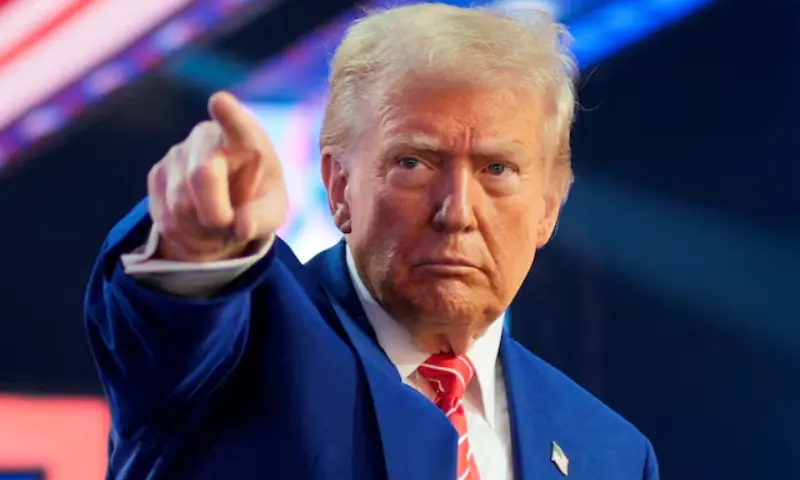

US President Donald Trump has announced a major expansion of the American role in Venezuela’s oil industry. Trump said the United States had secured majority control of more than 65 billion barrels of proven Venezuelan oil reserves.
The announcement marks an unprecedented move as Washington seeks to revive Venezuela’s struggling energy sector.
At the same time, the US administration wants greater access to crude and lower fuel prices for American consumers.
Trump provided few details about the agreement, however, leaving important questions about its structure and legal basis.
Trump Announces Majority Control of Venezuelan Oil
Trump said American companies would play a central role in developing Venezuela’s enormous oil reserves through a partnership with private businesses.
He described the arrangement as requiring no cost to American taxpayers while giving the United States majority control.
“At my direction, Secretary of State Marco Rubio, and Secretary of War Pete Hegseth, working closely with Highly Respected Interim President of Venezuela, Delcy Rodriguez, and, through a partnership with private business, have secured majority US control of more than 65 BILLION BARRELS of proven Oil Reserves in Venezuela, at no cost to the American Taxpayer,” Trump wrote on Truth Social.
The announcement followed weeks of negotiations between Washington and Caracas over the future of Venezuela’s oil industry.
Under the proposed arrangement, American companies would receive long-term access to several Venezuelan oilfields.
The resulting crude would also be supplied to the United States, according to the details surrounding the negotiations.
Venezuelan officials are preparing to sign agreements granting new exploration and production rights to several companies.
US firms are expected to have a particularly prominent role in those arrangements.
Venezuela Looks to Revive Oil Production
Venezuela possesses the world’s largest proven oil reserves, yet its production remains far below its potential.
The country currently produces around 1.25 million barrels per day, according to the supplied report.
Years of underinvestment, mismanagement and sanctions have contributed to the decline in Venezuela’s oil production.
Therefore, increasing output would require significant investment in the country’s ageing energy infrastructure.
The proposed US involvement could significantly change the scale of foreign participation in Venezuela’s oil sector.
However, the precise structure of the arrangement remains unclear.
Trump did not identify the specific fields, companies or mechanisms through which the United States would exercise majority control.
A list reviewed in connection with the agreement places the targeted fields in the Orinoco Belt and Lake Maracaibo regions.
Rubio Calls the Agreement a Win-Win
US Secretary of State Marco Rubio described the arrangement as beneficial for both countries.
He said the agreement would provide the United States with stable and low-cost oil supplies.
According to Rubio, greater access to Venezuelan crude could also help reduce gasoline prices in the United States.
For Venezuela, Rubio said the agreement could generate nearly $100 billion in private investment.
He also said the investment would support thousands of high-paying jobs and contribute to rebuilding Venezuela’s economy.
The proposed arrangement would therefore give Washington greater access to Venezuelan crude.
Meanwhile, Venezuela could gain investment and additional revenue from expanded oil production.
Venezuela Plans Development of 17 Strategic Fields
Venezuelan interim leader Delcy Rodriguez also welcomed the agreement.
She said the arrangement would support a significant increase in oil production through the development of 17 strategic fields.
Rodriguez further said the projects could generate $209 billion in tax revenue for Venezuela.
“These investments will contribute not only to the recovery and modernisation of our industry, but also to our country’s economic growth, the energy security of our hemisphere, and greater balance in international markets,” she said in a statement.
The proposed investment could consequently become a major component of Venezuela’s economic recovery plans.
However, several aspects of the arrangement still require clarification before its wider impact becomes clear.
Legal Questions Surround the Oil Deal
Analysts have raised questions about the legal and financial structure of the proposed agreement.
They said further details were necessary before determining whether the arrangement could attract investment on a significant scale.
One major question concerns how the United States would legally obtain control over Venezuelan oil reserves.
David Goldwyn, president of Goldwyn Global Strategies, questioned whether a US government lease would comply with Venezuela’s constitution.
He also raised questions about the country’s new hydrocarbons law.
Goldwyn said there was “no precedent for having the US government enter into a lease to operate oil fields.”
He also questioned whether the proposed arrangement would overcome the problems that have discouraged investors from Venezuela.
Political uncertainty remains one of the challenges facing potential investors in the country.
In addition, Venezuela faces limitations involving its electricity network and export infrastructure.
Government control over the oil industry could also create further uncertainty for international companies.
“It is hard to see how this kind of arrangement would accelerate investment at any material scale,” Goldwyn said.
Lower US Fuel Prices May Take Time
Although the agreement could eventually increase Venezuelan oil production, its impact on US gasoline prices may not come quickly.
Developing Venezuela’s oil infrastructure would require time and substantial investment.
The country also produces heavy crude, which creates additional requirements for transportation and refining.
Therefore, expanding production would not automatically translate into immediate reductions in American fuel prices.
The Trump administration is nevertheless facing pressure over gasoline prices ahead of the November midterm elections.
Greater crude supplies and increased production could provide Washington with another option for addressing consumer concerns.
The United States is also seeking ways to replenish its Strategic Petroleum Reserve.
Possible crude swaps with American producers have been considered as part of those efforts.
Venezuela’s Oil Industry Has a Long History of State Control
Venezuela nationalised its oil industry during the 1970s and placed state-run PDVSA at its centre.
Later, under President Hugo Chavez, the government strengthened its control over the sector.
Foreign oil producers were required to operate through state-led joint ventures.
The government later expropriated assets belonging to foreign companies, including projects operated by ExxonMobil and ConocoPhillips.
Those policies shaped Venezuela’s oil industry and affected the role of international companies.
Under former President Nicolas Maduro, Venezuela’s oil production declined sharply.
The proposed US-led investment model therefore represents a significant shift in the country’s approach to foreign participation.
A Major Shift With Unanswered Questions
Washington has been seeking a stable supply of Venezuelan crude while encouraging American investment in the country’s energy industry.
The latest announcement could substantially expand that role if the proposed agreements move forward.
At the same time, the plan faces questions about its legal framework, financial structure and practical implementation.
The exact mechanism for US control over more than 65 billion barrels of reserves remains undisclosed.
The companies involved and the precise oilfields covered by the agreement have also not been fully identified.
Moreover, analysts remain uncertain about how quickly new investment could translate into higher production.
For Venezuela, the proposed deal could bring substantial investment and greater oil output.
For the United States, it could provide another potential source of crude and support efforts to contain fuel prices.
Yet the agreement’s ultimate impact will depend heavily on its legal structure and implementation.
For now, Trump’s announcement signals a dramatic new chapter in the relationship between Washington and Venezuela’s vast oil industry.

