
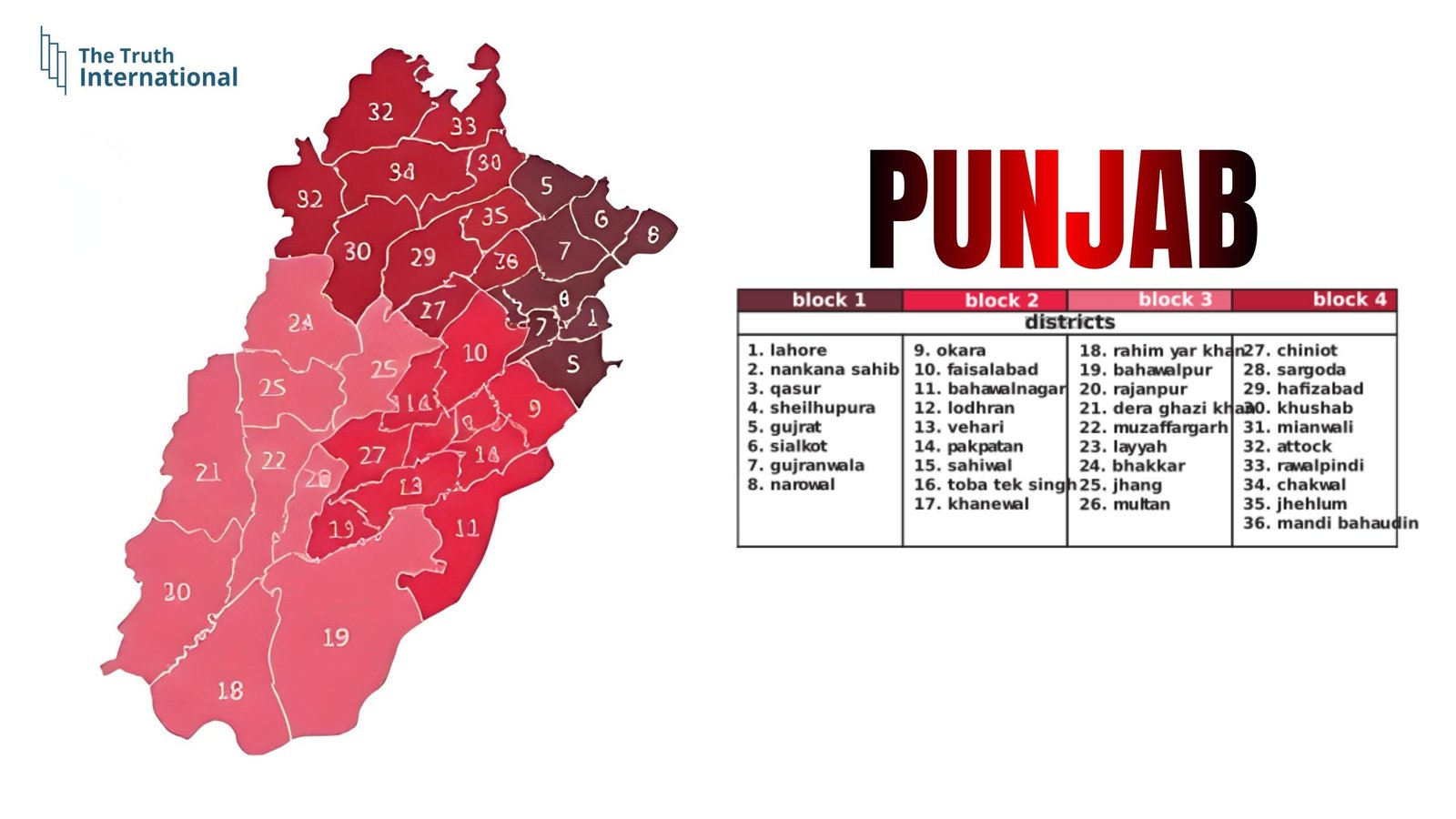

ISLAMABAD: Once again the good governance and creation of new provinces has become a talk of the town in Pakistan these days after the Director General of the ISPR and Interior Minister Mohsin Naqvi gave statements about the needs to improve governance. Almost all the mainstream political parties in the country, including ruling parties _ PML-N and PPP _ have given their responses to the calls for the creation of more provinces in the country. This analytical article looks into the pros and cons of the creation of more provincial units and the current state of the governance in Pakistan.
Punjab _ the largest province in Pakistan
Punjab remains Pakistan’s largest province by population and the country’s political and economic center. With an estimated population of around 120 million in 2025, it is home to nearly half of Pakistan’s people. Covering approximately 205,344 square kilometers, Punjab is the country’s second-largest province by area and contributes more than 70 percent of Pakistan’s staple food production, including wheat and rice. Its strategic importance makes the province indispensable to the country’s economic stability and food security. However, its enormous size has also generated an increasingly important debate: has Punjab become too large to govern efficiently, and would creating new provinces improve governance and balanced development?
Punjab’s population alone is comparable to that of Japan, one of the world’s leading industrialized nations. Japan has built its reputation through technological innovation, efficient public administration, industrial expansion, and world-class infrastructure despite having a population of roughly the same size. Likewise, South Korea, with a population of around 52 million, has transformed itself into one of the world’s largest exporting economies through investments in technology, manufacturing, education, and innovation. Malaysia, with nearly 35 million people, has also emerged as a regional success story because of its diversified economy, tourism sector, and industrial development.
These comparisons do not suggest that population alone determines economic success. Instead, they demonstrate that effective governance, institutional strength, long-term planning, and equitable development policies are decisive factors in shaping national and regional progress. Punjab possesses significant human and natural resources, yet its development indicators remain well below the standards achieved by many countries with smaller populations.
For decades, successive governments have struggled to address persistent governance challenges across Punjab. Despite periodic development initiatives, millions of residents continue to face poverty, unemployment, inadequate healthcare, weak educational facilities, insufficient municipal services, and uneven infrastructure development. Rapid urbanization has further increased pressure on public institutions, while administrative structures have often failed to keep pace with growing population demands.
One of the most frequently cited concerns is the concentration of development in Lahore. As the provincial capital, Lahore has received substantial investments in transport infrastructure, healthcare facilities, educational institutions, and commercial projects. Although such investments have contributed to the city’s growth, critics argue that many other regions of Punjab have not experienced comparable progress. Southern Punjab, western districts, and numerous rural areas continue to face shortages of quality schools, hospitals, clean drinking water, sanitation facilities, and employment opportunities.
This regional imbalance has strengthened calls for administrative reforms, including the creation of new provinces. Supporters believe that dividing Punjab into smaller administrative units could improve governance by bringing decision-making closer to local populations. Smaller provinces, they argue, may respond more effectively to regional priorities, improve resource allocation, and strengthen accountability within government institutions.
Governance remains one of Punjab’s most pressing challenges. Administrative efficiency often declines when governments attempt to manage extremely large populations through centralized decision-making. Bureaucratic delays, overlapping responsibilities, political patronage, and limited institutional capacity have frequently slowed the delivery of public services. Many analysts believe that governance reforms are as essential as economic reforms if Punjab hopes to achieve sustainable development.
Economic indicators further illustrate these challenges. According to the World Bank, poverty in Punjab reached approximately 30 percent in 2024, representing a significant increase compared to previous years. This means that more than 40 million people were living at or near the poverty line. While Punjab’s poverty rate remains lower than those of some other provinces, the sheer size of its population translates into an enormous number of citizens struggling to meet basic needs.
The World Bank attributed the increase in poverty to several overlapping factors, including the economic effects of the COVID-19 pandemic, the devastating floods of 2022, and Pakistan’s prolonged macroeconomic crisis. High inflation further reduced household purchasing power, particularly among low-income families. Rising food and energy prices disproportionately affected vulnerable communities, widening economic disparities across urban and rural areas.
The report also estimated that nearly 13 million additional Pakistanis fell below the poverty line during 2024 as inflation and slower economic growth weakened household incomes. The institution noted that poverty has risen steadily since 2019 and warned that the absence of updated household survey data limits the government’s ability to accurately assess poverty trends and evaluate policy interventions. It emphasized the need for better data collection to support evidence-based policymaking.
Unemployment represents another major concern. Data from Pakistan’s Planning Division indicated that unemployment in Punjab exceeded seven percent during 2024. Given the province’s enormous population, this percentage represents millions of unemployed individuals. A shortage of productive employment opportunities not only affects household incomes but also contributes to social inequality, migration, and rising frustration among educated youth entering the labor market each year.
Punjab’s economic challenges extend beyond employment. The province continues to face recurring energy shortages that undermine industrial productivity and discourage investment. Gas shortages, electricity load-shedding, and an unstable energy supply have disrupted manufacturing activities and affected agricultural production. These constraints reduce competitiveness, discourage new businesses, and limit opportunities for sustainable economic expansion.
Experts also argue that social development has not kept pace with demographic growth. Continued investment in healthcare, education, clean water, sanitation, agricultural modernization, and industrial development remains essential for improving living standards. Without substantial improvements in these sectors, Punjab may struggle to fully utilize its economic potential despite possessing abundant human capital and agricultural resources.
The debate over creating new provinces should therefore be viewed within a broader governance framework rather than merely as a political issue. Administrative restructuring alone cannot solve Punjab’s problems. However, if combined with institutional reforms, transparent governance, fiscal decentralization, and equitable development policies, smaller administrative units could potentially improve service delivery and strengthen regional representation. Whether policymakers choose to divide Punjab or pursue alternative reforms, addressing governance deficiencies and reducing regional disparities will remain central to the province’s long-term economic and social progress. This discussion forms the foundation for examining the proposed new provinces and their potential administrative structure in the next part of this analysis.

