
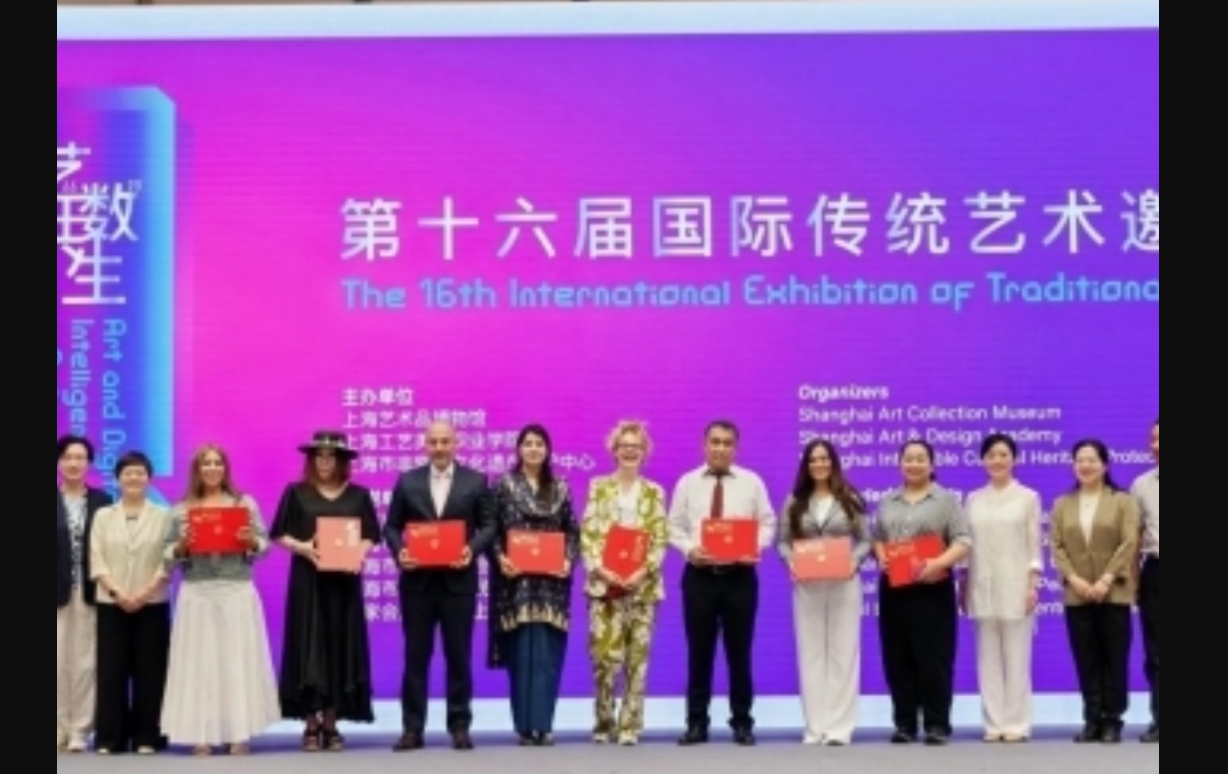

A Pakistani artist and academic has received international recognition in Shanghai for her contribution to traditional fine arts, highlighting a growing cultural exchange between Pakistan and China through contemporary artistic expression.
The honor was presented during the opening ceremony of the 16th International Exhibition of Traditional Fine Arts in Shanghai, where artists from 38 countries and regions are showcasing works that combine heritage, innovation, and digital-era creativity.
International Recognition at Shanghai Art Exhibition
The exhibition brings together a wide range of traditional and modern art forms, including painting, ceramics, embroidery, sculpture, enamel work, lacquer art, and digital installations.
Within this global platform, Pakistani scholar and lecturer Hira Ali, affiliated with the University of Peshawar and currently pursuing a PhD in artistic theory at the Shanghai Academy of Fine Arts, was awarded an honorary credential for her artistic contributions.
She described the experience as deeply meaningful and reflective of international artistic collaboration.
“Very surreal.” she said. “Local and international artists here were growing side by side. You can show your talent and abilities on various platforms, creating a welcoming and encouraging environment.”
Blending Urdu Calligraphy With Chinese Visual Culture
Hira Ali’s work focuses on connecting two distinct artistic traditions through visual storytelling.
Her recent calligraphic series integrates the vibrant colors of Shanghai’s urban environment with traditional Urdu calligraphy, creating a fusion that reflects both South Asian heritage and Chinese contemporary aesthetics.
This approach creates a cultural dialogue where two artistic identities exist within a shared visual space.
“This is how I experiment with techniques and themes, combining Chinese traditions, Chinese culture, and contemporary environments with elements of my Pakistani traditional calligraphy,” she explained.
Art Inspired by Cultural Exchange
One of her notable works titled “Chinese Tradition” reimagines a traditional Chinese pagoda using elements of Mughal miniature painting.
The artwork combines architectural precision with decorative motifs rooted in Pakistani artistic history, forming a layered interpretation of cultural identity.
Her creative portfolio also includes Chinese flower paintings on Xuan paper, lacquer-based works on wood and pegboxes, mother-of-pearl inlay panels, and eggshell lacquer compositions.
She also produces pencil drawings and acrylic paintings, demonstrating versatility across multiple mediums and techniques.
Academic and Cultural Contributions
Hira Ali has also worked on artistic projects linked to the United States Consulate General in Peshawar, particularly focusing on Pakistan’s truck art culture.
In addition, she contributed to initiatives documenting and preserving the Buddhist Gandhara heritage in Khyber Pakhtunkhwa, an important archaeological and cultural region of Pakistan.
One of her earlier works, titled “My Favourite Scene on Campus,” also received recognition for its artistic expression and detail.
Research Focus on Traditional Lacquer Art
Her academic research centers on Chinese lacquer art, an ancient craft with a history spanning thousands of years.
While the art form remains highly developed in China, it is declining in Pakistan, which has motivated her research direction.
She has conducted fieldwork in Fuzhou, Fujian province, a region widely regarded as a center of traditional lacquer craftsmanship.
Promoting Cultural Revival Through Art
Beyond her personal artistic practice, Hira Ali is working with academic mentors to establish a lacquer art association in Pakistan.
Her aim is to introduce structured learning and revival efforts for traditional techniques that are at risk of fading.
She hopes her experience in China can help strengthen Pakistan’s academic and cultural art landscape.
“I hope that the diversity of arts in China reaches every corner of the world,” she added.
Strengthening Cultural Bridges Through Art
Her work represents a growing artistic bridge between Pakistan and China, where traditional techniques meet contemporary experimentation.
Through calligraphy, painting, and research, she continues to expand the dialogue between two rich artistic traditions while contributing to global appreciation of cultural diversity.

